Near-average snowfall expected in Baltimore during 2025-26 winter season

Marylanders can expect near-average amounts of snow in infrequent and heavy bursts this winter, according to the First Alert Weather winter forecast.
It has been nearly a decade since Baltimore experienced a snowier-than-average winter. During the 2015-16 winter season, more than 35 inches of snow was measured at Baltimore/Washington International Thurgood Marshall (BWI) Airport. Only two-tenths of an inch of snow was measured during the 2022-23 winter season.
While last winter was the snowiest in a few years, less than 13 inches of snow fell throughout the entire season. The average winter snowfall at BWI is 19.3".
Here is a complete list of seasonal snowfall totals in Baltimore for the past 142 years.
Baltimore's winter weather outlook
Looking ahead to this winter, it is shaping up to be the snowiest in several years. However, a near-average or a bit less snowy than average season is still the most likely scenario.
The First Alert Weather Team is forecasting 15" to 20" of snow to fall in Baltimore through early 2026.
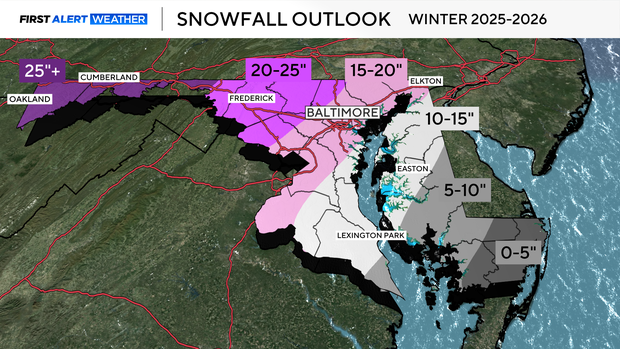
The most snow, more than 25", is expected to fall in the higher elevations of far western Maryland.
Keep in mind, a significant snowstorm or two cannot be ruled out. One significant storm could greatly impact seasonal snow totals. The first third to half of winter may end up being the coldest and most active.
A driving factor for this forecast includes a weak La Niña that should continue over the next two or three months. Usually, this pattern favors a colder winter across the northern United States and the Great Lakes region. Farther south, warmer-than-average winter weather is expected across the southern portion of the U.S.
A weaker Polar Vortex is also possible at times this winter. When the Polar Vortex weakens, it is more likely to move south from the North Pole and spread colder air into the United States. This series of events can lead to large storms as colder and warmer air masses interact with each other.
There are other factors that can make heavy snow more or less likely; the AAO, NAO, EPO and others. These oscillations tend to vary through the course of the winter season, and locally have a greater effect on our weather at times.
Stay with the WJZ First Alert Weather Team for the latest forecasts as we head into winter.


