Maryland lawmakers return to Annapolis for special session on congressional redistricting

Maryland lawmakers returned to Annapolis Monday for a rare special session focused on congressional redistricting.
Democratic leaders are pushing a proposed constitutional amendment they say would clarify the rules for drawing future congressional maps. Republicans, meanwhile, argue the measure is a partisan power grab.
The proposal would not redraw any of Maryland's current congressional districts. Instead, it would ask voters whether to change the rules for how future congressional maps are drawn.
"We are back now to be able to ensure that our elections should be in the hands of the people of Maryland; they should have the final say," Maryland Gov. Wes Moore said.
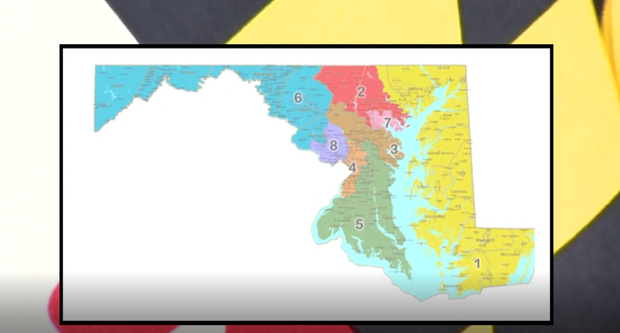
Democrats want to amend the Maryland Constitution so future congressional districts would be drawn using applicable federal standards instead of Maryland's current constitutional standards for state legislative districts. They say a 2022 court ruling created uncertainty about which rules apply.
"What we're doing with this amendment is restoring certainty in the standards for congressional map-making here in Maryland," said Senate President Bill Ferguson, D-Baltimore City.
Supporting Maryland's proposed redistricting
Supporters say the proposal would not draw new district lines or change the current congressional map. Instead, if approved by the General Assembly, the constitutional amendment would go before Maryland voters on the November 2026 ballot.
House Speaker Jocelyn Peña-Melnyk, D-Prince George's and Anne Arundel counties, said the proposal would "allow Maryland to meet the moment as states across the country engage in mid-decade redistricting."
Opposing an amended redistricting
Republicans argue removing Maryland's current constitutional standards would make it easier for Democrats to draw more partisan congressional maps.
"There are no other reasons to be here other than to see this hyper-partisan gerrymandering go through," said Sen. Stephen Hershey, R-Caroline, Cecil, Kent and Queen Anne's counties. "They're trying to change the Maryland Constitution in order to do what they want to do."
Republicans also criticized the wording of the proposed ballot question, arguing it is too confusing for voters to understand.
"We're going to end up in a state where millions of Marylanders have no voice," Del. Jesse Pippy, R-Frederick County, said.
Democratic leaders say lawmakers must act during the special session to get the question on the November 2026 ballot. The proposal still needs support from three-fifths of both the House of Delegates and the Senate before it can go before Maryland voters.


