How white supremacists staged the only successful coup in U.S. history

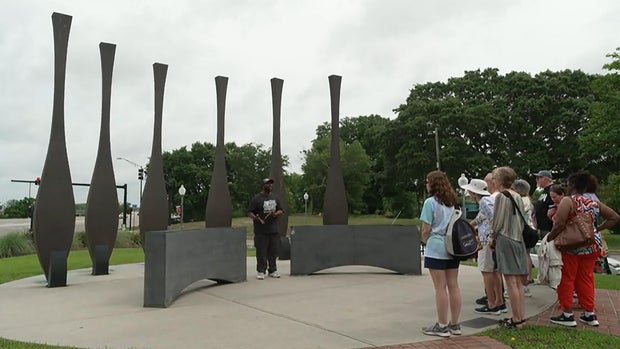
In downtown Wilmington, North Carolina, stands a memorial that's easy to pass – six bronze paddles stretching toward the sky. The plaque is hard to read in places, not because the words have washed away, but because what they say is so hard to believe.
There aren't many tours that tell the tale, but Cedric Harrison says he's determined to make it known. "The first thing we have to do to solve this problem is education," he said. "One of my elders always told me, if you knew better, you do better."
Not far away is Wilmington's First Presbyterian Church, where parts of that story live, too.
Lauren Collins, now a journalist at The New Yorker magazine, grew up in this church, and was baptized here. She pointed us to a stained-glass window in the back dedicated to Col. Walker Taylor. As a kid she didn't know the stories behind men like him, but she says, they weren't the only mysteries about her hometown. "I always had this sense that there was something a little off, a little amiss," she said.
It turns out that, back in the late 1890s, Col. Taylor was a celebrated white supremacist – and so was the church's pastor, Rev. Peyton Harrison Hoge. "When I learned this, it was shocking, and it was personal," Collins said. "Loving a place doesn't mean lying about it, or lying for it."
The church is making efforts to come to terms with the past; the city of Wilmington as a whole, however, has been a bit slower.
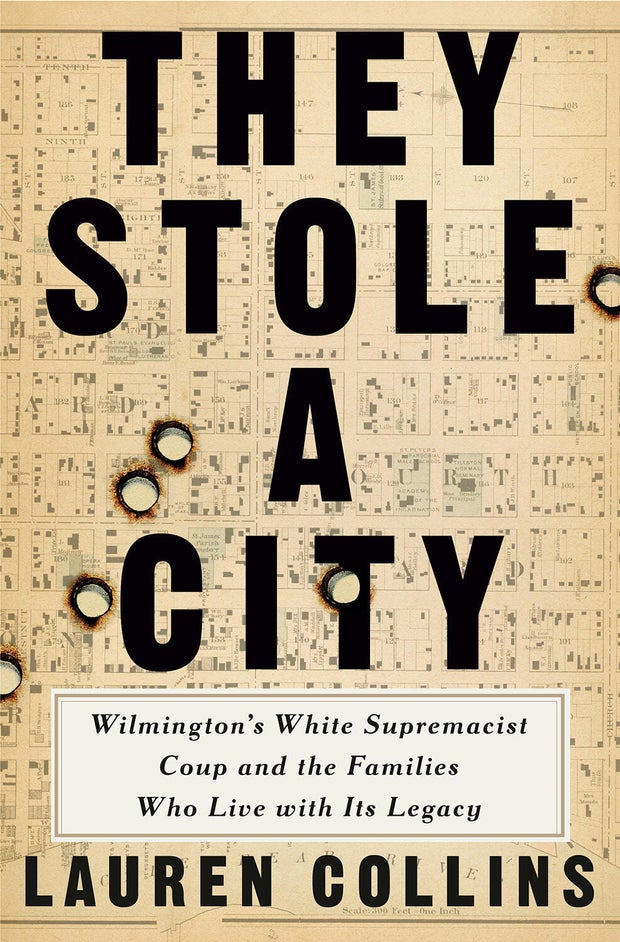
In her new book, "They Stole a City" (to be published Tuesday), Collins unravels Wilmington's darkest chapter: the only successful coup in our nation's history. Never heard about it? Well, most folks haven't.
Collins said, "There are people that I've asked to talk to, who haven't wanted anything to do with me. But there have also been a lot of people who are ready."
"This is not gonna end well"
In 1898, Wilmington was a prosperous integrated city. Blacks and whites shared political power and leadership positions. It was a model for the New South. Still, not everyone accepted the path that Wilmington had taken, especially the former slave-owning class (mostly Southern Democrats). "They explicitly centered their campaign around the issue of white supremacy," said Collins.
Tom Keith said local politicians literally had a handbook about how to build a white supremacy campaign. "It was not secret, like it would be today," he said.
Keith's grandfather was B.F. Keith, one of the few white elites in Wilmington who pushed back. "As he saw the white supremacy campaign develop, he wrote everybody – the governor, senators – 'Somebody's gonna get killed. This is not gonna end well.'"
There was even a "white Declaration of Independence" drawn up, written in part by a wealthy businessman named Hugh MacRae. Asked whether his great-grandfather was a white supremacist, Hugh MacRae III replied, "By definition, yes. The scary thing that strikes you is that I'm convinced that these folks thought they were doing the right thing."
And the right thing, according to them, was to purge Wilmington of all Black influence – and on the morning of November 10, 1898, that's just what they did, starting with the city's only Black newspaper. A mob descended on The Daily Record. They set the building on fire – and then posed for this picture.
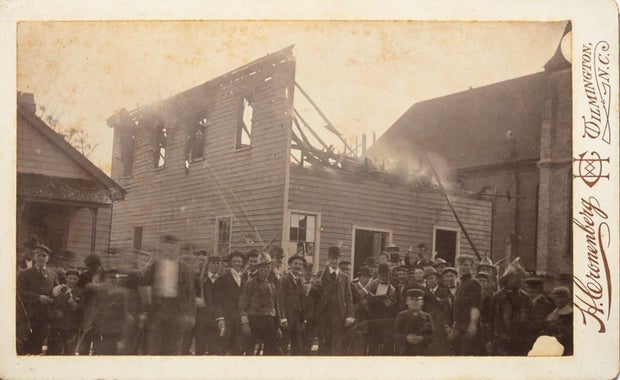
Collins said, every time she sees it, the photo "sends chills down my spine … They have this look of flushed satisfaction. It's a trophy."
But that was just the beginning. The mob then made its way to the crossroads of Fourth and Harnett Streets. A shot rang out across the intersection. Almost immediately, three Black men were dead.
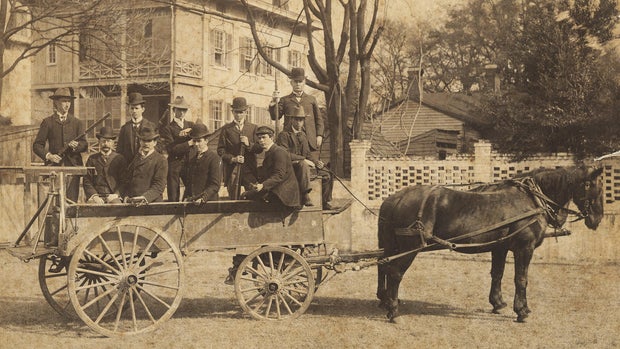
In the hours that followed, a cart fixed with a rapid-fire machine gun advanced through town with impunity, like a primitive tank, firing at will on the largely un-armed Black residents. No one really knows how many the mob murdered that afternoon, but historians generally agree the number ranges from dozens to hundreds.
One of the victims was Joshua Halsey, a Black laborer and father of four girls, who, according to notes taken during the conspirators' meeting, was singled out to be killed.
"It's in the minutes: 'When you see that n----- Josh, get that n----- Josh,'" said Elaine Brown, his great-granddaughter.
Halsey had sued the city after his wife, Sallie, tripped and injured herself on what was then a poorly-maintained bridge. His rightful legal action put a target on his back. "They were building a life, they owned a home, they were upstanding citizens," said Brown. "The only guilt was being Black."
She says Halsey was shot 14 times in the head as his wife, Sallie, watched. She, like many other Black women and children, was eventually driven out of town.
The last piece of the murderous puzzle that day was to seize political power. White Democrats stormed Wilmington's city hall, where its multi-racial government sat. Collins said, "When they walked into the room, the Board of Aldermen had seven white men and three Black men. And when they walked out, all of those officials had resigned – literally at gunpoint."
Not a single person was ever prosecuted, in part because newspaper headlines characterized the violence as whites defending themselves against a Black "race riot." With the only Black newspaper in town gone, there was no one to refute that false narrative.
"People who were suffering in Wilmington in the aftermath of the coup appealed to President McKinley, and he did nothing," Collins said.
"Healing doesn't come with lies"
In the years that followed, the coup was talked about less and less, and yet it had a kind of insidious undertow that kept yanking Black people away from Wilmington. At the time of coup, 56% of the city was Black. Today, that percentage has dwindled to only about 15%.
The ripples still roll across this place. Those who opposed the coup, like Tom Keith's grandfather, are still often thought of as traitors, just as his distant relatives are. Tom Keith said, "One of my cousins, when I was about four, he's thumbing down 421. Some old farmer picks him up, starts talking to him. Finally says, 'Well, what's your name, son?' Says, 'Julian Keith.' The guy slams on the brakes, says 'You're a damn Republican, get the hell outta my car!' Fifty years later!"
The echoes are just as strong for Hugh MacRae III. Much to his surprise, some see his great-grandfather's participation in the coup as heroic. One man said his great-grandfather "saved" Wilmington: "I was shocked. We think it's then, but a lot of that is still with us."
Asked if she believes there is room for forgiveness still, Elaine Brown replied, "There's always room for forgiveness. We have to start telling this story the way that it is, because we need justice, and we need healing. And healing doesn't come with lies. It comes with the ugly truth of things. We gotta pluck that out."
As for Lauren Collins, those odd questions about her hometown of Wilmington have been answered. Not satisfied, not understood, but answered, factually. "I feel a part of this story," she said, "and I also feel that it's incumbent upon white people like me to know this history, and to grapple with it, and to shoulder the full truth of it, even when it's uncomfortable."
READ AN EXCERPT: "They Stole a City" by Lauren Collins
For more info:
- "They Stole a City: Wilmington's White Supremacist Coup and the Families Who Live With Its Legacy" by Lauren Collins (Penguin Press), in Hardcover, eBook and Audio formats, available July 14 via Amazon, Barnes & Noble and Bookshop.org
- Lauren Collins, The New Yorker
- Lauren Collins on Instagram
- Lauren Collins' Lettre Recommandee (Substack)
- WilmingtoNColor Heritage Shuttle Tours
- Latimer House Museum and Gardens, Wilmington, N.C.
- Bellamy Mansion Museum, Wilmington, N.C.
- First Presbyterian Church, Wilmington, N.C.
Thanks to:
- New Hanover County Public Library
- Cape Fear Museum of History & Science
- Wilson Library, University of North Carolina at Chapel Hill
- "American Coup: Wilmington 1898" (PBS)
- 371 Productions
Story produced by Jon Carras. Editor: Carol Ross.


