Monarch butterflies find a vital stopover at Gibbs Gardens during their 3,000-mile migration

Every fall, one of nature's most remarkable migrations passes through Georgia, carried on wings so delicate they seem hardly suited for the journey ahead.
Generations of Monarch butterflies travel thousands of miles from their summer breeding grounds in Canada and the northern United States to the mountains of central Mexico, where they spend the winter.
Along the way, they need somewhere to eat.
At Gibbs Gardens in Cherokee County, a sprawling meadow of cosmos, zinnias and other wildflowers has become something of a roadside diner for butterflies on the move.
"The monarchs, they have to refuel every single day," said Eric Johnson, a horticulturist and host of PBS's GardenSmart. "Every day they have to find a nectar source."
And finding those sources has become increasingly difficult. "If they can't refuel, those are butterflies that don't make it," Johnson said.
Gibbs Gardens is the life's work of landscape designer Jim Gibbs, who began developing his vision for a world-class garden north of Atlanta in the 1970s.
Today, the 376-acre estate includes approximately 220 acres of landscaped gardens, many inspired by Gibbs' travels in Japan. Its celebrated daffodil festival was named the nation's top flower festival in USA TODAY's 2026 Readers' Choice Awards.
But among the property's carefully cultivated landscapes is a meadow with a purpose that extends well beyond its appearance. Originally planted to support honeybees, the meadow was later adapted to help monarch butterflies.
"It was in 2021, when the monarch populations were collapsing, [Gibbs] repurposed this garden significantly to have it focus largely on the monarch population," Johnson said.
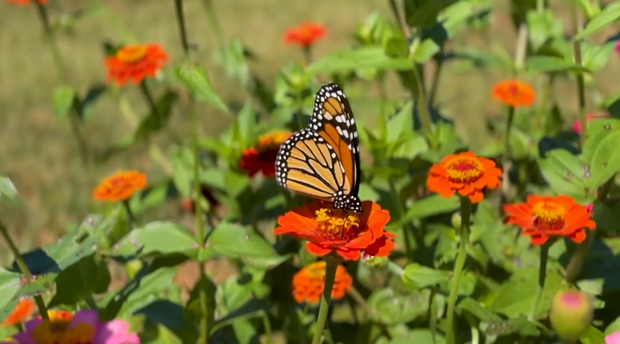
The flowers provide nectar, giving migrating butterflies the energy they need to continue their journey south. And those stops can make the difference between completing the migration and falling short.
The eastern migratory monarch population has declined by an estimated 80% since the mid-1990s, according to the U.S. Fish and Wildlife Service.
Habitat loss, pesticide exposure and climate change are among the threats facing the species. Although monarch populations fluctuate from year to year, their long-term decline has raised concerns about the survival of one of North America's best-known migrations.
For Johnson, the connection between conservation and gardening is direct. "What we do as gardeners absolutely makes a difference," he said.
The nectar-producing flowers at Gibbs Gardens provide fuel for adult monarchs. But another plant is essential to producing the next generation: milkweed.
Female monarch butterflies lay their eggs on milkweed plants, and their caterpillars depend on milkweed leaves for food. Without it, monarchs cannot successfully reproduce. As native milkweed habitat has disappeared from roadsides, fields and other open spaces, the butterflies have lost critical breeding grounds. That means even relatively small planting decisions can make a difference.
"The most important thing that homeowners could do if you care about the survival of monarchs, even if you just have a little corner of your garden and you can plant some milkweed and then some good nectar-producing flowering plants," Johnson said.
Native milkweed varieties appropriate for Georgia, combined with flowers that bloom throughout the growing season, can help support monarchs and other pollinators.
Monarchs generally pass through north Georgia during their fall migration from late September into mid-October, with the timing and number of butterflies varying from year to year.
Gibbs Gardens, in Ball Ground, is open to the public during its seasonal operating schedule. Visitors can purchase admission to explore the gardens, including the flowering landscapes that attract migrating butterflies.
A sighting is never guaranteed. The butterflies are wild, and their movements depend on weather, migration conditions and the availability of nectar. On a recent visit to the gardens by CBS News, monarchs by the hundreds were observed in an almost dancing movement across the tops of the flowers.
It is an extraordinary journey unfolding close to Metro Atlanta. For the monarchs, the trip to Mexico can stretch as far as 3,000 miles. Whether they complete it may depend, in part, on what is growing in places like Gibbs Gardens — or even in an ordinary Georgia backyard.


