In Georgia's Serenbe community, a philosophy of people and nature over cars takes center stage

If you arrived in the Georgia neighborhood of Serenbe without knowing anything about it, you might think you'd wandered onto the backlot of a movie studio.
There is a neighborhood bakery, horse stables, a boutique inn, a spa, public art, and winding paths connecting homes to forests and farms. Children ride bikes and play along quiet streets. Shop owners greet neighbors by name.
"It's almost like a Hallmark movie," said Ashley, a local pet groomer.
For Glen Slater, who owns a bike shop in the community, the appeal is simple.
"If you're a social person, you'll do well here," Slater said.
Serenbe, located about 30 miles southwest of Atlanta in Chattahoochee Hill Country, was designed to be different. Its name combines the words "serenity" and "be," reflecting a philosophy that has attracted national attention from planners, architects and environmental advocates.
At the center of it all is Steve Nygren, the entrepreneur and visionary who founded the community 25 years ago after asking a deceptively simple question: What if a town were designed around people and nature instead of cars?
Nygren didn't initially set out to create a nationally recognized model for community development. Years ago, he purchased a small farmhouse in the area as a weekend retreat from Atlanta. What he discovered there was a sense of peace he hadn't realized he was missing.
"I realized how dysfunctional everything we were doing was," Nygren said of conventional development patterns. "It's what drove me from the city."
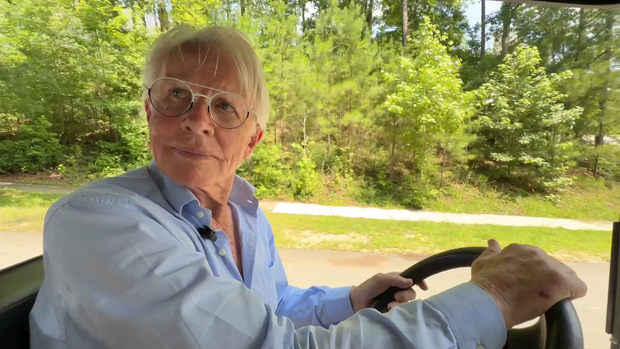
The idea that eventually became Serenbe took shape after he encountered a study by the Urban Land Institute examining golf-course communities.
The finding that caught his attention wasn't about golf.
"The majority of the people who owned those lots played golf twice or less a year," Nygren said. "Which means they were buying it for the open space. They weren't buying it to be on a golf course."
That insight became the foundation for Serenbe's design philosophy: preserve the landscape people value rather than paving over it.
Convincing lenders and developers wasn't easy.
Nygren argues that traditional suburban growth has consumed vast amounts of land while delivering diminishing returns for residents and the environment.
Serenbe, by contrast, clusters homes into compact neighborhoods surrounded by preserved forests, farmland and green space. Residents can walk to restaurants, shops, parks and community gathering places.
The homes, many inspired by English hamlets and village design, are known for their architecture and premium price tags, but Nygren insists the underlying concepts are not exclusive to luxury developments.
"The principles of saving nature and clustering housing are very basic," he said. "We're anxious to do that."
Now 80 years old, Nygren shows little interest in slowing down.
He recently authored a book detailing what he calls "biophilic living" — the idea that human beings thrive when they maintain meaningful connections to nature and to one another.
The concept extends beyond Serenbe's boundaries.
Nygren points to projects like Atlanta's Beltline as examples of development that prioritize people over cars by creating connections between neighborhoods, green space and public gathering areas.
What bothers him most about the growth of the Atlanta metro area?
"Everything we're building is auto-dependent," Nygren replied.
For him, the challenge facing Atlanta is not simply accommodating growth, but deciding what kind of growth the region wants.
Metro Atlanta continues to add residents at a rapid pace, bringing new housing, new roads and new development. Nygren believes the next chapter should focus less on expanding car-dependent communities and more on creating places where residents can walk, gather and connect.
His vision for the future may sound ambitious, but he believes it is achievable.
He predicts that communities across the Atlanta region will eventually be linked through expanded light rail systems and autonomous transportation networks, reducing the dependence on personal vehicles that has shaped the metro area's development for decades.
Whether that future arrives remains to be seen.
But walking through Serenbe today, it's clear that Nygren's experiment has become something more than a neighborhood.
The bakery, the farm, the trails and the gathering spaces all point toward a larger idea: that people may be searching for more than bigger homes or wider roads.
What they may be seeking is something much simpler: a place to belong.


