Electric air taxi companies like Vertical Aerospace promise to transform travel in Atlanta, other growing cities
The future of transportation in congested cities like Atlanta may soon be taking flight. Electric air taxis that take off like helicopters and fly like airplanes could become an option for commuters, with some companies saying the technology may arrive within the next few years.
At VertiCon, an aviation conference being held at the Georgia World Congress Center, March 10 - 12, two companies developing electric vertical takeoff and landing aircraft, known as eVTOLs, outlined how the technology could eventually help travelers bypass traffic in cities like Atlanta.
Electric air taxis could arrive within the next few years
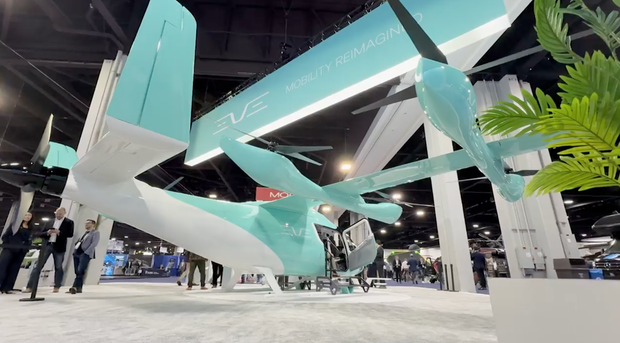
Executives with Eve Air Mobility say their aircraft could begin appearing in U.S. cities as early as late 2027, pending certification by regulators.
"We're designing these aircraft specifically for urban travel," said Chief Commercial Officer Megha Bhatia. "You could see them operating in Atlanta or other major cities where congestion is a challenge."
Another manufacturer, Vertical Aerospace, expects its Valo aircraft to begin certification in Europe first, with plans to bring the aircraft to the United States pending approval from aviation authorities in 2028, according to Chief Commercial and Strategy Officer Michael Cervenka.
Both companies say the aircraft are designed to transport passengers, cargo, or emergency responders on short routes of 20 to 60 miles.
A faster trip across Atlanta
One of the most common proposed routes would connect downtown Atlanta with Hartsfield-Jackson Atlanta International Airport.
Developers say a trip that can take an hour or more by car during rush hour could potentially be reduced to 10 to 20 minutes by air.
Vertical Aerospace says its Valo aircraft is designed to fly at about 150 miles per hour, allowing commuters to travel quickly between airports and nearby business districts.
"That airport-to-city connection is really the dominant use case we see around the world," Cervenka said.
Safety standards similar to commercial airliners
Because eVTOL aircraft represent a new type of aviation technology, companies say the certification process will be rigorous.
Cervenka said Vertical Aerospace plans extensive flight testing through 2027 and 2028 before receiving approval from European regulators and then seeking validation from the Federal Aviation Administration.
Both companies say their aircraft are built with multiple redundant systems to protect passengers if something fails.
Vertical Aerospace's Valo includes: Eight propellers powered by multiple motors, eight independent batteries, three flight control computers and backup structural systems
"The aircraft is designed so that if any system fails, it can continue flying safely and land vertically," Cervenka said.
Eve Air Mobility says its aircraft also includes backup systems in both the rotors and propulsion systems to ensure safe operations.
Quieter than helicopters
Developers say noise reduction is critical if air taxis are going to operate in busy cities.
Cervenka said the Valo produces about the sound of a loud conversation during takeoff and landing, and becomes even quieter once it transitions to forward flight.
In cruise, he said, the aircraft can sound similar to a household dishwasher, helping it blend into the background noise of a city.
Bhatia said Eve's aircraft is also designed to be quieter than traditional helicopters, which could help overcome restrictions that currently limit helicopter flights over many urban areas.
"Helicopter operations are limited due to noise curfews in the skies, and that is important for community acceptance and for public adoption, especially in urban areas," Bhatia explained. "These eVTOLs are designed to be able to circumvent that because they are quieter by design."
Both executives believe air taxis will likely start as a premium transportation option, similar to executive car services.
Early flights could cost more than rides on platforms like Uber or Lyft because the number of aircraft will initially be limited.
But as production grows and battery technology improves, companies say the price could eventually drop closer to ride-hailing costs.
"Over time, as more aircraft are produced and technology improves, the goal is to make this accessible to the masses," Bhatia said. "We are designing this eVTOL to be profitable for the operators, and therefore, they can pass those savings on to the customers."
Federal program aims to speed development
The technology is gaining momentum as federal regulators work with companies and local governments to create new rules for urban air mobility.
Earlier this week, the Federal Aviation Administration launched the eVTOL Integration Pilot Program, aimed at accelerating the safe introduction of advanced air mobility vehicles in the national airspace.
The initiative encourages partnerships between private companies and local governments to develop infrastructure and operating frameworks for the new aircraft.
Airlines and investors back the technology
Major airlines and aviation companies are also investing heavily in the emerging air taxi industry, which is a sign of the growing confidence in the technology.
American Airlines recently announced it will invest in Vertical Aerospace and has agreed to pre-order up to 250 aircraft with a potential commitment of about $1 billion. The airline also has the option to purchase an additional 100 aircraft in the future.
Several other aviation companies have partnered with Eve Air Mobility to help develop regional electric air taxi networks. United Airlines has invested $15 million in Eve and has a conditional purchase agreement for up to 400 aircraft, with plans to eventually introduce electric flights in cities such as San Francisco. Republic Airways has partnered with Eve to help develop regional networks across the central and eastern United States, with an order for up to 200 aircraft. SkyWest Inc. has agreed to purchase 100 eVTOL aircraft to support a regional operator network, while Bristow Group is partnering to develop urban air mobility services with a potential order for up to 100 aircraft. Florida-based aircraft lessor Azorra has also placed an order for up to 200 aircraft.
Both companies believe that partnerships like these will help the industry scale in the coming years.
"By the mid to late 2030s, we expect to see many more of these aircraft operating in cities around the world," Cervenka said. "There's a lot of space in the sky, and this technology has the potential to dramatically reduce time lost sitting in traffic."