Born from tragedy, the power of collective Black singing continues to stay relevant
Before it filled sanctuaries or concert halls, collective Black singing carried coded messages, community, and survival.
The Black choir didn't start in church. It started in captivity.
Dr. Daniel Black, professor of African American Studies at Clark Atlanta University, says before church choirs, before harmony, before robes and pulpits, there were voices below deck.
"This is when the Serer, the Tiv, the Ga, the Ewe, the Mandinka, the Yoruba, who were all forced together in the same place, forced together in the same horror, in the same tragedy," Black said.
Torn from their homelands, Africans carried rhythm in their bodies and music in memory. Melody became the last shared language.
After arrival in America, collective singing followed them to the plantation fields, where the sound became a signal.
"They were creating what I call spaces of subterfuge," Black said. "In other words, what they were also doing in the spiritual was creating ways to communicate with one another secretly."
What sounded like worship often carried coded messages — well documented in Negro spirituals, with songs like "Swing Low, Sweet Chariot."
"So while we sing 'Swing Low, Sweet Chariot,' we were really meaning 'swing low, sweet Harriet.' These spirituals have a double-tongued nature. When we sang about glory, we meant North," Black said.
Dr. Kevin Johnson, an associate professor of music at Spelman College and director of the Spelman College Glee Club, says that after Emancipation, field songs moved inside church walls, harmony was organized, and the Black choir was born.
"It's a culture built on struggle and on expressing that struggle and coming out on the other end of it with beauty," Johnson said.
Spirituals take the global stage
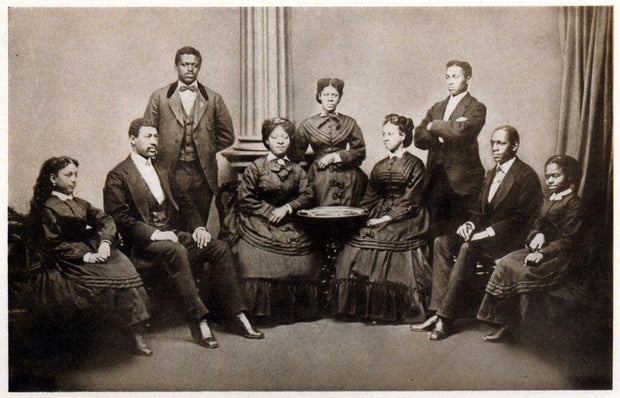
In 1871, the Fisk Jubilee Singers carried spirituals from formerly enslaved communities to global stages, raising money to keep their school open.
"Their harmonies were so amazing. Their harmonies were so tight. Their harmonies were so magical. But see, Black people have been doing polyrhythmic singing, polyrhythmic movement, polyrhythmic dance, and that's very important to understand," Black said. "Our extraordinary nature, our excellence, is actually regular."
By the 1930s, quartets shaped the sound. The 1960s ushered in the full Black gospel choir movement, led by figures like James Cleveland and Georgia's own Thomas Dorsey.
Choirs became a community in motion, especially during segregation, where collective sound meant collective strength.
Gospel music goes mainstream
By the late 20th century, gospel crossed into the mainstream.
"Kirk Franklin, who I think did magical work in terms of gospel music because gospel music got into places that it had never ever gone before," Black said.
And then came a shift.
"The choir movement has all but dissipated, and now we're into praise teams," he said.
So, what does the future hold?
"We need revolution in lyrics. We need gospel songs now about the marvel of Nat Turner. We need gospel songs about the genius of Fannie Lou Hamer. If we cannot sing our own heroes as deities, we remain captive to someone else's theology," Black said.
The Black choir was never just harmony. It was survival — history set to melody. And whether in a church, a protest, or a praise team, the tradition lives on as long as voices rise together.