Fabric created by Georgia Tech researchers could help prevent bedsores in young patients

Children's Healthcare of Atlanta says 10 percent of the children in its intensive care unit are at serious risk of developing bedsores. That's why doctors at the hospital are partnering with the Georgia Institute of Technology to try a new fabric designed to stop the painful ulcers in their tracks.
Amber Berry says her son, Connor, has been struggling with a serious bedsore while battling human metapneumovirus in the Children's Healthcare of Atlanta's intensive care unit.
The ulcers are caused by prolonged pressure, often while patients are unable to move in a hospital bed.
"The pressure wound has made it just so much harder for him to be mobile," Berry said. "It's harder for him to be turned. It's much easier for him to become, you know, septic through bacteria entering that wound … It was so bad, it almost, it actually still looks as though there's bone protruding."
Currently, moving Connor from his hospital bed takes three people, but a new fabric embedded with sensors invented at Georgia Tech could help. The researchers say the technology goes back to the 90s, but the fabric for the hospital beds began development in 2017.
The university researchers say the sensors detect how much pressure is coming in contact with the fabric, for how long, and if there is moisture. That way, hospital staff can determine exactly when they should move patients to avoid bedsores.
"By being able to collect the data, we can customize the intervention over a period of time so that a person who is heavier may need to be moved sooner," Professor Sundaresan Jayaraman said. "A person who is in the same position for a long period of time needs to be moved sooner, as opposed to a lighter person who may not be exerting that much pressure."
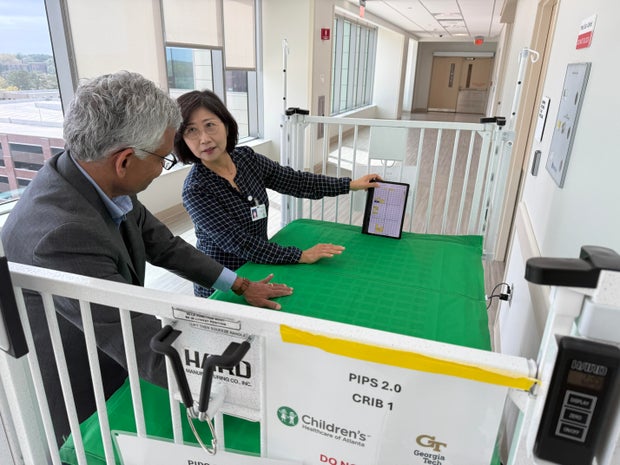
That data is processed in wires under the bed and then shows up on an iPad attached to it.
"[The] good thing about this system is, all the sensors are made of textile material, so [they're] not like the, the plastic or any other stiff materials," said Principal Research Scientist Sungmee Park, one of the researchers working on the project. "So it does not give any extra feeling or extra hardness to the patient."
Berry says this technology has major potential.
"I think it's a wonderful, wonderful idea, and a wonderful way to help parents not have to endure some of the sad journey that I've been through and other parents have been through, Berry said. "It's going to make a world of difference."
The hospital plans to expand the fabric from the ICU's cribs to larger beds as it experiments. The researchers say the technology can also be applied to other medical equipment, including wheelchairs and headgear.


