REED COWAN:
00:00:02
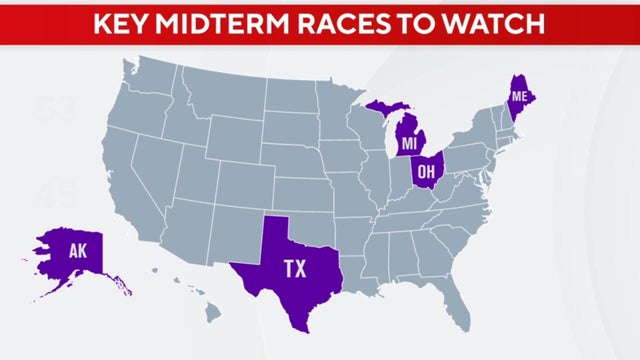
OK, America. And right off the top, we begin with key primary races in three states today, voters in Florida, Alaska, and Wyoming choosing candidates ahead of November's midterms. Now, in California, there's a special election to choose a replacement for disgraced Democrat Eric Swalwell, who, you'll remember, resigned from Congress and ended his bid for governor in that state. On the other side of the country, a hot governor's race in Florida, Trump-backed Republican Representative Byron Donalds faces 10 challengers, 10 of them in his primary. Former Republican and outspoken Trump critic David Jolly is the runner among those for Democrats. Florida has not elected a Democrat, keep in mind, to get the keys to the governor's office since 1994. Meanwhile, a newly drawn congressional map favors Republicans in four key Florida House districts. But progressives are also crowding the field on the Democratic side. They're challenging party moderates. CBS News Executive Director of Elections and Surveys Anthony Salvanto has a closer look at what's at stake in the polls. We watched the primaries today start with Florida. The really compelling story is on the House side. Florida, like a number of states, redistricted this year, redrew its lines. And on balance, that seems to favor Republicans, a potential pickup in Florida of maybe three or four seats by our estimates. But that all depends on the candidates that are chosen in these primaries. So you've got a lot of interesting races to watch there. Can Republicans really maximize what looks like on paper their potential gains from redistricting? And out West, keep an eye on Alaska because that's a Senate seat that we do rate as a battleground this year. It's a Republican-leaning state. President Trump won it easily. The Democrats think they have a candidate in Mary Peltola who could do better. She did do better than Kamala Harris in the last cycle. And with an instant runoff system come November, they think they might have a chance. That's certainly one we'll be watching when it gets into the fall. Anthony, thank you. Live to CBS News congressional correspondent Nikole Killion in South Florida's Broward County where it's hot today. Nikole, let's start with the race to replace Republican Governor Ron DeSantis. Who are the frontrunners? Yeah, I heard you earlier referenced this as a hot race, but it is hot literally here, as you know, almost close to 100 degrees here. But that's typical of Florida in August. But that being said, yes, this race is heating up in the sense that, after tonight, we should know who will advance to the general election, although some candidates in this race are already kind of starting that pivot, most notably, Republican front runner Byron Donalds, who is currently leading a pack of 10 candidates. And then on the Democratic side, you have David Jolly, who is a Republican turned Democrat. So both of them anticipate that they will likely face off against each other. Obviously, we'll have to see how their respective primaries play out, but they both have been sizing each other up, if you will, because, look, this is the first time that there is an open seat in a number of years. Whoever ultimately wins this seat in November will succeed Governor Ron DeSantis, who has been in office for several terms now and is term limited. I would point out that DeSantis did not endorse in the Republican primary. That is something that I asked Byron Donalds about. Obviously, he has the backing of President Trump, who, just this morning, posted on Truth Social, reaffirming his support for Donald. But look, Donald and DeSantis don't necessarily have the best of relationships, although Donald was hopeful that, eventually, if he does, in fact, advance to the general election primary, that DeSantis would consider endorsing him because he believes that that will help unify the Republican Party. David Jolly, on the other hand, should he succeed and be a successful tonight again, is looking to really thread the needle between that moderate Republican, moderate Democrat, and independent route. Those are those core entities that he believes that he needs to mount a successful candidacy here in a Republican state that hasn't seen a Democratic Governor since the mid-1990s. So it'll be interesting if these two end up facing off against each other, certainly both of them very hopeful that that will come to pass later on this evening. Nikole, we look at the headlines. We hear about the polls. And what's fascinating is that you are in Florida and, to your point, tends to lean heavily Republican. But we are seeing more progressives running in Florida races. How does that read as far as the tea leaves go?
NIKOLE KILLION:
00:04:59
Yeah, well, that's the interesting thing here because Florida is quite conservative and has really trended more Republican over the last several decades now. And so even in spite of that, you still have these pockets of democratic socialism that's kind of popped up in different races. So for instance, you have the Democratic Senate primary, where you've got state Representative Angie Nixon, DSA candidate who is running against Alexander Vindman. He is a Congressman, originally representing Virginia, but he moved here to Florida. He is a combat veteran. He is a whistleblower and was involved in President Trump's first impeachment trial as a witness, some may recall. So he is kind of taking that more moderate lane of course, Angie Dixon taking that more progressive DSA lane. And then also you have in Florida's 25th congressional district another Democratic socialist candidate, Oliver Larkin, who's going up against Jared Moskowitz, the incumbent Democratic Congressman. This is a newly redrawn district. So in terms of that challenge, it has become a bit more competitive. But in talking to voters, some of them are more accepting of democratic socialism than others. Take a listen to some of the voters we spoke to here at this polling place a short time ago. Even the people that are on the right and are very against socialism can see that it has done-- democratic socialism, at least, has done good for people in New York and in other places. So this boogeyman of they're social democrats, all they're doing is looking out for the basic interests of the community. And they're not going-- we could have-- half of the country could be senators. Half of the Congress could be socialists. And the United States is not going to become a socialist country. We are run by capitalism. We love capitalism. We like having our big screen TVs. We love having our gas guzzlers. It's not going to change. So in both of these cases, both of these voters generally accepting of democratic socialists, that last voter you heard from those, saying, look, just because you elect one or two here doesn't mean everything's going to turn socialist. And then the other voter we spoke to was kind of a younger voter, more progressive. And he simply felt that, look, maybe the establishment isn't cutting it. And so, yes, maybe you do need change. And so if that change comes from a democratic socialist candidate or a more progressive candidate, so be it. That being said, we talked to other voters who feel like, especially in South Florida, just this notion of democratic socialism is really hard to contend with. There's a high exile population here from not only Cuba but other Latin American countries, and so that message doesn't necessarily resonate well with them, if that is something that they or their families fled from generations ago. So that is the ongoing debate here in South Florida. At the end of the day, though, whether these candidates advance, it's still an uphill climb, again, considering that this is a mostly red state, Reed.
REED COWAN:
00:08:10
Yeah, I worked for years standing right where you are down there in South Florida. I know South Florida politics is a lot like the weather, and it's a sport in and of itself. No one better to catch that ball than you. Nikole Killion in South Florida, thank you so much. Go get a cold cafecito to cool off, my friend. Take care.