Watch CBS News

Tulsi Gabbard resigning from Trump's Cabinet

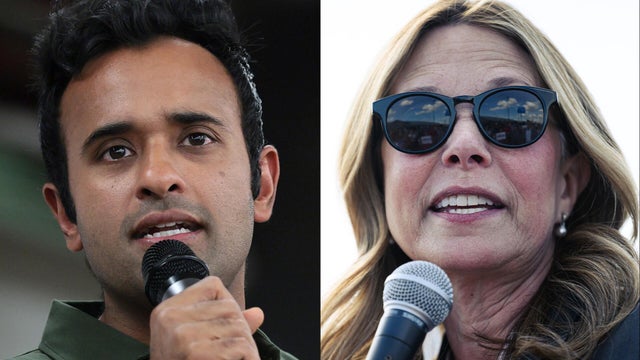
Tulsi Gabbard, President Trump's director of national intelligence, has announced her resignation. CBS News' Weijia Jiang, Sam Vinograd and Nicole Sganga report.
May 22 (22:22)

TRANSCRIPT FOR: “TULSI GABBARD RESIGNING AS TRUMP'S DIRECTOR OF NATIONAL INTELLIGENCE”

SAMANTHA VINOGRAD:
00:03:05

Well, certainly, Tony, Tulsi Gabbard has used her tenure as director of national intelligence to restructure the intelligence-community apparatus overall, as well as the priorities that are guiding intelligence-community collection and analysis. Early into her tenure, Tulsi Gabbard did eliminate various task forces, including on malign foreign influence and other related matters. And Tulsi Gabbard's focus on threats to the homeland have really been driven by a lot of domestic priorities, including limiting illegal immigration to this country, as well as the president's very strong focus, for example, on counternarcotics and broader immigration-related matters. That was very clear in the Worldwide Threat Assessment that she released, as well as other public comments that she has made. Certainly as she departs, there will be a lot of questions about what a new director will focus on from a prioritization perspective and most importantly, Tony, what kind of relationship the new DNI will have with President Trump. President Trump has had a complicated relationship with the intelligence community in terms of undercutting, at various points, the role that intelligence has played when it comes to Iran, North Korea, and otherwise. So regardless of who the new director is going to be, the outstanding question is how heavily President Trump will rely on that director because, as Weijia was pointing out, Tulsi Gabbard did have somewhat of a roller-coaster relationship with the president. Hey, Sam, this comes at a time when we are in a paused but still open-ended war with Iran. We have a situation in Cuba that sometimes seems to be moving from the back burner to the front. There's still Venezuela. It's a dangerous world out there. It's a big job. The president now has an opportunity to put somebody new in this role. Can you talk about how important the job of director of national intelligence is, particularly now?

SAMANTHA VINOGRAD:
00:05:07

Well, Tony, the job of the director of national intelligence is, unfortunately or fortunately, only as important as the commander in chief chooses to make it. Intelligence is only as important as the president chooses to make it. So assuming that President Trump installs a new director that he trusts, the job of the director of national intelligence is critical. The director of national intelligence is not only responsible for ensuring that the president's daily brief, the intelligence briefing that the president gets every day, contains the most important intelligence analysis that the president needs to hear. The DNI is responsible for briefing the president at the top of every National Security Council meeting with the latest and greatest intelligence on a particular matter, like Iran, like Venezuela, like Cuba. But even beyond that, Tony, the Director of National Intelligence, is responsible for not just overseeing the entire intelligence community, tens of thousands of people, tens or hundreds of millions of dollars, but also ensuring that our intelligence community has the resources, talent, money, technology it needs to remain competitive in an incredibly complicated geopolitical moment. So the director of national intelligence is not only serving the president's intelligence needs. They're doing so not just by briefing the president but by ensuring that the health of the intelligence community is adequate to keep United States' national security as high as it can be.

TONY DOKOUPIL:
00:06:35

Yeah, and that's where the stakes of this continue to matter for us as a country here. Sam Vinograd, thank you very much. Weijia Jiang, thank you very much. The news, again, is this. The director of national intelligence, Tulsi Gabbard, will step down at the end of June, citing the health of her husband, who has bone cancer. Our coverage will continue on CBS News 24/7, your local news, and tonight on the CBS Evening News. This has been a CBS News special report I'm Tony Dokoupil. All right, so let's scaffold off of what Tony Dokoupil just reported there with Weijia Jiang and others. Let's go ahead and bring up that letter that Tulsi Gabbard released. This has got the letterhead of the national intelligence office there and sending it directly to the president. I will read it to you. Dated May 22, 2026, turning a page in the administration. She writes, "Dear Mr. President, I am deeply grateful for the trust you placed in me and for the opportunity to lead the Office of the Director of National Intelligence for the last year and a half. Unfortunately," she goes on, she says, "I must admit my resignation effective June 30, 2026." She says her "husband, Abraham, has recently been diagnosed with an extremely rare form of bone cancer. He faces major challenges in the coming weeks and months. At this time, I must step away." If we can drop that banner right there just for a second because I promised the viewers I'd read it to him. Thank you so much. "Step away from public service to be by his side and fully support him through his battle." She goes on to talk about how her husband has been her rock and steadfast through her deployment, et cetera, et cetera, et cetera. So the bottom line, that is a letter from Tulsi Gabbard directly to the president of the United States. Catching all of this news and disseminating it to the world is Weijia Jiang, CBS News senior White House correspondent. Weijia, first of all, there's the personal angle to this story and then the political angle to this story. Tulsi Gabbard citing personal issues, but our own reporting has said that this has been something that some wondered if it was next to happen with the administration. That's right, Reed. CBS News has been reporting in recent months that the president had been floating the idea of replacing DNI Gabbard after a rocky tenure since she began her post here. Remember, before she took on this job, before she joined the administration, she was extremely vocal about the US not getting entangled in foreign wars. And so when she was in the hot seat up on Capitol Hill defending the administration's decision to attack Iran, which ultimately led to the war that is ongoing, she said that the intelligence community did not have any evidence that Iran was building a nuclear weapon, which went directly against one of the reasons President Trump cited for launching that initial attack on Iran. There has been other episodes in which she had to make tough decisions about what to say because she could have been at odds with President Trump. For example, her deputy, Joe Kent, wrote a scathing letter in his resignation talking about his opposition to the Iran war, and she did not condemn those words afterwards. She did not personally fire Kent and ultimately issued a statement to say that it is the president who makes decisions about personnel. So there have been moments where her longevity has already been in question, Reed. So it's not necessarily surprising that she is departing now. What is completely new information is the reason that she has given the public. As you mentioned, she has to tend to her husband, who is battling a very rare form of cancer. Of course, our thoughts are with him and their entire family. In the letter, she ends it by thanking President Trump for understanding during this deeply difficult and personal time, Reed. Of course, the public will remember at the beginning of President Trump's second term, Tulsi Gabbard was a lot more vocal. And then we started to see an arc where we saw and heard less of her in those cabinet meetings, et cetera. Can the public read anything into that? And did you yourself, as somebody who has proximity in covering the Trump administration, see that she was a little less vocal as the months went on? Well, it wasn't just that she was less vocal but there was certainly less exposure for her. When the president was launching air strikes from out of town, she was here in Washington with the vice president and other officials but not in his inner circle when he was making some critical decisions when it came to the war in Iran. And so that was notable. And also, yes, after her congressional hearings, we did start seeing and hearing less from her. But it should be noted that on the numerous occasions that the president himself and other spokespeople, including the press secretary you see right there, really defended Gabbard and insisted she wasn't going anywhere. It was just last month that the president was asked on Air Force Onewhether he still had confidence in Gabbard, and he said yes. So she was able to survive those challenging instances in which her view didn't necessarily align with the president's. And, ultimately, now she is leaving because of a personal matter, Reed.

REED COWAN:
00:12:20

All right, you are watching continuing coverage on CBS News 24/7. You see it right there on your screen. Having a conversation with Weijia Jiang as Tulsi Gabbard resigns as director of national intelligence. In recent weeks, she also was in the headlines relative to the Trump administration's push for election security, and she really set into momentum-- I'm thinking of Fulton County, Georgia-- some actions that really looked at that as an issue. Going into the midterms, what happens to that issue that she was, arguably, in charge of? Well, I don't think the issue goes away because it was President Trump, this administration, obviously, that was backing that trip to Georgia. And there has always been an argument that there's been foreign interference with regard to US elections, and that is not something that I imagine the president himself and others will stop saying. But there really opens a question about who will replace Gabbard because it hasn't only been in this term but even in his first term, the president has had no issues going against what his intelligence community has found. He has contradicted reports. He has contradicted statements from intelligence officials. And so it will be really interesting to see who he puts in that position and what that might tell us about what he expects from this position moving forward.

REED COWAN:
00:13:56

Weijia, we just got this from President Trump's own Truth Social post. We will read that and then talk about it. The president says, "Unfortunately, after having done a great job, Tulsi Gabbard will be leaving the administration June 30. Her wonderful husband, Abraham, has recently been diagnosed," as her letter to the president said, "with a rare form of bone cancer. She, rightfully, wants to be with him, bringing him back to good health as they currently fight a tough battle together." The president goes on to say, "I have no doubt he will soon be better than ever. Tulsi," he says, "has done an incredible job, and we will miss her. Her highly respected Principal Deputy Director of National Intelligence, Aaron Lukas, will be serving as Acting Director of National Intelligence." Signed by President Donald Trump on Truth Social. So now we have an acting attorney general at the United States in President Trump's cabinet, and we also now have an acting director of national intelligence, Aaron Lukas. How much exposure have you had to Mr. Lukas as a reporter, and what can people learn from maybe a little bit about what the future is for that office under his guidance?

WEIJIA JIANG:
00:14:57

Well, he has obviously been working under Gabbard, and so they have to have the same philosophy moving ahead. And this is somebody who the president also had to sign off on. So we don't know, in depth, how he will serve differently from Gabbard. But I think what's notable from the president's post there is that he continues to express confidence in Gabbard, and we've seen this now with every single departure from his cabinet because unlike the first time around, when he was filling those positions largely at the advice of others because he was brand new to Washington, for his second term, he handpicked every single person in his cabinet. These were all his people. And so, obviously, there's going to be any kind of resistance to criticizing them because, ultimately, he is the one who made the decision to put them in that post. And so he continues to express his confidence in Gabbard there and said that she did a great job, which I do think is notable.

REED COWAN:
00:16:08

All right, Weijia Jiang chasing this story. This will be a big one for your dinnertime headlines. Thank you so much for helping us get the jump on it and this breaking news. Tulsi Gabbard resigns as national intelligence director. Thank you so much, Weijia. Now to CBS News Homeland Security Reporter Nicole Sganga. Nicole, another historic day in the Trump administration. What are you hearing from your post? Yeah, Reed, and just to piggyback off of what Weijia was just saying about Aaron Lukas, he is an interesting pick, though, albeit not a particularly surprising one because he had been serving in this number-two position. But he has spent more than 20 years serving the intelligence community, primarily within the CIA. He was a former intelligence analyst, a clandestine operations officer. He was the former CIA chief of station. He was chief of staff at ODNI back when Rick Grenell was the director back in the first Trump administration. He also served in the National Security Council. He was part of the libertarian think tank Cato Institute in the early part of his career. As for what Tulsi Gabbard will be remembered by, certainly more of an unorthodox choice for this role. But back when she first took the helm as the director of the Office of National Intelligence, she launched ODNI 2.0, which was a major downsizing and restructuring of the Office of the Director of National Intelligence. ODNI at the time said that it would reduce the staffing within the IC by 40% by the end of FY2025, which Gabbard, at the time, claimed would save the administration more than $700 million annually. She also made, quote, "ending weaponization of the intelligence community" a central theme, saying that she was going to restore trust in the intelligence community. But as Weijia pointed out, it was very interesting as time passed under the Trump administration. She had a very limited involvement in major Trump national security initiatives, especially Venezuela and Iran. And she was oftentimes sidelined in some of those discussions, particularly when it came to the Iran deliberations. She had reportedly clashed with the administration, emphasizing some of the differences between US and Israeli goals and maintaining that Iran had not tried to revive its nuclear program after prior US strikes. So a sort of colorful history and legacy that she created for herself at ODNI. And you also mentioned her unusual role in election security. And back in January, we know that she was seen in Fulton County during an FBI search of 2020 ballots and election materials at President Trump's request and was never quite able to explain why she needed to be here. Of course, we know that this raised alarms just because DNI's role is normally focused on foreign intelligence threats, not domestic ones. Well, and then, of course, at the very beginning of President Trump's second term, we saw her called on the carpet relative to so-called Signalgate, which is when a reporter was accidentally included in on a very important, what was supposed to be a highly secure communication between government officials. It's been a rocky go for her who, really, she's arguably a contrarian everywhere she goes. Even had political ambitions for the presidency at one point. Yeah, ran for the presidency as a Democrat back in 2020. I was a campaign reporter at the time and spent many days with her campaigning in New Hampshire, where she felt like she had a shot at the time. Since then, of course, she has sort of switched her political leanings. She was always seen as an outsider within the Democratic Party but then became more and more friendly with the Trump administration and did work very hard as one of the leaders when Trump was putting together his staffing for his second term, for his second administration. She worked hand in hand with him to develop the team and then rose to this position as head of the ODNI. It will be interesting to see what, if anything, she pursues in the future. Of course, for now, understanding that she has to put her family first, as her husband battles what she calls a rare form of bone cancer. And I will just say that her husband, her family, her sister has always been very close with her. And back during her campaign days, they had a very prominent role on her campaign. So clearly taking this as an opportunity to spend more time with them in a personal capacity. Nicole, just before I leave you, of course, now we have an acting national intelligence director. How long can that acting status go on before the president has to nominate somebody else? And then do they have to go through confirmation with the Senate? Yeah so Aaron Lukas has already been confirmed for his current role. If he were to be the permanent nominee, he would need to be nominated to lead ODNI. This administration, though, seems to instead like to appoint people for a limited time before they can find a sort of replacement. And we'll see. I mean, when Joe Kent left as the NCTC director under Gabbard, he was somewhat quickly replaced by Sebastian Gorka, who is now serving in an acting capacity in that role. So we do expect that the Trump administration will move to put a permanent leader at the helm of ODNI. As for how long, I believe it's something under 200 days before that individual can no longer serve in that acting capacity, Reed. Fascinating time. Once again, continuing coverage, breaking news on CBS News 24/7. Tulsi Gabbard resigns as director of national intelligence. You're watching CBS News 24/7. We'll be back with this big breaking news story once again affecting President Trump's leadership.

View CBS News In
CBS News App Open
Chrome Safari Continue