OLIVIA RINALDI:
00:00:33
Crews sifted through the rubble of a police station in Tehran Monday, as the US and Israel continue to pound Iran with missiles. This was our last best chance to strike.
OLIVIA RINALDI:
00:00:45
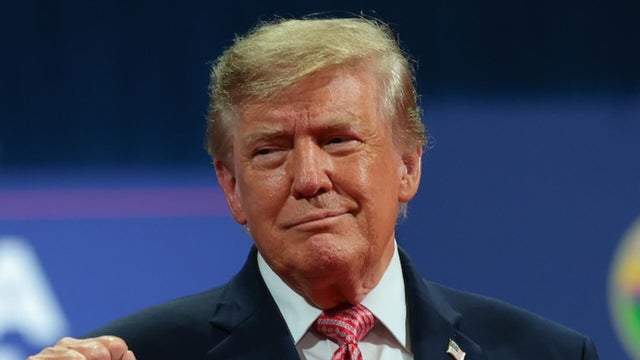
In his first live comments since the military operation against Iran began, President Trump said the US will take as long as needed to remove the threat of Iran's ballistic missiles and its nuclear program. We projected four to five weeks, but we have capability to go far longer than that.
OLIVIA RINALDI:
00:01:05
Iran and its allies struck back immediately. Smoke could be seen rising from the US Embassy in Kuwait, and several locations inside Israel were also hit. At a Pentagon briefing on Monday, Defense Secretary Pete Hegseth confirmed the first US casualties. It happened to hit a tactical operation center that was fortified, but these are powerful weapons.
OLIVIA RINALDI:
00:01:27
The chairman of the Joint Chiefs said there may be more casualties. We will work to minimize US losses. But as the Secretary said, this is major combat operations.
OLIVIA RINALDI:
00:01:39
The Pentagon also confirmed that Kuwait shot down three US F-15 Jets in what they're calling a friendly fire incident. All six crew members survived. President Trump's GOP allies here on Capitol Hill have praised the US military strikes on Iran, while some Democrats have blasted the administration for not consulting Congress first. There needs to be a plan. And we need to know what the objectives are, and we need to know what the long-term exit strategy is.
OLIVIA RINALDI:
00:02:07
The House and Senate are scheduled to get an all members briefing tomorrow. Olivia Rinaldi, CBS News, Capitol Hill.
LINDSEY REISER:
00:02:14
I want to bring in Jon Alterman with the Center for Strategic and International Studies. Jon, how unprecedented is this action and moment in history? It's pretty unprecedented that the United States would go in with another country and take out, not only a leader, but the leadership, with unclear objectives of what happens next. I can't think of a clear parallel.
LINDSEY REISER:
00:02:39
What does the death of the Supreme Leader mean for the power vacuum currently there, and what regional instability could that lead to?
JON ALTERMAN:
00:02:47
Well, the fact is, there's a whole network that the Supreme Leader presided over. They have guns, they have money. They have a structure that is time-tested. I think it's going to be very hard, frankly, to move that whole leadership out, to move that structure out. I certainly hope for more democracy for the Iranian people. They certainly deserve it. But I'm not sure that an air campaign is going to deliver it.
LINDSEY REISER:
00:03:15
Do Israel and the US have competing interests or objectives in this war, and what would it look like if it were to come to a head? Look, from an Israeli perspective, Israeli security people talk a lot about mowing the grass. Every few years, you have to go attack your enemies. You destroy their weapon systems. Then you have to remind them of your ability and willingness to do it. From a US perspective, the US wants to get out of the Gulf. The US doesn't want to keep fighting these wars. And the US has partners in the Gulf who certainly don't want chaos coming out of Iran. So I think the Israelis are happy with the whole set of outcomes that a lot of Americans and a lot of American allies and partners are much less happy about.
LINDSEY REISER:
00:03:57
Jon Alterman, thank you.
JON ALTERMAN:
00:03:59
Thank you, Lindsey. Good to see you again.
LINDSEY REISER:
00:04:01
Thank you.