DONALD TRUMP:
00:00:21
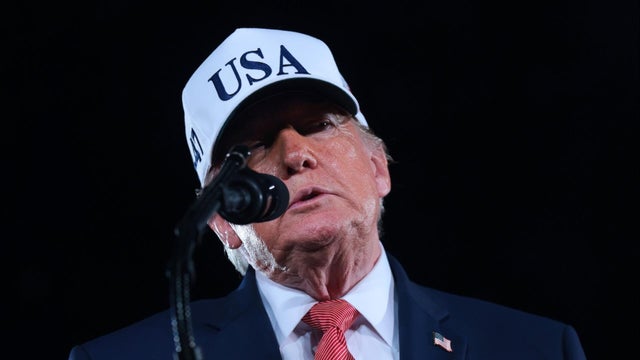
They want very much to make a deal. So far, they haven't gotten there. We're not satisfied with it. But we will be. We will be. Either that or we'll have to just finish the job. They're negotiating on fumes, but we'll see what happens.
LINDSEY REISER:
00:00:34
The president said he doesn't feel pressure to strike a deal before voters head to the polls in November for the midterms.
DONALD TRUMP:
00:00:40
They thought they were going to outwait me. We'll outwait him. He's got the midterms. I don't care about the midterms. People understand it. They know that-- very simple-- Iran cannot have a nuclear weapon.
LINDSEY REISER:
00:00:50
We have team coverage. CBS News correspondent Natalie Brand is at the White House. CBS News senior national security correspondent Charlie D'Agata is at our Washington, DC Bureau. So, Natalie, let's start with you. What does the president need to see in a deal with Iran in order to be satisfied? Hi, Lindsey. Well, President Trump, in the cabinet meeting today, really emphasized that the number one goal remains making sure Iran does not get a nuclear weapon. We know that's been a priority in these negotiations, as well as immediately reopening the Strait of Hormuz without restrictions. And the president, when pressed today, said he would not accept a deal in which Iran, or anyone else, controls any part of the Strait, saying that this is an international waterway, that no one can control it. There have been reports that Iran and Oman have been talking about potentially charging tolls. The other key aspect in the principles of a possible deal that began to emerge over the weekend is making sure that Iran agrees to get rid of its stockpile of enriched uranium. The president asked today by reporters, would he be comfortable with, say, Russia or China getting that enriched uranium, given Iran's relationship with those countries? And he said no. The president also said he did not launch this operation for a, quote, "crummy agreement." And the Secretary of State, Marco Rubio, said that while diplomacy is the preference here, there are other options if these talks don't work out, Lindsey. How is the president responding to voters' concerns? Yeah, the president was asked if he feels urgency because of the economic concerns and fallout, and he says he feels urgency, again, to make sure Iran doesn't get a nuclear weapon. He's continued to downplay those economic concerns, arguing today that the US produces a lot of energy and that gas prices will drop immediately following this conflict, even, Lindsey, as you know energy analysts have said it could take months or up to a year for gas prices to return to pre-war levels once the strait reopens.
LINDSEY REISER:
00:03:04
Natalie Brand, thank you. Let's go now to CBS News senior national security correspondent Charlie D'Agata. So the president said today, Charlie, he may resume strikes on Iran to, quote, "finish it." What options does he have? Multiple options, Lindsey. Natalie just talked about reopening the Strait of Hormuz. That could be done by force. And that is part of what the US military calls a strike package, so taking out targets and trying to reopen that by force. That is not going to be easy. In addition, they have target proposals of taking out some of Iran's energy infrastructure and energy grid and going after what might be called civilian targets, bridges, electricity, water, et cetera, in order to make the Iranians suffer. We have to also continue to remind our viewers, this wouldn't just be US, Iran. Israel would be part of this more likely than not if this were to restart the hostilities. The Israelis were responsible for targeting the Iranian regime, the United States largely for targeting Iran's military infrastructure. So when I spoke to US military commanders about where they are in terms of readiness, in terms of the US military assets in the region, the USS Abraham Lincoln and the carrier strike group with something like 12 guided missile destroyers and cruisers, they are still in that region, part of that blockade. They are able to strike Iran and Iranian targets. So back in February, when they would have gamed out how this was going to play out, they would have had a number of military targets inside Iran looking at the Strait of Hormuz, looking at Kharg Island, looking at Iran's oil and energy infrastructure, looking at potential civilian targets. Remember, they took out the largest bridge in Iran. Those were US airstrikes. So that is all on the table. And when I speak to the US military, which I did again today and throughout the weekend, in terms of their readiness, if these talks fail, are you ready? And they said, not in 24 hours, whenever they say so. And that's where they are right now. And those sorties are taking place. It was just on Monday-- sorry, Sunday morning that we learned that there had been strikes, US military strikes against Iran. They took out a couple of boats that were laying mines in the Strait of Hormuz. And when the aircraft went in to take out those boats-- there were two Iranian boats-- they were targeted. At least they got a signal from missile launchers, and they struck those two. So the ceasefire is in place. But there have been these sort of breaches in the ceasefire, if you will, in the past few weeks.
LINDSEY REISER:
00:05:35
OK, Charlie D'Agata, thank you. Thank you.