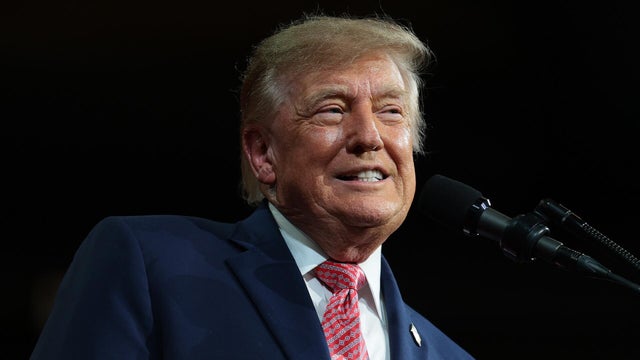
DONALD TRUMP:
00:00:11
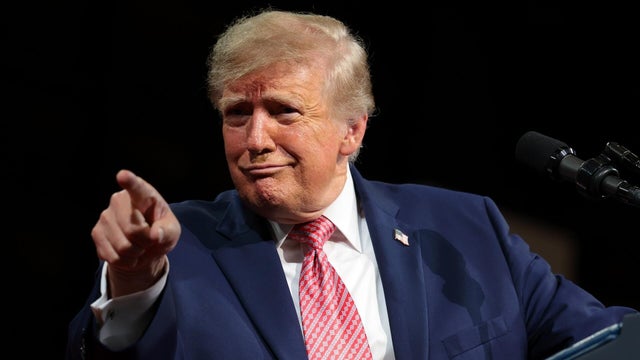
These people were brought to our country to vote, and they vote illegally. And amazing that the Republicans aren't tougher on it. The Republicans should say, we want to take over. We should take over the voting-- the voting-- in at least many-- 15 places, the Republicans ought to nationalize the voting. OK. I want to bring in CBS News White House reporter, Aaron Navarro. Aaron, what are we hearing from the President about elections? And how are fellow Republicans responding to this? Liz, I'll note that President Trump is in the Oval Office right now to sign the government, or partial Government Funding Bill. So we may hear him take questions on that. But we did see White House press Secretary, Karoline Leavitt, take questions on this, where she said that President Trump, when he talked about nationalizing the elections, was referring to the SAVE Act in Congress. That's a Republican bill that requires proof of US citizenship when registering to vote in federal elections. Here's what Leavitt told reporters earlier today. What the President was referring to is the SAVE Act, which is a huge, commonsense piece of legislation that Republicans have supported, that President Trump is committed to signing into law during his term. And he spoke with the Speaker directly about that yesterday, about the need to get that bill on the floor for a vote, because it provides very common sense measures for voting in our country, such as voter ID. Trump has specifically mentioned he wants his party to federalize elections in 15 states, in particular. And Leavitt, when asked about that, said Democrat states with alleged fraud, such as California and New York, are on that list. But others on that list of 15 states who do not have photo ID requirements for voters does include crucial battleground states for these November midterm elections, such as Nevada and Pennsylvania. In terms of the Congressional response from Republicans, House Speaker, Mike Johnson, said he had not spoken with Trump yet on this, and said the general system and the constitution of states controlling their own elections works well, and that Republicans do have quote, "Real concerns about how Democratic states administer their elections." He referenced the SAVE Act that Karoline Leavitt mentioned as a key solution, though, that remains stuck in the Senate. And Aaron, President Trump hosted the President of Colombia at the White House earlier today. What do we know about that discussion? The White House and Leavitt said that Trump was, quote, "positive headspace" before that meeting, but we do not yet have a full readout on the meeting itself from the White House from Trump's side. Though, pictures were shared indicating it was a decent meeting, including one where Petro got a note from Trump saying it was a quote, "Great honor, and that he loves Colombia." Petro had also told the radio station that him and Trump talked about the possibility of exporting Venezuelan gas through Colombia, as well as the larger fight against drug trafficking. But it's really notable that they seem to have a pretty cordial meeting, because leading up to this, they have traded some harsh actions and rhetoric. Trump has insinuated that Petro and Colombia are directly responsible for drug trafficking in Central America. He's revoked Petro's visa, and Trump has threatened to apply the same pressure on Petro as the US did with Maduro in Venezuela. Petro has denied his role in drug trafficking, and tried to fight back against Trump's deportation program before tariffs and sanctions were threatened. And Petro has also spoken out against the strikes of alleged drug vessels in the Caribbean, which did lead to US sanctions of Petro and allies. But things started to change earlier this year, days after the capture of Maduro, where both men posted about a call they had where they came away feeling good about it. And so far, and what we've heard from the meeting today, it was a similar kind of truce between the two world leaders. Aaron Navarro, thank you so much.