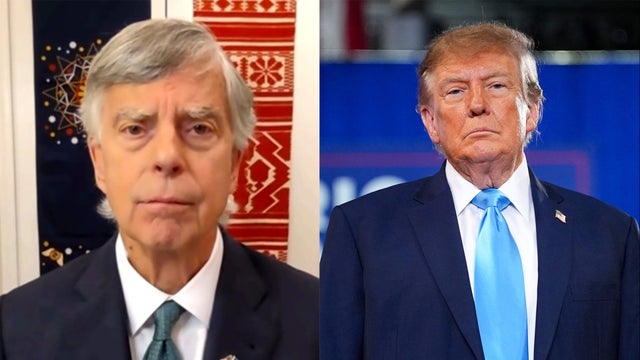
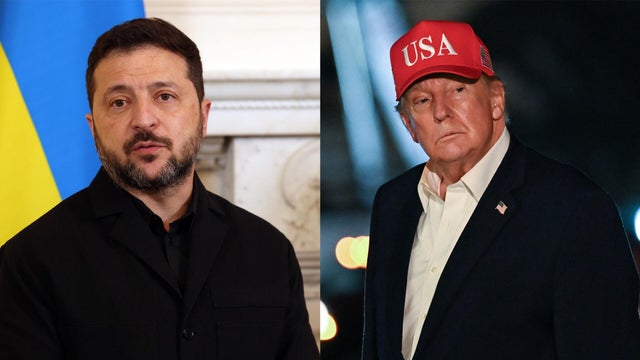
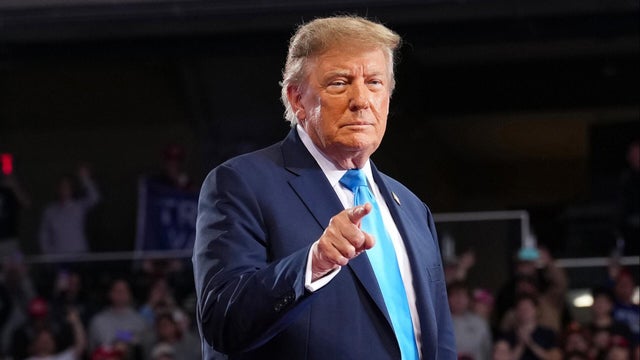
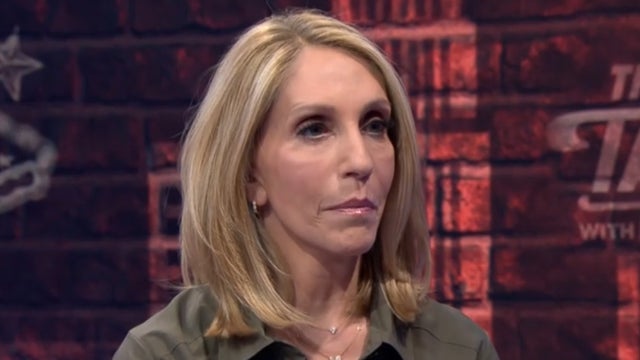
DONALD TRUMP:
00:02:56
I get along with him. And you know what? The fact that I get along with him, that's a good thing, not a bad thing. He has 57 very powerful nuclear weapons. Should have never allowed it to happen. They should have never allowed it. Now, South Korea's defense minister said he believes that number is closer to 80 to 120 weapons. But this announcement from the president also comes after he said that the US will scale back the number of US forces participating in joint military drills with South Korea. He also shared a couple of pictures of him and Kim Jong Un on Truth Social over the weekend.
VLADIMIR DUTHIERS:
00:03:30
All right, Aaron, thank you very much. Appreciate it.
KELLY O'GRADY:
00:03:33
For more on this, we're joined now by CBS News National Security Analyst Aaron McClain. He's also the host of the School of Warpodcast. So good to see you, Aaron. So I want to stay on this topic of North Korea. I mean, the president met with North Korea's leader three times in his first term. Didn't achieve a substantive result on denuclearization. Do you think Pyongyang would be able to get to something here? They'd be willing to play ball this time around? In terms of meaningful denuclearization, I think the short answer is it's very unlikely. The longer answer is that the president looks back on his diplomacy with North Korea in the first term with a good deal of nostalgia. I think it's easy to forget how close we were to war with North Korea in 2017 and 2018. Those are the days of fire and fury and very intense rhetoric. That then resolved in a series of meetings and exchanges, warm feelings, a lot of good visuals. I think President Trump naturally looks to moments like that kind of as the sort of thing he hopes would happen with Iran, but he's being denied that sort of outcome on Iran, substance free, essentially, as it was back with North Korea, and he'd like to kind of get the band back together again. So this all comes after the US and South Korea agreed to cut short their joint military exercises at the president's direction, simply because the South Koreans do not want to be entangled in this war of choice with Iran that the United States is now involved in. But I guess the question is, what is the larger message that this sends the region, and what implication could it have? Yeah, the US-South Korea relationship is very complicated, and one of the strange twists here is that the South Korean government at this moment is actually pretty dovish towards Pyongyang. So the South Korean government on its own has taken steps to reduce tensions with the North, but that hasn't prevented the introduction of this major tension between the United States and South Korea since the president's social-media message on Sunday. We still don't know, by the way, what actually sparked that message. Was it a desire-- this was the post, of course, where he announced the reduction of American participation in the exercise. Was it the president simply trying to change the subject? Was it, we might speculate, some consequence of talks with the North Koreans that are already occurring on some level? Was it something that happened in the US-South Korea relationship that upset the White House? We don't know the answer to that question. This did come out of nowhere. And as ever, it shows that the president is very flexible on his approach to allies. They can't really rely on us as much from him as they would from others. And, Aaron, you probably heard the other Aaron talking about this. The president, when we're talking about Iran, has announced a, quote, "crushing economic operation," calling it-- [COUGH]-- an economic D-Day. Swallowed wrong there. What do you think this means? Because we've heard this before. We know that Iran is under economic pressure, and they don't seem to have really bent the knee, if you will. Yeah, the double-barreled Aaron is always a good way to start the hour, guys. This comes down to the leverage that the United States potentially has on other countries that do business with Iran. We can always go to them and say, look, you have to choose. You do more business with Iran, or you do business with the United States. And so there's any number of ways in which that can play out in terms of sanctions, in terms of tariffs, in terms of punitive measures. But as Aaron Navarro pointed out, when it comes to China, such an approach involves pain here in the United States, an economic cost to us. So the question following the president's social-media message is, how far does he, in practice, intend to go in terms of operationalizing this? The more pain he's willing to assume and the more pain introduced into these economic relationships with countries like China, he can impose meaningful costs on the Iranians. The problem he faces there is that economic warfare is a long game. This is not, even in its most aggressive iterations, not going to be a matter of days and weeks. This is months and months and potentially more. And we keep spending, and our own national debt continues to increase. Keeps rise.
KELLY O'GRADY:
00:07:25
All right, Aaron, thank you so much for your time.