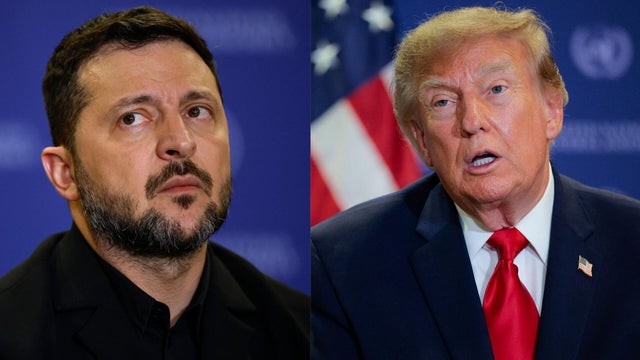
PETE HEGSETH:
00:00:58
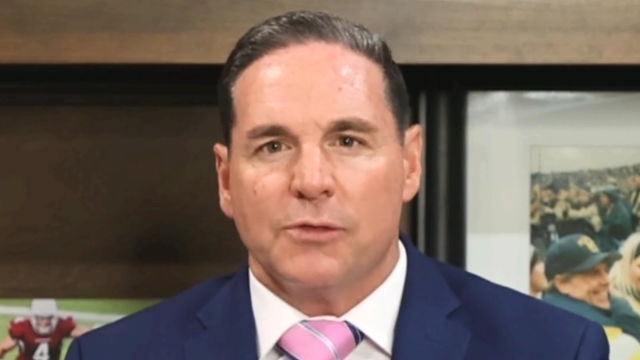
The mission of Operation Epic Fury is laser-focused. Destroy Iranian offensive missiles, destroy Iranian missile production, destroy their navy and other security infrastructure. And they will never have nuclear weapons. We're hitting them surgically, overwhelmingly, and unapologetically. We didn't start this war. But under President Trump, we are finishing it. If you kill Americans, if you threaten Americans anywhere on Earth, we will hunt you down without apology and without hesitation. And we will kill you.
ADRIANA DIAZ:
00:01:33
For more on this, CBS News correspondent Natalie Brand is at the White House. Natalie, thank you so much for joining us. Break down what the rationale has been presented as for these strikes. The Secretary said Iran was holding a gun to our heads. Explain this rationale. Yeah, we got a little bit of it from President Trump, who had released two pre-recorded video messages over the weekend in which he said the objective is to, quote, "eliminate imminent threats from the Iranian regime." And he went on to talk about 50 years of threats and deadly attacks from Iran and its proxies. And he in that video statement, as well as Hegseth today, also talked about diplomacy not really moving forward in the way that this administration had wanted to. Keep in mind that we had negotiations late last week. Technical talks were scheduled for today in Vienna to begin with the UN nuclear watchdog. But President Trump on Friday signaled he was just not happy with the way those negotiations were going. Secretary Hegseth expanded upon that today. Let's take a listen to that portion of his remarks.
PETE HEGSETH:
00:02:48
The former regime had every chance to make a peaceful and sensible deal, but Tehran was not negotiating. They were stalling, buying time to reload their missile stockpiles and restart their nuclear ambitions. Their goal-- hold us hostage, threatening to strike our forces. Well, President Trump doesn't play those games. And as Secretary Rubio said after the Maduro raid, "If you don't know, now you know." We also know that the administration has been extremely concerned with Iran's ballistic missile program. That's also something that Israel has made a case for to the United States, and that the talks that had been going on were focused on nuclear, not necessarily the ballistic missiles. The president, in his video message, accused Iran of developing long range missiles that can threaten allies in Europe, troops overseas, and could one day reach the American homeland. Now note, there is a Defense Intelligence Agency assessment from last year that said Iran could develop a long-range missile by 2035 if it chooses to pursue it. So critics in Congress are questioning this idea of an imminent threat. That's something that President Trump and his top military leaders will have to continue to explain. Another notable takeaway from that news conference is we don't have a timeline of how long this will go on. President Trump in an interview, a phone call, over the weekend with the Daily Mail suggested it could go on for four weeks or so. Secretary Hegseth didn't want to answer questions about that timeline, kind of deflected, and said that it will go on until they achieve the mission. We know additional forces are on the way. Secretary Hegseth and the Chairman of the Joint Chiefs, Dan Caine, also paying tribute today to the four US service members who have been killed in this operation since it began. And General Caine warning, "We expect to take additional losses." He says the US will work to minimize that, but that this is major combat, Adriana.
ADRIANA DIAZ:
00:05:04
Natalie, the information coming from the White House has been doing so a bit untraditionally. The president has been speaking to individual news outlets over the weekend. He spoke to our Bob Costa this weekend. But he hasn't held a full briefing like most presidents typically do after a military action like this. Do you have any sense of why that might be? We don't really have any insight into the strategy there. This Pentagon news briefing was the first time we heard from top military leaders who took some questions from reporters in the room. We're waiting to hear from President Trump today. But it's also notable that those pre-recorded video messages that went out on Saturday and Sunday did not have the pool reporters in the room, either. They just simply were recorded and then released. And then the president having a number of phone calls, as you noted, including with CBS News's Bob Costa, but at times giving different information in each one. For instance, he told Bob Costa that there were some potential good candidates to take over in Iran following the supreme leader's death. But he then told ABC News's Jon Karl that some of those candidates were killed in the operation. Obviously, this is a fast moving situation. There's a lot of different information. But it is notable that we're getting bits and pieces across these various interviews with outlets.
ADRIANA DIAZ:
00:06:32
All right, Natalie, thank you so much. Let's go to our senior national security correspondent, Charlie D'Agata, who is live in Tel Aviv. Charlie, thanks so much for joining us. What are we learning? What stood out for you and filled in the blanks about how these operations were conducted? Yeah, Adriana, we learned a lot about it because that's what all the questions have been about. I've been here for a week waiting for what was about to unfold. And we heard from the Joint Chiefs of Staff General Caine-- "Raizin Caine" as President Trump likes to call him, exactly about the tick tock who he called H-Hour in the same way that the military calls D-Day. And it was an execution where the first wave of attacks was launched using Tomahawk cruise missiles. That's kind of a big deal, because we think the idea of maybe airstrikes were involved. Tomahawk cruise missiles are launched from destroyers in the Gulf, or in the region. He talked about the USS Gerald R Ford that we've been talking about that needed to be in place. The USS Abraham Lincoln needed to be in place. He talked about long range bombers. And all of this was coordinated at the same time. The launch was pre-dawn, but the execution was after dawn in working with the Israeli military and fighter jets there in order to work around deconfliction. And the reason I mention all of that, about the nature of that first wave of attack, is that this had been weeks, months, years in the planning for target acquisition, figuring out what they wanted to bomb, what they were going to hand over to the Israelis, how it was going to be executed. And this is very vital and very important how the United States was prepared for the retaliation. Here's a bit more of what he had to say.
DAN CAINE:
00:08:07
More than 100 aircraft launched from land, sea, fighters, tankers, airborne early warning, electronic attack, bombers from the States, and unmanned platforms, forming a single synchronized wave. This was a daylight strike based on a trigger event conducted by the Israeli Defense Forces, enabled by the US intelligence community. The first shooters at sea were Tomahawks unleashed by the United States navy, closed in on Iranian naval forces, and began to conduct strikes across the southern flank in Iran. On the ground, forces fired precision standoff weapons-- measured, deliberate, precise, and lethal. This was a massive, overwhelming attack across all domains of warfare, striking more than 1,000 targets in the first 24 hours. 1,000 targets in the first 24 hours. And that would have been trying to cripple Iran's capability of launching counterattacks. He also paid condolences to four US service members who were killed in Kuwait, and he also warned there would be more. As far as the timeline, one thing he pointed out in his words, this is not an overnight attack. It's not what we saw in Operation Midnight Hammer back in June, so they are expecting this to go on for some time and expecting Iran to retaliate, and expecting, sadly, that there may be more US casualties. Adriana?
ADRIANA DIAZ:
00:09:36
So, Charlie, given that this is not going to be an overnight attack, and the secretary and the general both said that we are going to be in this as long as it takes, what about the Iranian side. How much reserves do they have? How strong is their military? How resolute is the Revolutionary Guard? Or are there cracks there that we can take advantage? And how much has their missile stockpile been impacted? Adriana, that is a key question. And it was asked during that press conference with Defense Secretary Pete Hegseth and General Caine. They didn't answer it, partly because they said Bradley Cooper, who is the Admiral in charge of Central Command-- that's the area of responsibility, this is where this is all being unfolded in the Middle East. He hasn't had the opportunity to do a battle damage assessment. And the unknown factor here, or whether they know it or not-- they're not sharing it with us, is when you talk about Iran's capability to strike back, they were expecting-- intelligence officials here told me, and people in the United States. They were expecting more of an ultimate barrage from the Iranians. It was expected that they had between 1,800 or 2,000 missiles-- short range, medium range, to attack here in Israel. And goodness knows, we've probably had 20 air raid sirens and incoming throughout the past 24 hours alone just here in Israel. But we talk about Kuwait, which has come under attack, all this friendly fire, took out the F-15s, Kuwaiti defenses it looks like-- the first US forces. Kuwait is very close to Iran. It doesn't take a long-range missile to fire on US targets there. We have Al Udeid, which has come under attack, Bahrain, which has come under attack, other soft targets-- civilian targets, these resorts throughout the UAE, in Dubai, and Doha. But I think most analysts would agree-- and I'm not depending on that. But Iran has not fired what it's got, or in the wholesale way that they've done it. At the same time, the United States is doing everything they can and the Israelis to target where those missiles are-- and especially when it comes to the mobile missile launchers, to make sure they can continue to go after Iran's missile capabilities.
ADRIANA DIAZ:
00:11:52
All right. Charlie D'Agata in Tel Aviv with all of the late-breaking news. Charlie, thank you and your team so much. Stay safe. Reza Pahlavi, the son of the late ousted Shah, and the man some Iranians want to lead their country, praised President Trump for what he called an intervention in Iran. Here's what he told 60 Minutes.
REZA PAHLAVI:
00:12:11
My message to President Trump is that I'm here to echo and join millions of my compatriots inside and outside of Iran, to thank him for having done and having the courage to do what is not easy, but intervene.
ADRIANA DIAZ:
00:12:26
Let's turn now to CBS News foreign correspondent Ramy Inocencio, who is tracking developments from a British Air Force base in England. Ramy, we're hearing praise for the president from Pahlavi. But how are US allies in Europe responding? Yes, Adriana, we are seeing the first steps of Western allies of the United States ante up, basically, in order to help support the US operation in Iran. For example, today, the reason why we're here outside the Royal Air Force station Fairford is because overnight, Prime Minister Keir Starmer gave the green light for the United States to use military bases here in order to stage a strategic missile targeting of Iran over the next foreseeable future. In particular, Fairford here is the only site in all of Europe that can actually handle B-52 bombers, B-2 bombers, and B-1 bombers because of the length of that runway behind me, nearly 10,000 feet. That's nearly 2 miles in length. And also, the strength of the runway can handle such heavy loads. In addition, we're also hearing that France has said that it will defend its interests in the Gulf states, along with Jordan. There are roughly an estimated 400,000 French citizens in and around those countries. And earlier this morning I spoke to an Iran expert, Sanam Vakil, at Chatham House. And she said that we should expect even more European countries to follow. Take a listen.
SANAM VAKIL:
00:13:59
I think it was inevitable that the UK would enter this war one way or another. The longer this war continues, I see more of American-European cooperation emerge. That also is inevitable to me. The worst case scenario-- and this must be said out loud, I think, for Europe is very vague, and perhaps unachievable, is the so-called regime change option. And no one is-- well, many people are not crying over the death of the Ayatollah. And a lot of people, a lot of supporters here in Western countries say that they will support the United States, will support President Trump. Germany also just having said that it will also defend its interests. You and our other colleagues in the London Bureau have done extensive reporting, talking to Iranians in Tehran throughout the past weeks and months. Who do Iranians want to lead their country? Yes, the people who are speaking out, Adriana, are vocally calling for Reza Pahlavi, the son of the ousted Shah. To be sure, this is a vocal community, but not an absolute voice here, because Iran has a population of about 90 million people. But again, the people around the world in the Iranian diaspora who have left Iran, who live in London, who live across Europe, who live in Los Angeles, in Vancouver, they are very happy, very joyful about the chances that the son of the former Shah may take some leadership position. I spoke to some demonstrators yesterday here in London. London is home to the biggest Iranian diaspora community in all of Europe. And one person minced no words in how she felt about the death of the Shah. Take a listen. The Ayatollah is dead. How do you feel. Amazing. We are so happy. We are so happy. Happiness-- moment for Iranians. He's been the head of the terrorists of whole world.
RAMY INOCENCIO:
00:16:10
In the ayatollah's last breaths on this Earth, what would you like to have told him. Go to hell. Yeah. Go to hell. And that sentiment is shared by the people that I have been able to reach out to in Iran by voice, as well as by text. One person at that protest just now told me that he also wanted even more bombs from the US to fall on his country. Adriana.
ADRIANA DIAZ:
00:16:40
All right, Ramy. Thank you so much.