CHUCK GRASSLEY:
00:00:11
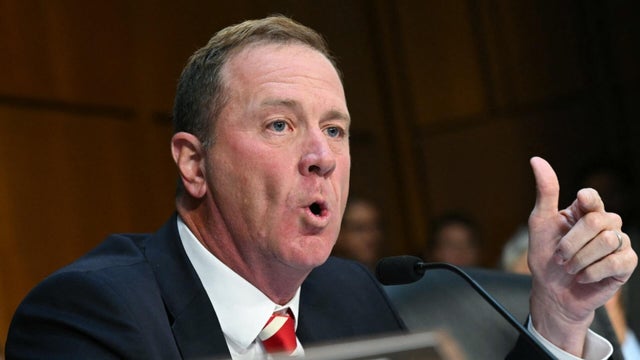
Please be seated, and you can give your statement now. Thank you. Good morning, Mr. Chairman, Ranking Member Durbin, and members of the committee. It's an honor to be here with you today as the ninth director of the FBI. I want to provide by providing a briefing into the tragic assassination of Charlie Kirk. It's important that this FBI is transparent as possible without jeopardizing investigations. Charlie Kirk was shot at 12:23 AM-- excuse me, PM, on September 10. I think this timeline is critically important. Less than a day later, the FBI, at my direction, released the first set of images of the suspect that we captured based on our analysis on the ground. Later that evening, while conducting extensive interviews and cell-phone analysis and also flying out evidence response teams and hostage rescue teams and evidence technicians who were collecting evidence in live time and flying them back to Washington, DC, and our laboratories for immediate analysis, we were able to extract video from the campus feed. And at my direction at 8:00 PM, in partnership and promise to working with the public to bring this fugitive to justice, we released a newly, never-before-seen video of the suspect. We also released new, enhanced photos of the suspect. A few hours later, that suspect was in custody, pursuant to the interrogation of the suspect's own father who stated, "When I saw that video that you released, I recognized it was my son, and I confronted him, and he was handed over to lawful law-enforcement authorities." That is the FBI working with the public, as I promised, being transparent, and providing critical information along the way in the manhunt for the suspect or suspects involved in Charlie's assassination. We received over 11,000 tips in the first 24 hours alone. We received 16,000 submissions to our digital media enterprise and tip lines. That is a large number of material to go through. I want to thank President Trump and the attorney general, Pam Bondi, for their unwavering support and commitment of resources to this and all investigations. I also want to especially thank our colleagues in Utah, the governor's office, DPS, and the sheriffs out there. State and local law-enforcement partnership has been a cornerstone since I took over at the FBI, and it was no different here. And our teams in Salt Lake City, our SACs out there, across the country, our lab technicians in Quantico who raced to complete the evidence analysis so the public could have the answers they need, these people worked through the night without sleep for days on end. They are to be commended. They are not to be attacked. And many, many, many more people I don't have time to thank here today, but I do want to thank the American people especially. The mission of the FBI is for them and with them and by, with, and through them, and it's that mission and that ethos that I brought to this investigation and so many others, and that's why that suspect is in custody. We cannot do our job without the American public and credible reporting in the media, and that's why Tyler Robinson is in custody today, about to face charges. The last time I appeared before this committee was in January for my confirmation hearing. I told you then that if I were confirmed, I would provide and do everything I can to provide a safe and secure America. I promise to provide the courageous men and women of the FBI the tools and resources they need to crush violent crime and defend the homeland. I pledge myself to commit to full transparency, oversight, and accountability so we could restore the public's trust in the FBI, and that's exactly what I've done. Under this administration, the FBI has arrested more than 23,000 violent criminals. That's more than twice for the same time period from last year alone-- 23,000, more than twice from the same time period last year. We've taken over 6,000 illegal firearms off the streets. That number is an exponential increase. We've identified and located more than 4,700 child victims. More than 4,700 child victims have been found by this FBI. That is a 35% increase from the same time period last year. 1,500 child predators have been arrested. That's a 5% increase from the same time last year. 300 human traffickers have been arrested. That's a 10% increase from the same time last year. Over 350 members of Tren de Aragua, a foreign terrorist organization, have been arrested, and we have 42 ongoing cases. That is a 250% increase from the same time last year. Those are just some of the things the FBI is doing differently and better because we are leading the mission to crush violent crime and defend the homeland. We have also arrested four-- captured four top-10 fugitives from the FBI's top 10 most wanted list. To put that in perspective, that's the same amount I've captured in seven months than my predecessor did during the entirety of the Biden administration. Those are real results, and the credit is to the men and women at the FBI. We've been able to achieve these results because the FBI recognizes violent crime doesn't just happen in Washington, DC. That's why one of my first decisions as director was to get the people, the Bureau's professional staff, out to the field. And we've done that with great speed, and every single one of your districts and states has received a plus up of FBI personnel, agents, and special operators, to the tune of almost a thousand. We did that because crime had unexpectedly and unacceptably exploded across the country. In fact, one of the stats that the American people should thank the FBI the most for is we are on track to have the lowest murder rate in modern American history, the lowest murder rate by double-digit percentages. A major factor in the drop of this violent crime is the FBI'S flagship Operation Summer Heat. We used this initiative at the direction of the president and the attorney general, surging resources to our major and midmajor cities across America, conducting intelligence-based operations to target the worst of the worst, to target the gangs, to target the transnational organizations, to target the TCOs, and to target the drug-trafficking cartels. And we have taken them out city by city. There's a lot of work left to be done, but we're off to a great start. Just ask the citizens of Seattle, Miami, Memphis, Charlotte, Chicago, and so many more places. Specifically in New Orleans and Nashville alone, there has been an increase in the number of violent-crime arrests by an average of 250% for each of those cities, and there has been a drastic reduction in crime across the board in midmajor cities across this country thanks to the men and women of the FBI. How are we doing that? We are attacking the drug epidemic. We've seized nearly a thousand kilograms of meth and cocaine off the streets of America. We've taken over 1,600 kilograms of fentanyl off the streets. Maybe one of the greatest achievements we have this year, 1,600 kilograms of fentanyl. That's a 25% increase from the same time last year. To put things in perspective, that's enough fentanyl to kill a third of the American populace, 115 million Americans. We're also going after the companies that manufacture these precursors overseas in places like mainland China and their cutting agents. In fact, this month in Cincinnati, we announced groundbreaking charges aimed at the individuals and businesses responsible for flooding these opioids and their precursors and cutting agents into the streets of America. And for the first time that I can remember, we are charging these businesses and enterprises not just in America but in mainland China, and seizing their operational necessity to have money by seizing their cryptocurrency wallets. We're also equally important to protecting the homeland. We know we have a no-fail mission. We're committed to keeping our nation safe from terrorism, cyberattacks, and foreign adversaries, whether stopping threats inspired by foreign terrorist organizations or lone-wolf actors or sponsored by hostile nation states. This year, we've already made nearly 60 counterintelligence arrests. 60 counterintelligence arrests this year alone is a 30% increase from the same time period last year for the CI work at the FBI. I'm proud when we can share our successes, such as when an espionage charge was brought against an active-duty US Navy sailor caught spying for the People's Republic of China. But I want the American people to know the FBI is protecting the homeland from foreign adversaries in a way that will never make the news, and a lot of the good work that they do will never be able to discuss it in this setting. We're working on cyberthreats. We're attacking malware infrastructure, going after ransomware attackers, delivering a new partnership with the private-public sector engagements we've taken with the companies who are attacked by these foreign adversaries and nation-state actors and individual enterprise rings from around the world. We are combating Salt Typhoon, Volt, Typhoon, Flax Typhoon, and so many other ransomware and cyber threats this nation faces. We're also arresting people such as a Tajik national in Brooklyn who is suspected of sending tens of thousands of dollars to support ISIS. We're going after the new form of what I refer to as modern-day terrorism in America, 764 crimes that involve harming our children by going after them online, causing self-mutilation, suicide, sexual abuse, and steering them in the wrong direction. Currently, we have 3,500 international terrorism investigations. Specifically, we have, in this country, 1,700 domestic terrorism investigations, a large chunk of which are Nihilistic Violent Extremism, NVE, those who engage in violent acts motivated by a deep hatred of society, whatever that justification they see them as. The FBI has seen a 300% increase in cases opened this year alone versus the same time last year. In the last couple of months, the FBI secured a guilty plea for a man in Tennessee who attacked an energy facility with drones and explosives. We secured the indictment of a violent Sinaloa cartel faction leader in Chicago on narcoterrorism charges. Our folks in San Francisco-- excuse me, Sacramento, collaborated with domestic and international partners to secure a guilty plea for a leader of a transnational terrorist organization who solicited the murder of federal officials. But the Bureau's job is not done. I'm committed to this transparency. Mr. Chairman, you alluded to our work with Congress. To date, in the seven months that I've been FBI director, we have produced 33,000 pages to the United States Congress-- 33,000 pages. Just to put that in perspective, my predecessor, in his seven-year term, issued 13,000 pages to Congress, and his predecessor in his four-year term issued 3,000 pages to Congress. I've issued 33,000 pages in seven months, and we're going to keep going. I'm dedicated to restoring the trust that the public has and needs in the integrity of the FBI, and it's being done every day by the men and women of the FBI. Now, I know that there's a lot talk about Epstein, and I'm here to testify that the original sin in the Epstein case was the way it was initially brought by Mr. Acosta back in 2006. The original case involved a very limited search warrant or set of search warrants and didn't take as much investigatory material it should have seized. If I were the FBI director then, it wouldn't have happened. The search warrants were limited to small time periods to include 2002 to 2005 and 1997 to 2001. Mr. Acosta allowed Epstein to enter in 2008 to a plea and nonprosecution agreement, which then the courts issued mandates and protective orders legally prohibiting anyone from ever seeing that material ever again without the permission of the court. The nonprosecution agreements also barred future prosecutions for those involved at that time of those individuals. Still, this administration, at the direction of President Trump, has done more to turn over all the credible information we are legally able to do so, and we will continue to work with Congress to achieve that end. Under the direction of the president, we-- excuse me. Thank you for your support for our mission to working to jointly deliver transparency and congressional oversight to the United States. Lastly, I want to close with the president's initiative here in Washington, DC, as an example of what we're doing around the country, and I think our next city is Memphis. 21,000 arrests in DC with our federal partners, a huge decrease in violent crime. 60% decrease in gun crimes in Washington, DC, in the last month. 74% decrease in carjackings in Washington, DC, in the last month. 53% decrease in homicides in Washington, DC, in the last month. The drugs are disappearing. People are freely walking around the states, and we're restoring the nation's capital to its glory. That work is through the interagency process that the FBI is proud to be a part of and the initiative spearheaded by President Trump and the attorney general. And perhaps most notably for investigations, in Washington itself, it was the intelligence that the FBI gathered through our source network here in DC that helped us identify the suspects in the horrific murder of the DC intern, Eric Tarpinian. We were proud to be a part of that investigation. We're proud to put the resources to bear of the FBI. And in closing, Mr. Chairman and members of the committee and Ranking Member Durbin, I'm honored to be the ninth director of the FBI. I'm not going anywhere. If you want to criticize my 16 years of service, please bring it on. Over to you.