3,600 stock trades in 3 months: Breaking down Trump's flurry of investment moves
Washington — President Trump's investment accounts traded between $212 million and $695 million in stocks and other securities over the first three months of the year — an unprecedented sum for a sitting president.
CBS News is presenting the data from the president's most recent financial disclosure in a new interactive dashboard here. It shows that the president's investment accounts made 2,346 purchases and 1,296 sales between Jan. 6 and March 30, 2026. The figures for individual transactions were presented in a range, which is reflected in the wide disparity between the minimum and maximum values of the trades overall.
The sheer volume of the trades, and the timing of certain transactions, has prompted ethics experts and Democrats in Congress to criticize the president for maintaining an active portfolio. Democratic Sen. Elizabeth Warren of Massachusetts has called for an investigation into "potential insider trading." One investment professional, who reviewed the transactions at CBS News' request, said the trades likely reflect a strategy by Mr. Trump's money managers to reduce his tax bill. Another said he had "never seen a strategy out there that would warrant that amount of trading."
The Trump Organization, meanwhile, said neither the president nor his family have any influence over his portfolio, which it said is managed by "independent third-party investment managers."
Trump's stock trades, by the numbers
CBS News extracted and organized the data from the scanned disclosure form, known as an OGE Form 278-T, to produce the fullest picture yet of the thousands of trades on the president's behalf.
Federal officials, including the president, are required under the law to report any securities transactions worth more than $1,000 within 45 days to the Office of Government Ethics, which publishes the reports.
The president's document, which he signed on May 8, includes 3,642 transactions across 1,026 individual firms and funds, with technology giants and popular exchange-traded funds topping the list of the most frequent and highest-volume transactions.
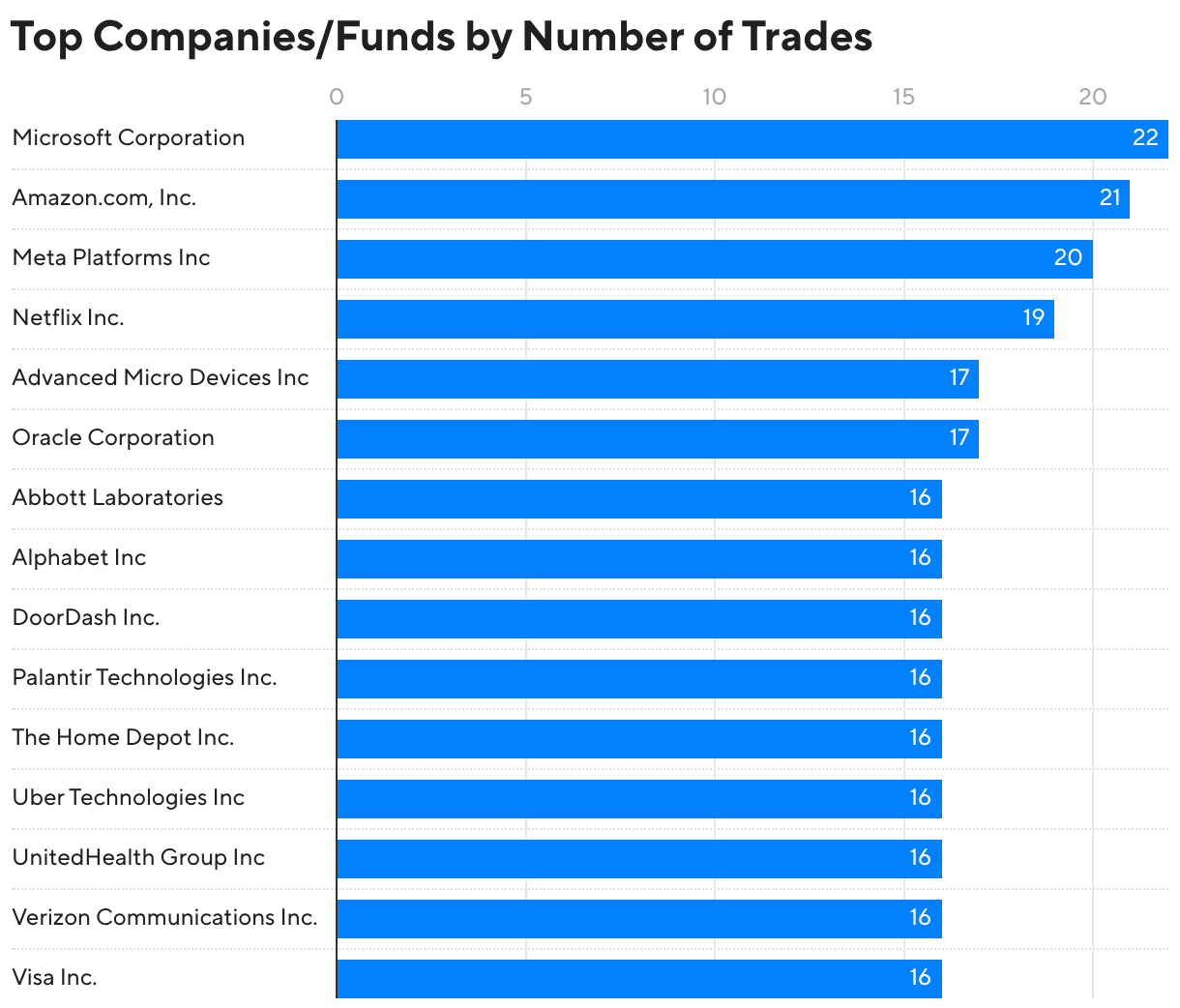
Microsoft, Amazon, Meta, Netflix, Oracle and AMD appeared most frequently in the document, with between 17 and 22 trades each:
The total value of stock purchases was between $126 million and $399 million. Sales totaled between $86 million and $296 million.
The most common transactions were trades valued at between $15,001 and $50,000, with 998 purchases and 393 sales falling in that range. The highest value range — $5,000,001 to $25 million — included four sales of Amazon, Meta, Microsoft and a Vanguard ETF.
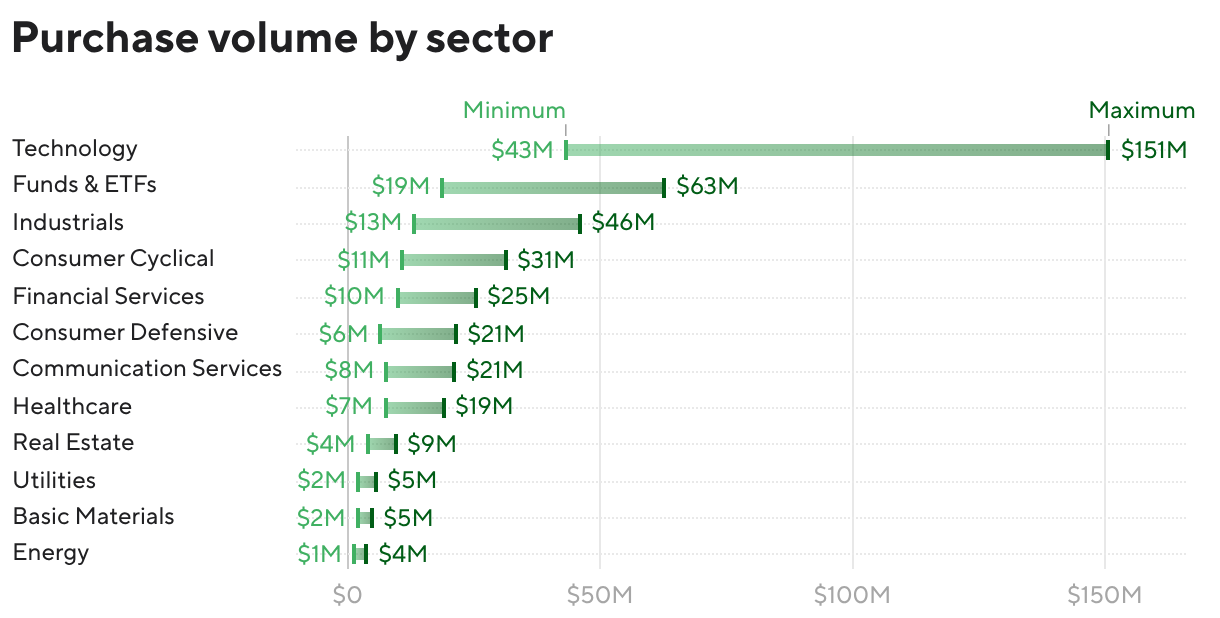
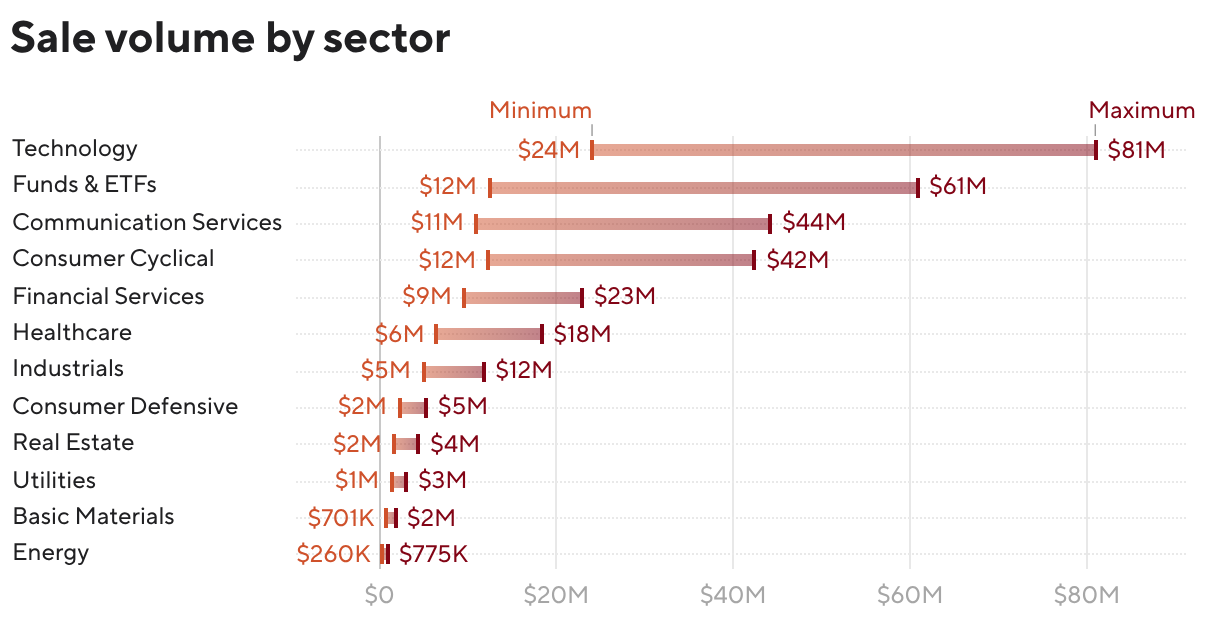
The companies were sorted into 11 sectors using classifications from Yahoo Finance, plus separate categories for ETFs, funds and unclassified transactions. The data shows that technology firms were the most frequently bought-and-sold securities, followed by financial, consumer, industrial and healthcare companies. The transactions involving tech companies included at least $43 million in purchases and $24 million in sales:
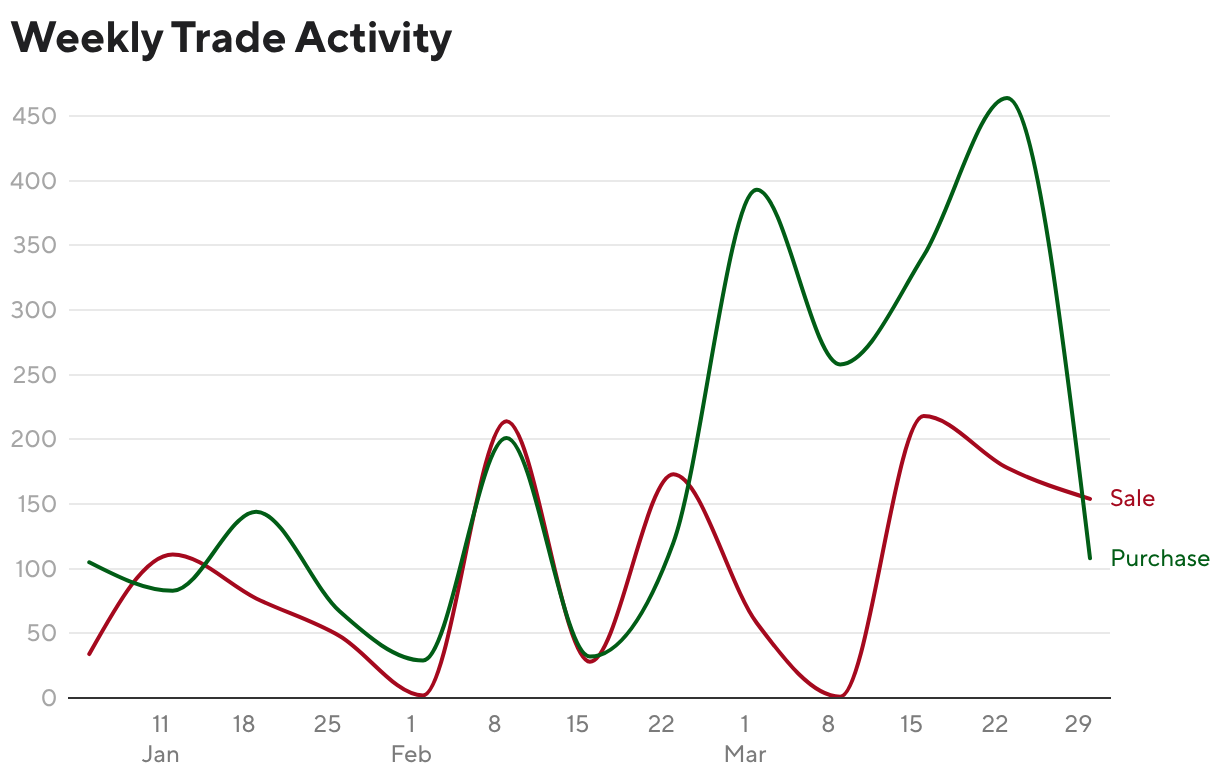
The data reveals several spikes in trades in February and March. On Feb. 10, the president's accounts sold large amounts of Microsoft, Amazon and Meta, with each transaction valued between $5,000,001 and $25,000,000.
Buying increased sharply in March. The accounts made 1,565 purchases in that month, compared to roughly 400 buys in each of the previous two months. On March 23 alone, the accounts made 283 purchases and 17 sales.
The disclosure represents the highest volume of stock trades on the president's behalf since he took office last year. Previous disclosures showed that his investment accounts mainly bought and sold municipal and corporate bonds at a much slower pace. His January disclosure, for example, listed just 191 transactions over the last two months of 2025, compared with the 3,642 transactions in his May filing. (Another filing signed on May 8 also lists 69 other transactions, most of which appear to be bonds.)
Timing of trades
Some of the trades in the latest disclosure preceded policy moves by the administration or public statements about the companies by the president himself, prompting a flurry of headlines about the timing of certain trades shortly after the disclosure form was released in May.
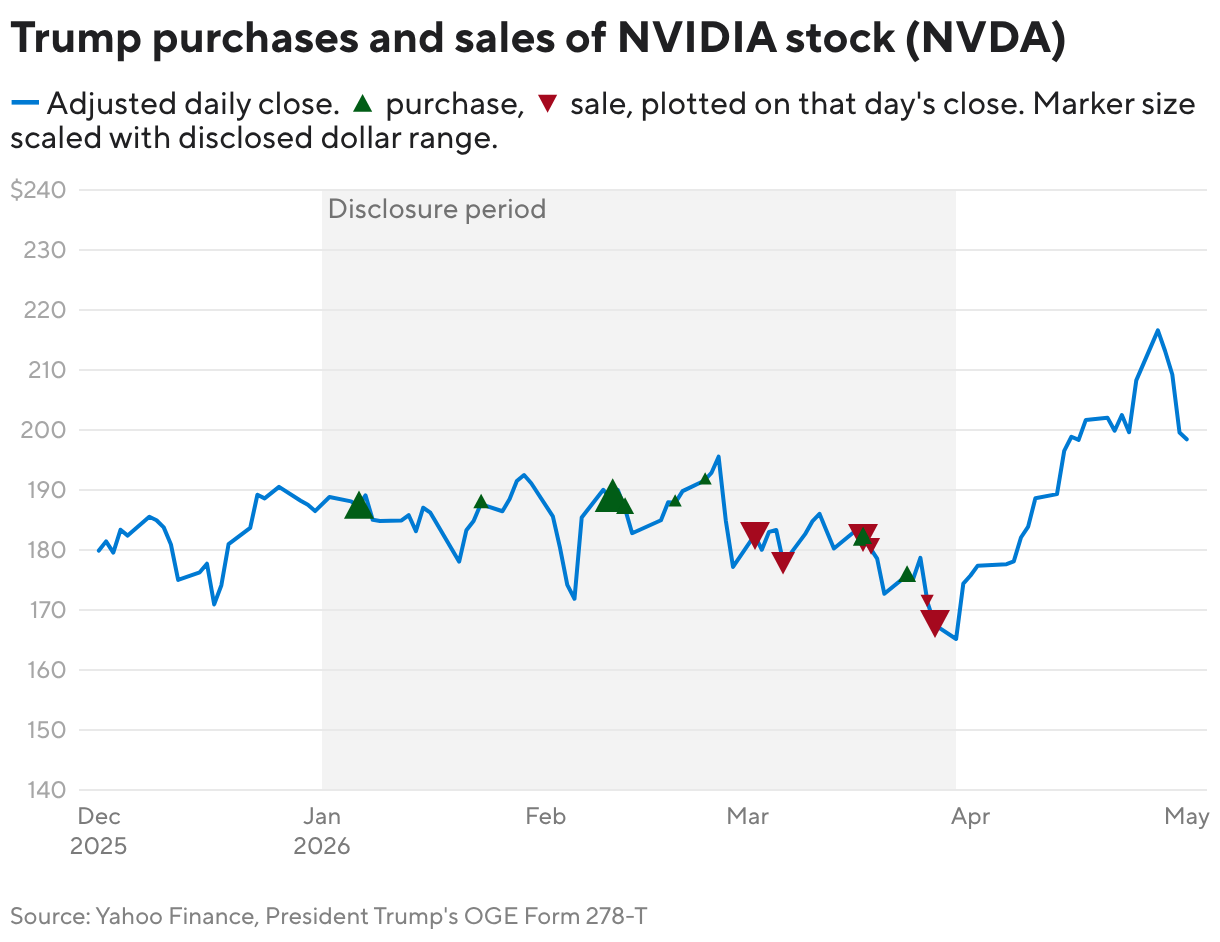
For instance, the president's financial managers bought between $500,001 and $1,000,000 of Nvidia stock on Jan. 6, 2026, the first of a total of 15 transactions — nine purchases and six sales — over the three months covered in the disclosure. The next week, the administration relaxed export controls on Nvidia's highly prized AI chips, clearing the way for the company to sell them to China.
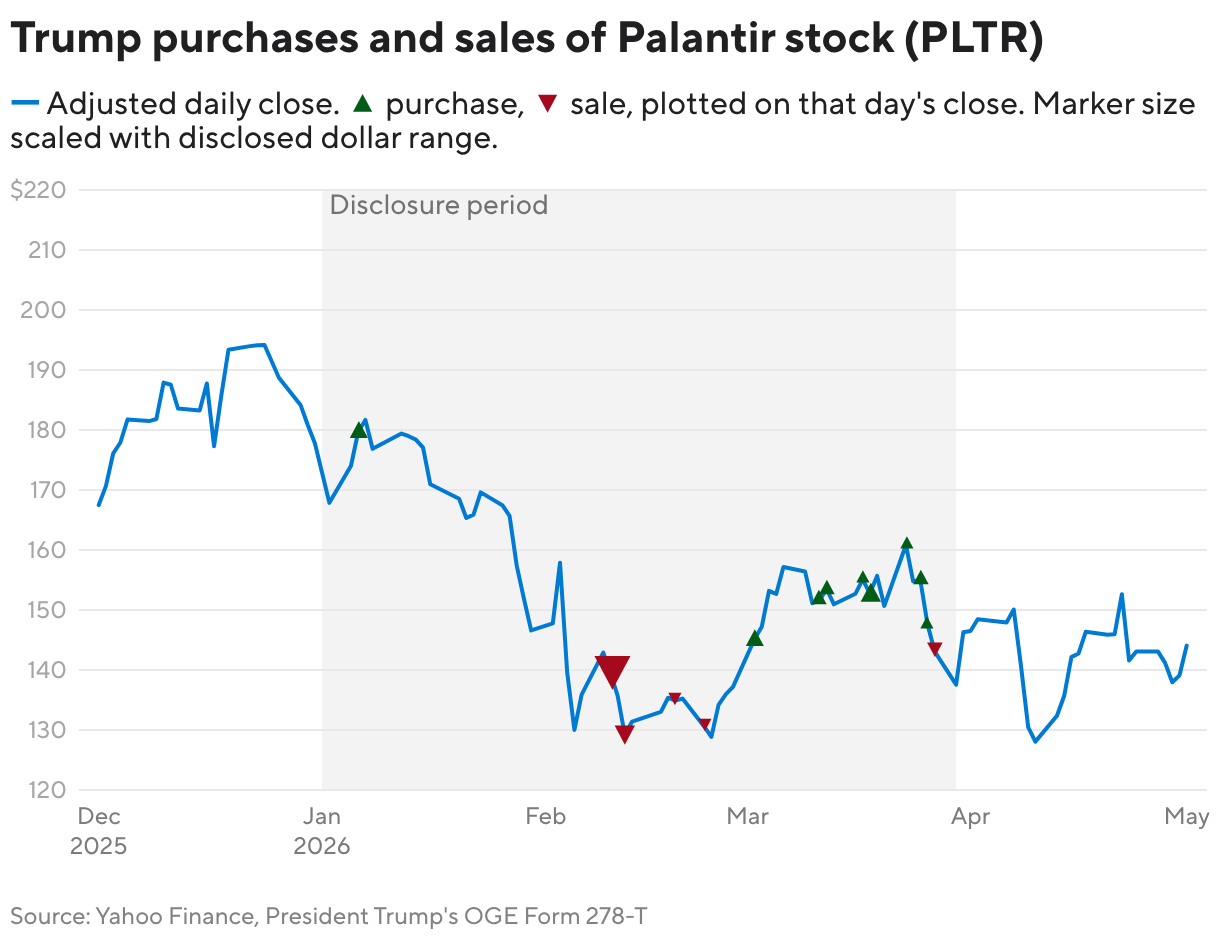
The president's accounts also purchased hundreds of thousands of dollars worth of stock in Palantir, the defense contractor with extensive government business, over the course of March. On April 7, Mr. Trump praised the company in a post on Truth Social that included its stock ticker: "Palantir Technologies (PLTR) has proven to have great war fighting capabilities and equipment. Just ask our enemies!!! President DJT"
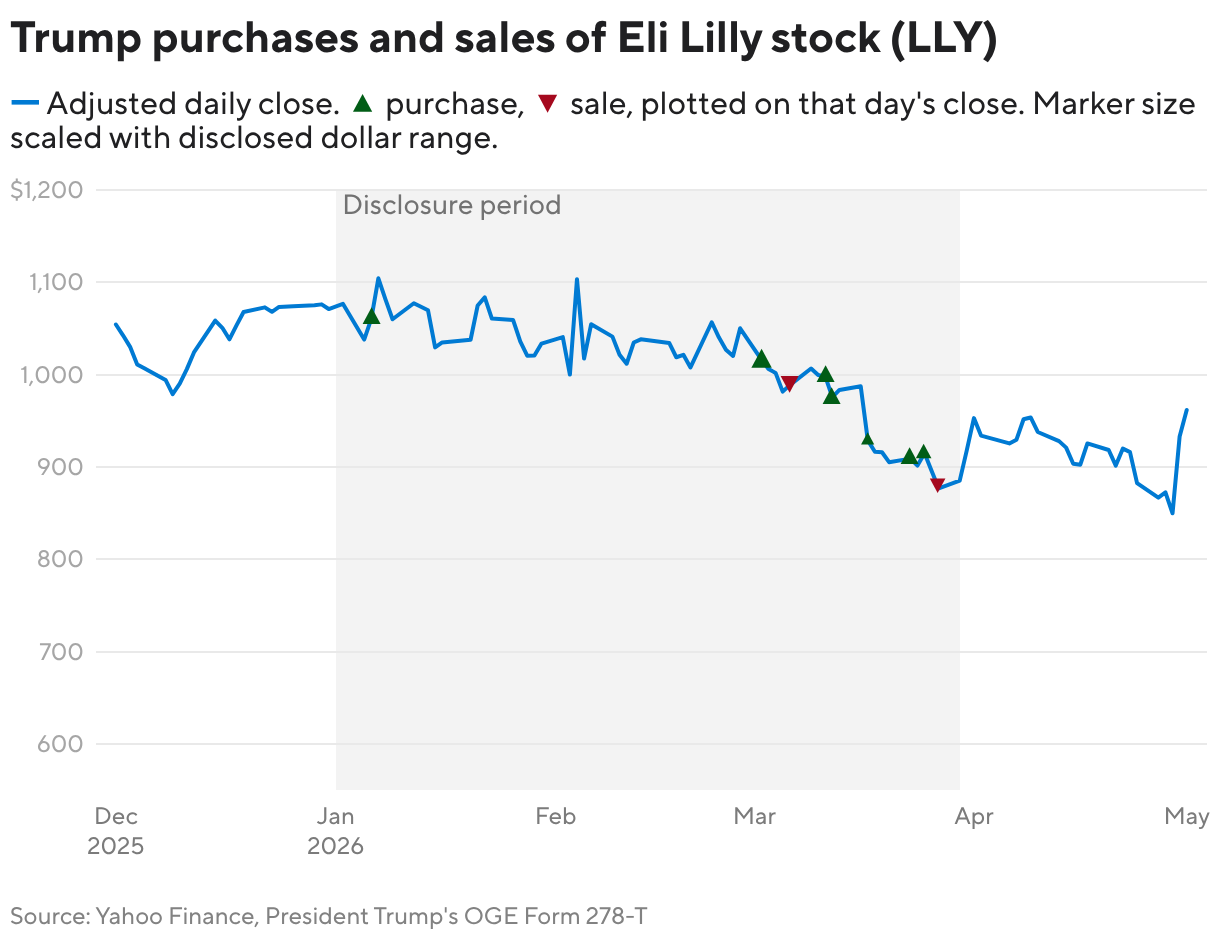
Mr. Trump's accounts also bought stock in drugmaker Eli Lilly, and the timing coincided "with several favorable government decisions benefiting the drugmaker's GLP-1 business," according to KFF Health News. The data shows that Mr. Trump's accounts bought as much as $730,000 in Eli Lilly stock over the first quarter.
Warren, the senator, pointed to the Nvidia trades and other transactions at a recent hearing on Capitol Hill, alleging that the president "is enriching himself by taking advantage of his position." She pressed Treasury Secretary Scott Bessent to open an investigation.
Professional investment managers who reviewed the data for CBS News said the volume of trading makes it hard to discern whether any transactions were prompted by insider information. The data also shows that the accounts bought and sold stakes in Nvidia, Palantir and Eli Lilly at various times, beyond the instances that raised possible suspicions, making it harder to allege that certain transactions were prompted by insider trading.
David Salem, a portfolio manager at Hedgeye Asset Management in Cambridge, Massachusetts, said he believes the trades represent "classic tax-loss harvesting activity," in which investment managers sell some securities at a loss to offset gains elsewhere. Salem said he believes the president's advisers were pursuing a strategy of "direct indexing," or buying and selling individual securities in a way that mimics the composition of large index funds.
"There are actually computers that can automate the whole thing for me. I can program these computers to buy and sell. I can sell and realize the loss, and I can also simultaneously sell something that's up a lot and have the losses on the one that's down offset the taxes that are from the stocks that are up," Salem said.
Salem said the strategy can result in a smaller tax bill over time.
"The manager and managers, plural, who are doing this for Trump are probably doing it for tens of thousands of other customers. You can't do this kind of direct indexing you see in the filing unless you have pretty sophisticated computers, and legal and tax gurus to figure all this out," he said, adding that the strategy is "a service that is available only to high-net-worth or ultra-high-net-worth individuals."
Salem said the spike in activity on March 23, the day with the most purchases, was an indication of the strategy.
"That happened to be the day that the major index providers, S&P 500 and FTSE, did their rebalancing," he said. "If you were following an indexed approach where you were trying to hug a benchmark in a tax-sensitive manner, you would expect to see trades captured by that rebalancing, and we did. That's prima facie proof of tax-loss harvesting."
Salem said he saw no evidence of insider trading, but noted that he "can't prove a negative."
Eric Diton, who has spent the past 40 years as a financial adviser to high-net worth individuals, said he could not explain the volume of the trades.
"I can't come up with a rationale for that amount of trading for anyone. Even if people were trying to pin him for … trading on information, you still wouldn't trade thousands of times. There's not enough information swirling to trade that many times," said Diton, who is president and managing director of the firm the Wealth Alliance.
"It's also tax inefficient. If the goal is maybe to create short-term losses, again, I have not seen a strategy that would warrant that kind of trading, ever," he added. "I build my life on giving advice and giving explanation. I truly can't explain it. It makes no sense to me. Maybe there is some sophisticated trade out there for tax purchases, I've never seen a strategy out there that would warrant that amount of trading. Thousands of trades in a quarter."
Diton concluded: "I don't think the president can sit there and day trade. To do thousands of trades in a quarter, that's a full-time job and then some."
The Trump Organization said in a statement that "[n]either President Trump, his family, nor The Trump Organization plays any role in selecting, directing, or approving specific investments."
"They receive no advance notice of trading activity and provide no input regarding investment decisions or portfolio management," the statement said. "This structure was intentionally designed to maintain a clear separation between President Trump and the independent third-party investment managers overseeing the accounts and avoid even the appearance of any conflict of interest."
Ethics concerns
Stock trading by a sitting president is not illegal, and presidents are exempt from a key conflict of interest law that requires other federal officials to recuse themselves from matters that might affect their own finances.
But the sitting president having an active stake in certain companies has raised alarms among ethics experts and Democrats on Capitol Hill, who say the arrangement leaves the door open for corruption.
"The concern is he is in a position to make all kinds of decisions that can affect stock prices. Not even decisions — tweets. He gets on Truth Social and says a deal with Iran is near. That's going to affect prices, and he then gets on the next day and says, 'No, they're being difficult. We have to bomb again,' and that's going to affect stock prices in a different way," said Richard Briffault, a Columbia Law School professor who specializes in government ethics. "In the meantime, he could have bought or sold stocks that are affected by these decisions."
Most presidents in the modern era have placed their assets in a blind trust before taking office, or limited their holdings to diversified funds. A blind trust prevents the beneficiaries from having insight into the day-to-day management of their money. The move is meant to avoid any conflicts of interest, or even the appearance of a conflict.
Mr. Trump declined to place his assets in a truly blind trust. His decision to have his investment accounts managed by advisers without those constraints means he likely has visibility into the transactions, Briffault said.
"He must know — or he could know — what his holdings are, and he could know how his actions and statements affect them," he said. "One [concern] is you just have to trust them. There's no independent monitor."
In an exchange with Warren at a Senate hearing on June 3, Bessent, the treasury secretary, deflected calls for an investigation, saying that "President Trump is not sitting in the Oval Office engaging in a high-frequency trading strategy. Clearly, he had an outside manager who was doing that."
But Warren pointed to the possibility that the president could be influencing the positions his advisers take.
"The investments that President Trump has made are not blind. President Trump literally signed the 113-page document publicly listing all of his individual stock trades at the same time that he is making decisions affecting those stocks," Warren said at the hearing with Bessent.
The focus on banning active stock trading has mostly centered on allegations of insider trading by members of Congress in recent years, and there have been various proposals on Capitol Hill to outlaw trading by lawmakers. Some of those proposals would also ban trading by members of the executive branch and judiciary.
Sen. Andy Kim, a Democrat from New Jersey, has pointed to the trades to push his Restoring Trust in Public Servants Act, which would ban officials in all three branches of government from owning or trading stocks.
The HONEST Act, a bipartisan proposal in the Senate, would ban trading by members of Congress as well as the president and vice president. It would also require officials to divest their assets upon taking office for their next term. The bill advanced out of a Senate committee last year but has not made it to the floor in the GOP-controlled chamber.
The proposal was sponsored by Sen. Josh Hawley, a Republican from Missouri. The president singled Hawley out for criticism when he joined Democrats on the Senate Homeland Security Committee to advance the bill.
"I don't think real Republicans want to see their President, who has had unprecedented success, TARGETED, because of the 'whims' of a second-tier Senator named Josh Hawley," Mr. Trump wrote on Truth Social in July 2025.
Hawley reiterated his support for the legislation in comments to CBS News last week, while noting that he "would support anything that we can get passed and signed into law."
"I'm supportive of any stock trading ban we could get. My legislation would not apply to this president or anybody currently in office. It would take effect for the executive branch in January of 2029," Hawley said. "But, you know, I've long been a proponent of banning stock trading, and we should start with members of Congress."
Gabriella Biello, Maria Sullivan, Arden Farhi, Melissa Quinn and Kaia Hubbard contributed to this report.