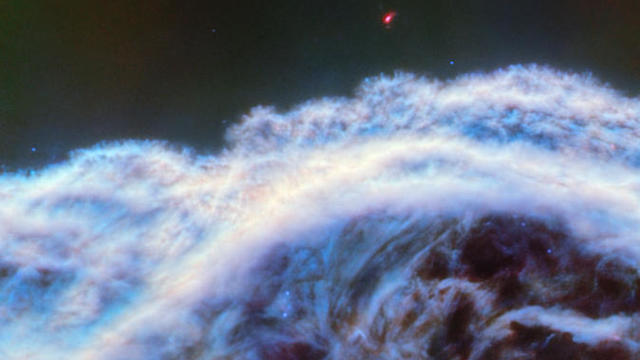
New NASA images show iconic Horsehead Nebula in unprecedented detail
The Horsehead Nebula, which NASA has called "one of the most distinctive objects in our skies," is located in the constellation Orion.
Watch CBS News
The Horsehead Nebula, which NASA has called "one of the most distinctive objects in our skies," is located in the constellation Orion.

Astronauts Barry Wilmore and Sunita Williams say they have complete confidence in the Starliner despite questions about Boeing's safety culture.

In 1961, Ed Dwight was selected by President John F. Kennedy to enter an Air Force training program known as the path to NASA's Astronaut Corps. But he ultimately never made it to space.

The creepy patterns were observed by the European Space Agency's ExoMars Trace Gas Orbiter.

In November 2023, NASA's Voyager 1 spacecraft stopped sending "readable science and engineering data."

NASA's Voyager 1, the first spacecraft to travel beyond our solar system, has started sending information back to Earth again after scientists managed to fix the probe from 15 billion miles away.

In two weeks, Boeing's Starliner spacecraft is scheduled to launch its first piloted test flight, bringing two veteran NASA astronauts to the International Space Station. Astronaut Matt Dominick joined CBS News from the ISS to talk about the mission and life in space.

NASA confirmed Monday that a mystery object that crashed through the roof of a Naples, Florida home last month was space junk from equipment discarded by the space station.

NASA said it agrees with an independent review board that concluded the project could cost up to $11 billion without major changes.

It was a "bittersweet moment" as United Launch Alliance brought the Delta program to a close.
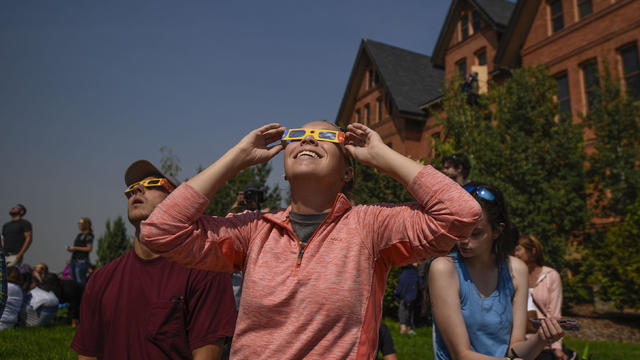
How often do total solar eclipses, like the one on April 8, occur? It was the first in the U.S. since 2017, and the nation won't get another until 2044.
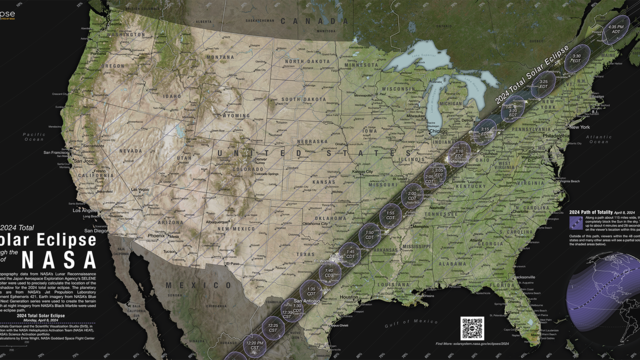
Astronomy fans figuring out where and what time to see the April 8, 2024, total solar eclipse could check out maps showing the path of totality.

While millions of people gawked at the skies for an eclipse experience Monday, teams of scientists were running experiments behind the scenes. Edmund Nowak, professor and chair of the Department of Physics and Astronomy at the University of Delaware, joins CBS News to discuss his research.

Spectators in Cleveland, Ohio, saw the total solar eclipse around 3:15 p.m. ET as the moon covered the sun for a little more than three minutes. CBS News' Dave Malkoff witnessed the event with Stephen Bowen, a NASA astronaut and retired U.S. Navy captain.

A solar eclipse happens when the moon passes between the Earth and the sun, casting a shadow blocking out the sun's light. CBS News' Lana Zak is in Indianapolis, Indiana, and Jim Free, NASA's associate administrator, joins CBS News with more on what viewers should look for when experiencing the eclipse.

A high school class in Indiana used a special telescope during the 2024 solar eclipse to help NASA collect data on the sun's corona.

Scientists at NASA will be sending rockets into the path of Monday's total eclipse in an effort to help unravel the mysteries of the solar system. NASA astronaut Stephen Bowen joined CBS News to discuss some of the scientific aspects of the eclipse.

As Cleveland eyes a hopeful break in the clouds for the solar eclipse, NASA's Glenn Research Center gears up for an unprecedented experiment. Leveraging advanced camera tech on high-altitude aircraft and launching rockets from Virginia, scientists aim to capture the Earth's ionosphere during the rare moment of totality.
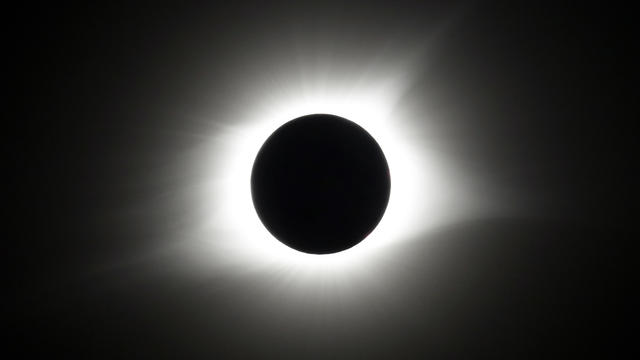
The moon will shroud parts of North America in darkness when the total solar eclipse happens today, April 8. Here's what causes the phenomenon and why.
About 31.6 million people live in the path of today's total solar eclipse across the U.S., and millions more will see a partial eclipse. Here's how and where to see it.
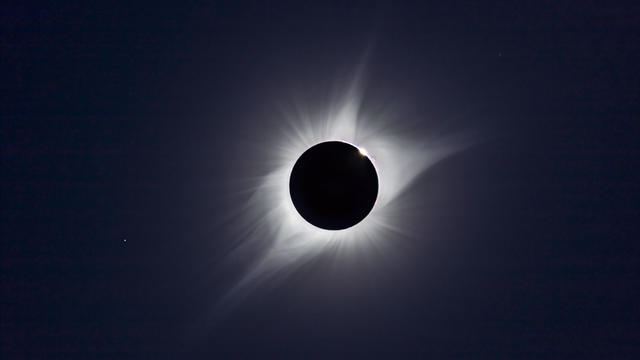
The total solar eclipse on April 8, 2024, will be the last one to be visible from the contiguous U.S. until 2044.

A Russian Soyuz capsule carrying three crew members, including one American astronaut, landed at the International Space Station on Saturday.

Landing on the steppe of Kazakhstan completed the replacement of five long-duration space station fliers.
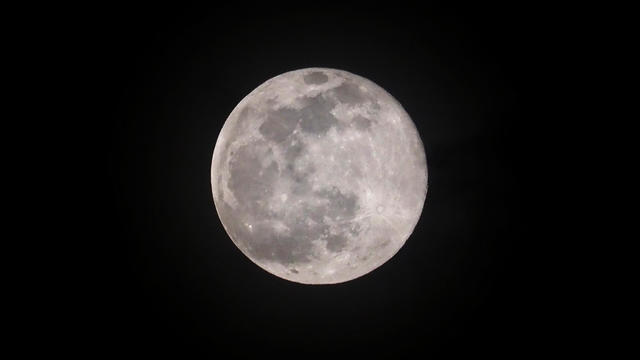
The White House wants to create a time system for the moon, in part to help promote economic opportunities for lunar travel.

Millions will experience next week's total solar eclipse using their eyes, and hopefully a pair of filtering glasses. But what about people who are blind or visually impaired? CBS News national environmental correspondent David Schechter reports on how an astronomer is aiming to create an accessible eclipse experience.