San Jose Mayor Mahan proposes jail for homeless persons repeatedly refusing interim housing
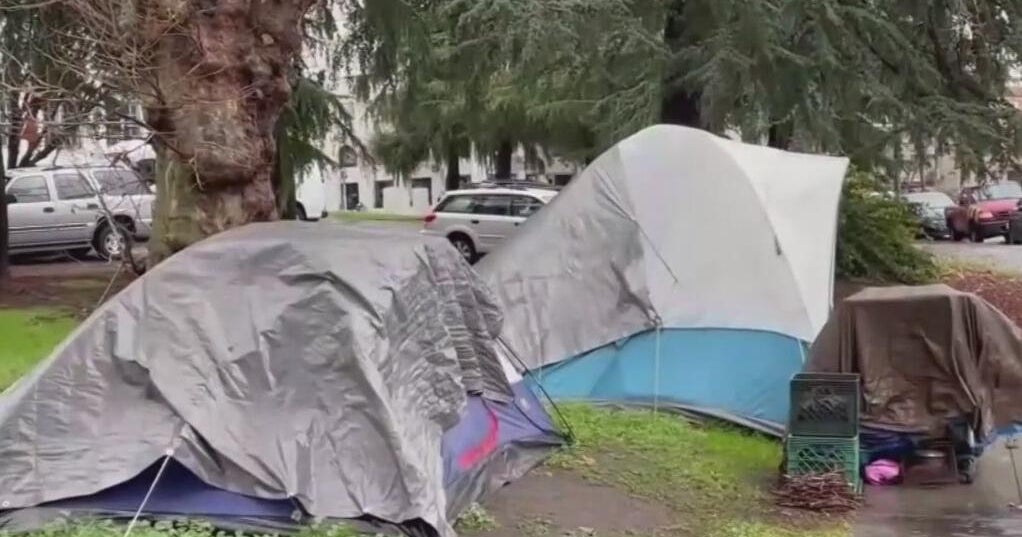
People experiencing homelessness in San Jose who refuse offers of interim shelter will be issued written warnings and will face arrest for repeated refusals under a proposal unveiled Thursday by Mayor Matt Mahan.
The new policy seeks to hold unhoused residents accountable for coming indoors, with the Mayor's Office saying one in three homeless residents refuse offers of housing with private rooms, bathrooms, and doors that lock. Roughly 200 unhoused residents die outdoors each year in Santa Clara County, the office said.
At a press conference Thursday morning in front of a building with multiple units available for homeless persons at Branham Lane and Monterey Road, Mahan said his "Responsibility to Shelter" plan would allow for the arrest of individuals after three refusals to come indoors.
"Homelessness can't be a choice," Mahan said. "I'm proposing that after three offers of shelter, we hold people accountable for turning their lives around." His and other speakers' remarks were interrupted at times by hecklers loudly protesting the city's homelessness policies.
The proposal is among other California cities, including Berkeley, Oakland and San Francisco, that have recently enacted more stringent rules on homeless encampments and the resulting public drug use, crime, and health hazards.
The changes followed a U.S. Supreme Court ruling in June 2024 that overturned a precedent requiring cities to first provide shelter before removing homeless encampments.
Mahan opposed Gov. Gavin Newsom's order last year directing local jurisdictions to clear homeless encampments and adopt homelessness policies consistent with those of the state Department of Transportation, which has aggressively cleared encampments along highways and on-ramps.
The Democratic mayor has instead focused on getting unhoused persons into interim shelters more quickly and constructing more emergency housing, in opposition to other Democrats who say the focus should be on permanent housing construction and support services.
Mahan said the city has sacrificed funding for other city services to construct the interim housing, and in turn, unhoused residents should not be choosing to remain outdoors or in encampments.
"We could be funding longer library hours, better roads and parks, more police officers and firefighters," said Mahan. "The community is making big sacrifices to meet our responsibility to our vulnerable neighbors. And I believe that when dignified shelter and housing is offered, people have a responsibility to use it."
Theresa Said, an unhoused woman living on the train tracks across from Mahan's press conference, told CBS News Bay Area that finding stable housing is often a rocky road for some individuals. Loud noises and mentally unwell neighbors housed near her room would keep her from sleeping at night on occasions when she accepted shelter.
Now when the offer arises, she said she has to take her own mental health into consideration before accepting.
"I have past trauma issues that if I'm around more than four people, I get panic attacks," Theresa said.
Often, she'd refuse.
"I have night terrors and scream so I can't stay in a regular shelter," she said
Theresa lost her home in 2019 and has bounced in and out of housing ever since. She settled on the train tracks lining Monterey Road in South San Jose two years ago, surviving off money she made from building furniture out of nearby piles of garbage.
Despite bad experiences in public housing, Theresea still looks forward to living indoors. But she doesn't believe forced housing will be the solution to San Jose's homelessness problem.
David Low, the senior director of public policy at Destination Home, also believes Mahan's proposal will exacerbate homelessness problems.
"There's just simply nowhere near enough places for people who are experiencing homelessness in our community to go right now," Low said.
San Jose has about 5,477 homeless people on any given day, but only 2,968 beds available. Low said the discrepancy in housing is why he thinks the plan won't work.
"We simply cannot arrest our way out of our homelessness crisis," he said.
The "Responsibility to Shelter" initiative proposal will require approval from the City Council.
Kara St. Cyr contributed reporting.