E-motorcycles on East Bay's Iron Horse Trail becoming urgent safety issue
On the Iron Horse Regional Trail traversing Contra Costa and Alameda counties, the whir of electric bikes has become part of the summer soundtrack. But not all of those rides are what they appear to be, and some are moving fast enough to alarm the people sharing the path.
"They kind of just speed fast by me, and it just kind of scares me a little bit sometimes," said Ashley, who attends high school nearby.
Local law enforcement says the problem has grown serious. In Danville, the police department said officers recently detained a 12-year-old boy after he ran a stop sign traveling at 45 miles per hour on a Talaria electric motorcycle. Police say it's a vehicle that looks like a bicycle but operates like a motorbike. Officer cited both the child and his parents.
The incident prompted Police Chief Thomas Rossberg to urge residents to educate themselves about the vehicles their children are riding.
"These electric motorcycles are not 'e-bikes' — they are motor vehicles, and are not street legal," wrote Rossberg in a social media post. "Not only will illegal riders be stopped and cited, parents of underage riders will also be cited."
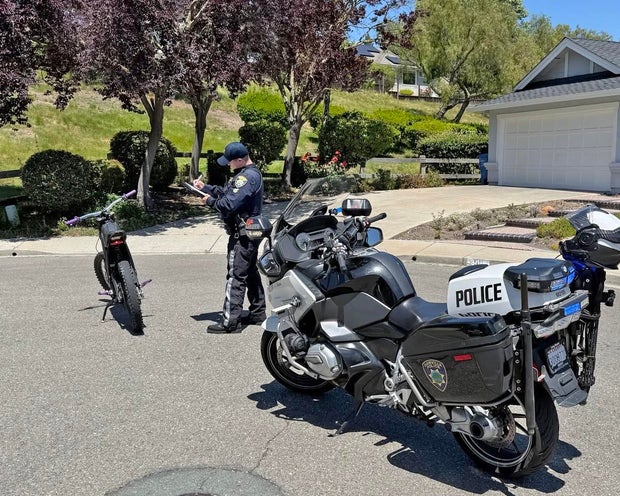
Officers say they are increasingly encountering these machines, which can reach speeds of 50 to 60 miles per hour, on residential bike paths where they are prohibited.
Southern California state Sen. Catherine Blakespear (D-Encinitas) says the incidents point to a broader problem with how these products are being sold.
"I think it's a really confusing marketplace," Blakespear said.
Her legislation, Senate Bill 1167, would require clearer distinctions between legal e-bikes — which are limited to 28 miles per hour and must have operable pedals — and high-powered electric vehicles that, she argues, are motorcycles in disguise.
"They don't have operable pedals, it's only a throttle, and it goes 50 to 60 miles per hour," Blakespear said. "You can't ride that in a bike lane. It needs a license. It's a motorcycle."
The bill takes aim at what she describes as deceptive marketing practices, in which manufacturers and retailers classify powerful electric motorcycles as e-bikes to sidestep regulations requiring registration, licensing and insurance.
Last month, California Attorney General Rob Bonta and local prosecutors issued a consumer alert to parents, manufacturers, retailers and users about state laws on the sale and use of e-bikes.
"Sometimes, what looks like an e-bike or is marketed as an e-bike is not a bike at all. We are seeing a surge of safety incidents on our sidewalks, parks, and streets," Bonta said. "Bike riders and parents: If your or your teen's electric two-wheeled vehicle goes too fast, it might be a motorcycle or a moped — not an e-bike."
For Oliver Berger, a middle schooler who regularly rides the Iron Horse Trail with friends, an e-bike represents independence.
"Especially whenever you're with friends, it's like freedom and fun," Berger said.
But Berger has also watched peers push their machines to dangerous speeds, and he worries about the consequences for riders who follow the rules.
"Kids are just getting hurt, they're crashing," he said. "Don't do anything stupid and keep it legal for all of us."
Senate Bill 1167 passed the state Senate with little opposition. It now moves to the Assembly, where a vote is expected this fall.
A recent University of California, San Francisco study found that injuries from e-bikes nearly doubled each year from 2017 to 2022. Meanwhile, a study from the University of California, San Diego showed injuries among e-bike riders under 18 in San Diego soared 300% between 2019 and 2023.


