Maps show how Texas, California, Missouri, North Carolina and Utah redistricting could affect congressional seats

Several states undertook mid-decade redistricting efforts to try to alter the makeup of their congressional delegations this year, after President Trump began last summer to press Republican-led states to increase the number of GOP-friendly districts to help his party hold the House in next year's midterm elections.
Indiana became the first of these to reject a new map proposed by GOP legislators to redraw the state's congressional districts so that all nine congressional districts would be favorable to Republicans.
Texas was the first to kick off the gerrymandering push, when Gov. Greg Abbott signed legislation in August to redraw the districts and create five GOP-friendly seats. In California, Gov. Gavin Newsom, in turn, launched an effort to redraw his state's map to help Democrats. In November, the plan was approved by voters by a 29-point margin.
In Missouri, state lawmakers redrew their map in September to squeeze Democratic Rep. Emanuel Cleaver from his Kansas City district. Then in October, North Carolina state Republicans redrew the 1st Congressional District, held by a Democrat, to make it more favorable to conservatives.
But Republicans in Indiana's state Senate rejected the redistricting measure in a 31-19 vote on Dec. 11, despite the GOP's 40-10 advantage in the chamber. Ahead of the vote, as the lawmakers faced intense pressure from Mr. Trump and other members of his administration, Indiana state police said they had received "numerous" bomb threats and swatting hoaxes against state senators.
Utah lawmakers also reworked their state's map after a judge ruled the current districts violated restrictions on gerrymandering. All four of the state's House districts are represented by Republicans, but a judge in November threw out the GOP-controlled legislature's map and ordered one that will create a Democratic-leaning district in Salt Lake City.
Congressional maps are normally redrawn every 10 years after the U.S. Census reveals population shifts. But this rare mid-decade redistricting push was kicked off as Republicans seek to maintain — or even expand — their razor-thin majority in Congress in the 2026 midterm elections. Historically speaking, midterms are often a rebuke of the party in the White House.
Although both parties are trying to rig their states' congressional districts to be favorable to themselves, the outcome is far from guaranteed.
"Computers and technology do give us a lot more ability to to make predictive statements about outcomes, but we're doing it — I think it's fair to say — in a very volatile environment politically, where things that we have seen as trends are sort of being turned on their heads," said Kareem Crayton, vice president of the Washington, D.C.-based the Brennan Center for Justice.
Crayton noted several current issues that could factor heavily into voters' decisions, and called it "folly to assume that just because people showed up and voted for the current president of the United States, that people want to show up for a member of Congress, particularly … a new candidate in a district that hasn't been created before."
See how maps passed in Texas, California, North Carolina and Missouri could change their congressional makeup
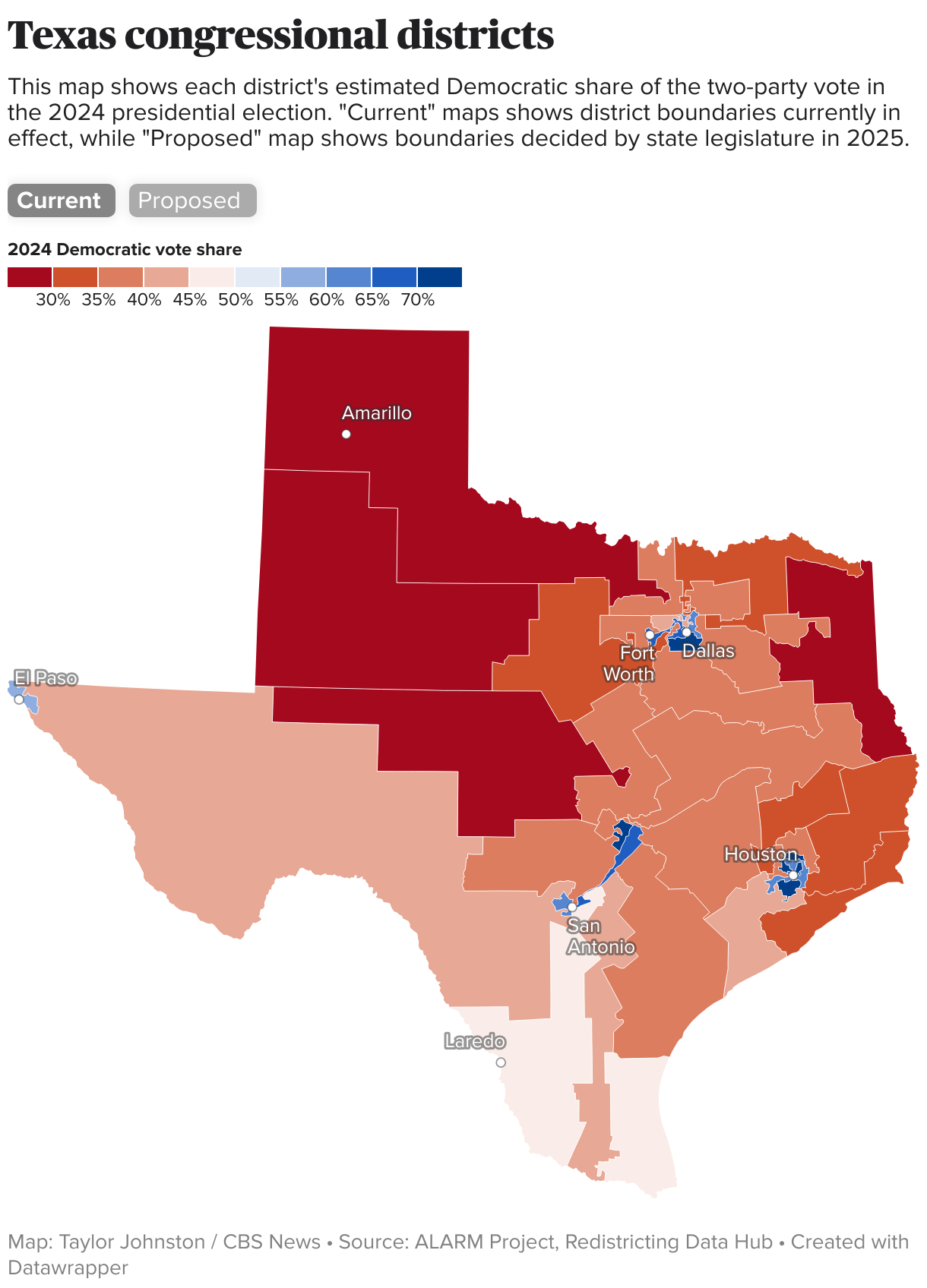
Texas has 38 congressional seats, with 25 held by Republicans and 13 by Democrats.
Republicans have invested heavily in the Rio Grande Valley, once a Democratic stronghold, but they've made inroads. In 2024, two of the three Rio Grande Valley House seats voted for Mr. Trump, though they reelected their Democratic congressional representatives. The maps were designed to increase those gains and box out the two Democrats.
Texas Democrats have recently made gains in the Dallas-Fort Worth area and Houston's Harris County. The new maps reshape Democratic Rep. Al Green's Houston district in the rural areas, making a district that was 72% Democratic into one that is 40% Democratic. The proposed map also changes Rep. Julie Johnson's Dallas-area district from 62% to 41% Democratic. Rep. Marc Veasey's district in Dallas-Fort Worth remains a Democratic stronghold, but he would no longer live in the district.
Liberal Austin is further dissolved into neighboring districts. Rep. Lloyd Doggett, who was first elected in 1994 and whose district gave former Vice President Kamala Harris her largest margin of victory in all of Texas, announced in August that he would not seek reelection if the proposed maps are upheld by the courts, avoiding a primary with Rep. Greg Casar, also of Austin.
On Nov. 18, a three-judge panel in the U.S. District Court in El Paso blocked Texas from using the maps approved by the legislature in August. The court said that the plaintiffs will likely succeed in showing that race predominated over partisanship in the map-making process, and said the legislature appears to have set and followed a racial target.
Abbott appealed the decision to the U.S. Supreme Court, which ultimately restored the map passed this summer.
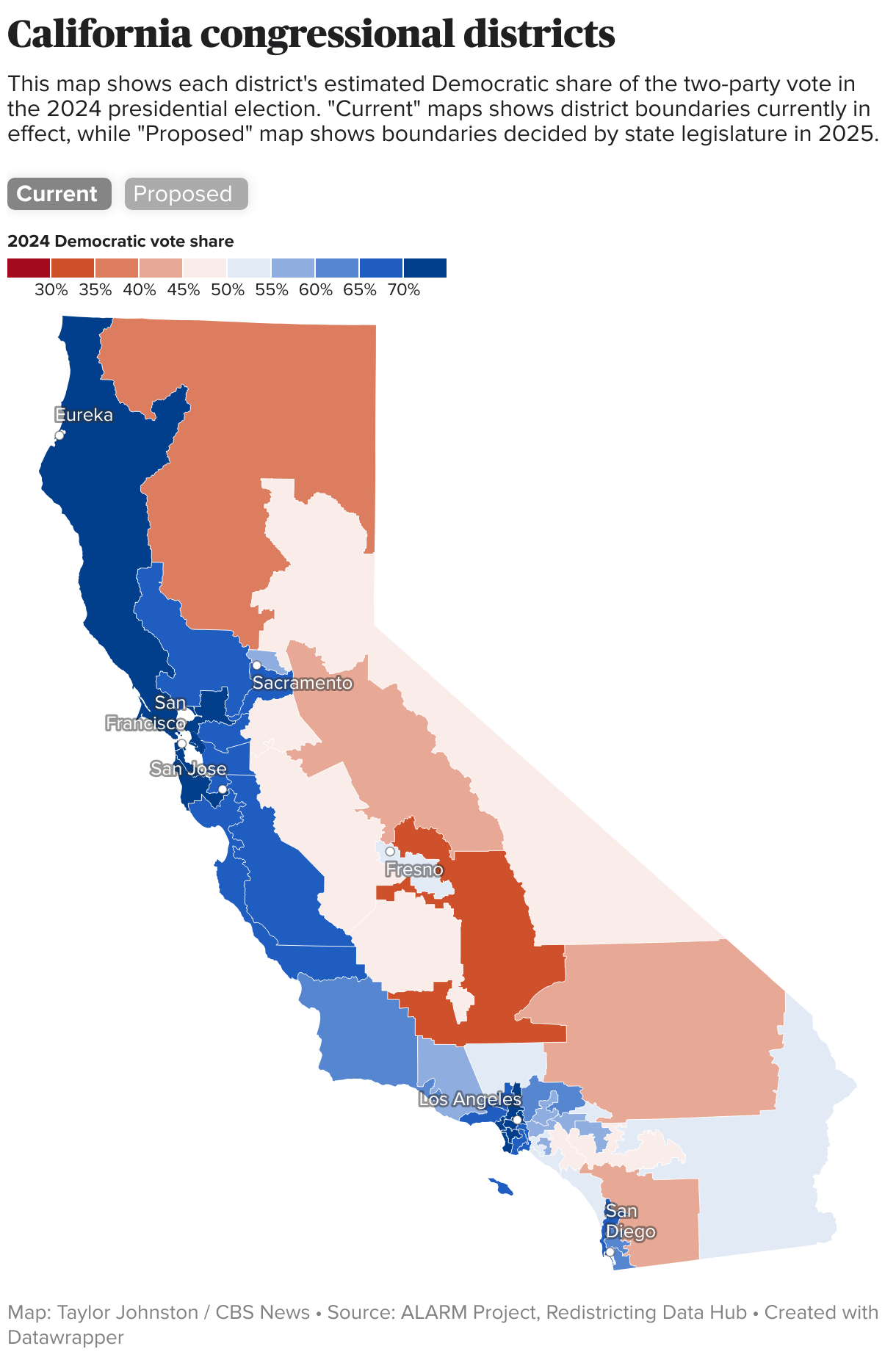
California has 52 House representatives, with nine Republicans and 43 Democrats.
In 2020, Republicans flipped three seats held by Democrats for the first time since 1994. They've hung onto two of them, including GOP Rep. David Valadao's 22nd District in the Central Valley.
Under the proposed map, Valadao's district would go from being 47% Democratic in 2024 to 49% Democratic, making him slightly more vulnerable. And GOP Rep. Darrell Issa's 48th District near San Diego would change from 42% to 52% Democratic.
In Southern California, Rep. Ken Calvert's 41st District in Riverside would be redrawn further toward Los Angeles, shifting it from a district that was 47% Democratic in 2024 to one that is 57% Democratic under the proposed maps.
In Northern California, GOP Rep. Doug LaMalfa's District 1, which includes the northeastern-most part of the state, would shift further south toward Marin County and the northern part would be absorbed in the 2nd District, home to heavily Democratic Eureka and the northern Pacific coast. Rep. Kevin Kiley's district, which snakes along the California-Nevada border through Death Valley, would instead move further toward heavily Democratic Sacramento. Republican Rep. Tom McClintock's 5th District would be shifted to include the southern portions of what was Kiley's district.
Kiley, whose district would go from one that was 48% Democratic in 2024 to one that is 55% Democratic, has been an outspoken critic of redistricting, even introducing legislation in the House to ban mid-decade redistricting.
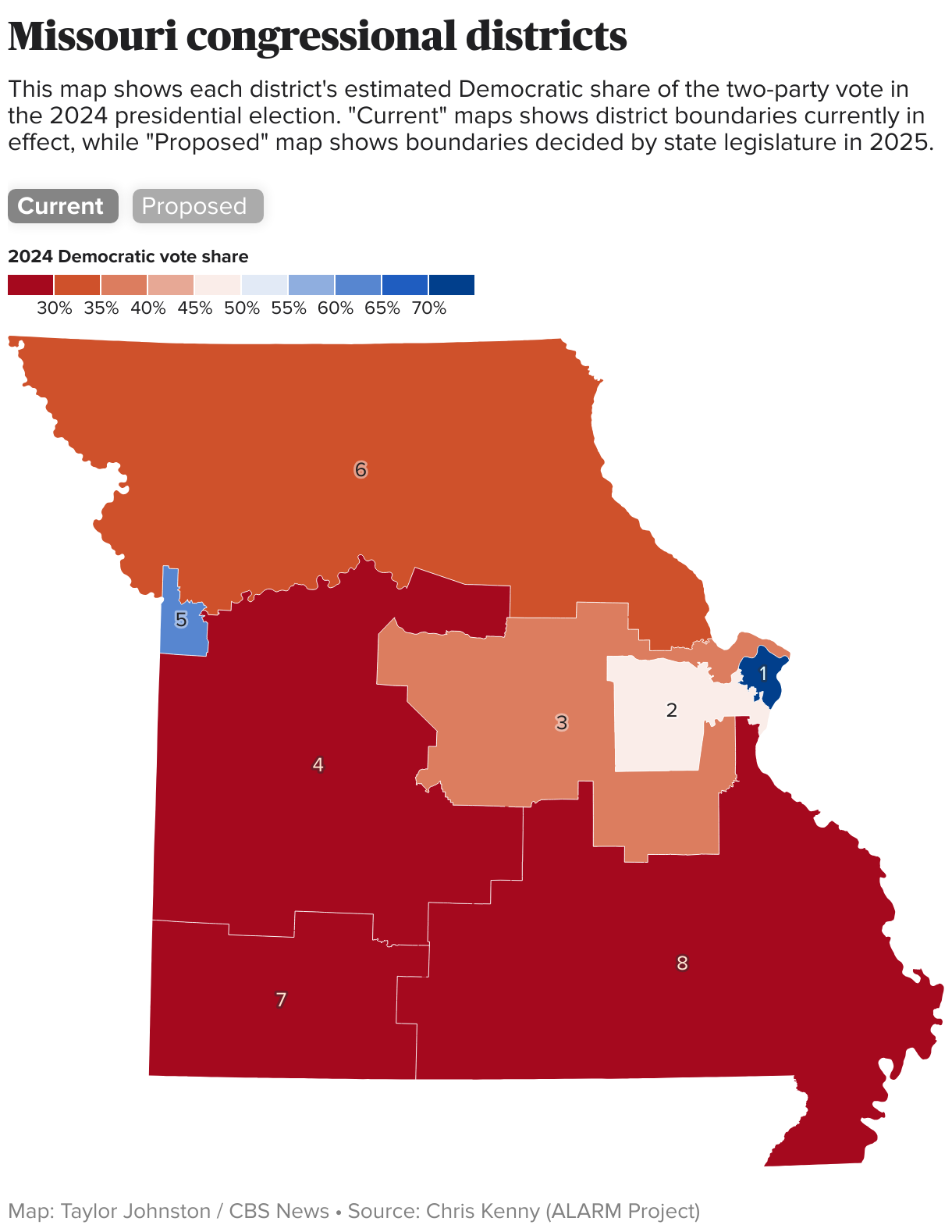
After Texas and California's redistricting efforts, Gov. Kehoe called a special session of Missouri's legislature to take up redistricting. Missouri currently has two Democratic representatives in Congress: Rep. Wesley Bell, who represents St. Louis and was first elected in 2025, and Cleaver, who has represented the Kansas City area since 2005.
As Missouri has trended toward Republicans over the past 20 years, Cleaver's district has been a target of the GOP, especially in the 2021 redistricting when several lawmakers pushed for what was called the "7 to 1 map" that would have redrawn the 5th Congressional District to be more Republican. Lawmakers ultimately decided against that plan. St. Louis' NPR station reported that Republicans worried that the short-term gains from carving up the district could lead to long-term problems in the neighboring suburban districts.
Nonetheless, the Missouri GOP joined the redistricting effort in 2025. Under the new map, Cleaver's district transforms from one that is 62% Democratic to one that is 41% Democratic. Cleaver says he still plans to run for reelection.
The neighboring 4th and 6th Districts both become slightly bluer, to 39% and 36% Democratic, respectively, but they are still safely Republican.
By expanding the 2nd District south and west, GOP Rep. Ann Wagner's district becomes redder, going from 46% Democratic in 2024 to 44%. While Wagner has maintained her grip on the district, Mr. Trump won by only 100 votes under the previous lines in 2020. In the 2021 redistricting, Wagner's district lost some of the Democratic-leaning St. Louis County.
Opponents of the map submitted in early December more than 300,000 signatures on a petition to force a ballot measure on the new map. A judge is currently reviewing if the signatures are valid.
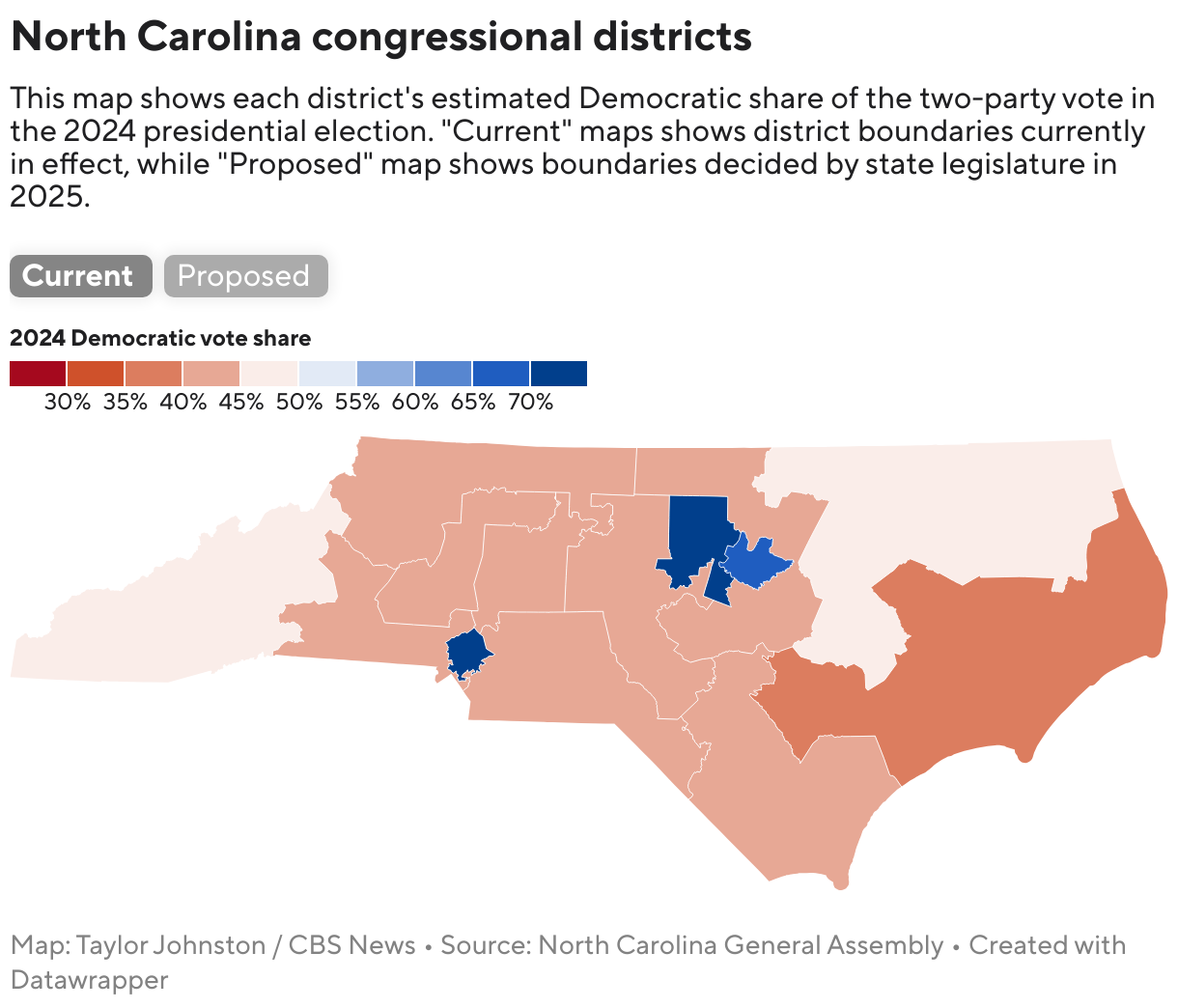
North Carolina has 14 congressional seats, 10 of which are held by Republicans. But the state is not as solidly red as that breakdown would suggest — it's closer to a 50/50 state at the presidential level these days, and the state's governor and attorney general are both Democrats.
In the redistricting push undertaken this fall, North Carolina Republicans are targeting a single seat: Rep. Don Davis' 1st Congressional District. Davis' win in 2024 in the northeastern part of the state was a rare bright spot for Democrats, especially after Republicans were able to flip congressional three seats in North Carolina that year.
In the map passed by the North Carolina Assembly on Oct. 21 and 22, Davis' district boundaries move further south, into the current 3rd District. That changes the makeup of the district from one that was 48% Democratic to one that is 44% Democratic.
See how maps of how court-ordered redistricting could change Utah's congressional makeup
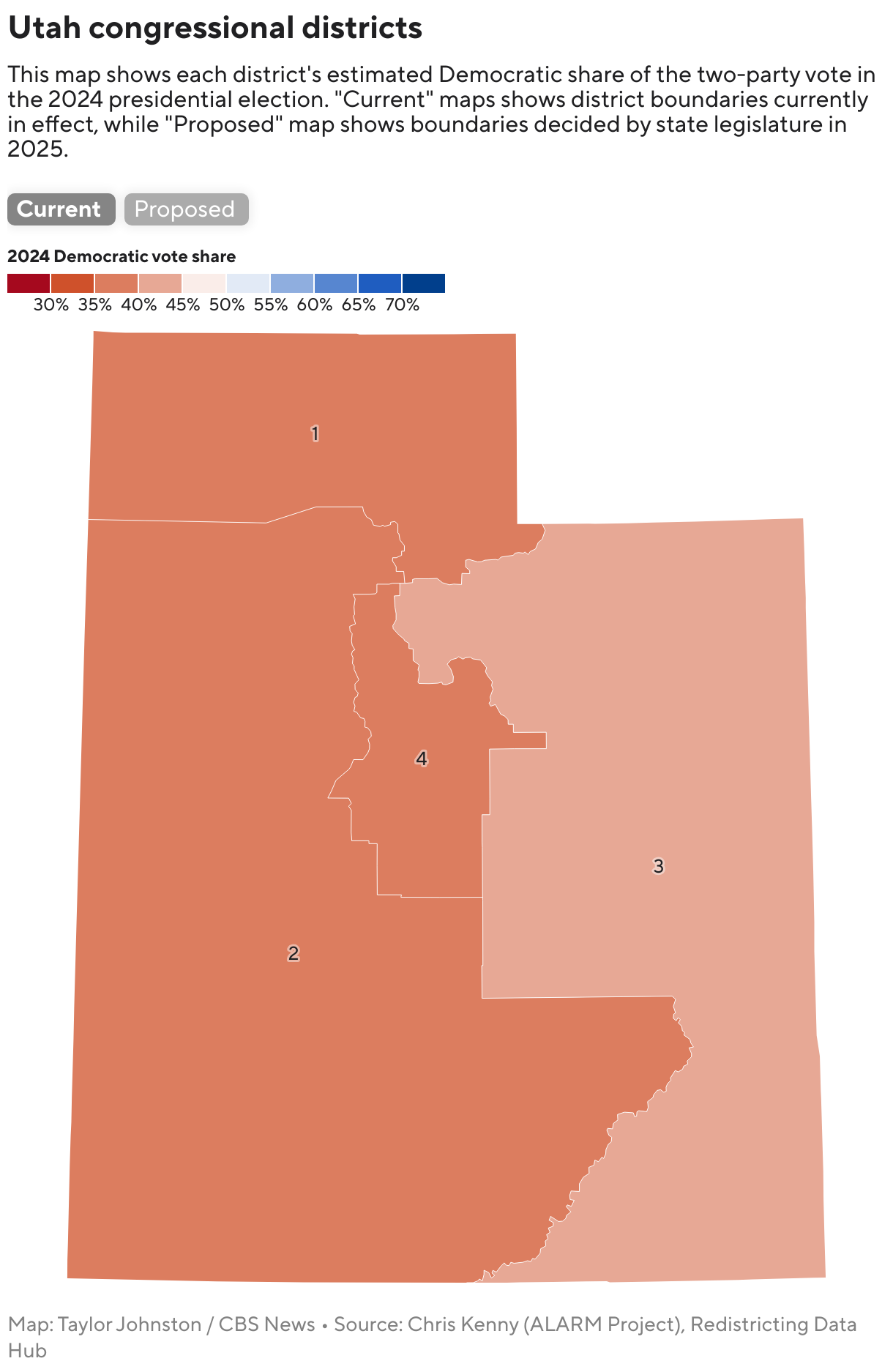
Utah differs from the other states here, among other reasons, because there are no Democrats among the four members of its congressional delegation. And its 2025 redistricting effort was put in motion when a judge ruled the current districts violated a voter-approved measure to prevent partisan gerrymandering.
The GOP-controlled legislature produced four maps for public comment, and on Oct. 6, approved a map that would be the least competitive for Democrats. The legislature proposed a map that would split Salt Lake County into two districts, which would make Districts 2 and 3 more competitive for Democrats.
But a district court judge in Utah on Nov. 10 rejected redistricting maps selected by the Republican-controlled legislature and instead selected a map that would create a Democratic-leaning congressional district in Salt Lake City. The map approved by the legislature "does not comply with Utah law," wrote 3rd District Court Judge Dianna Gibson in her opinion. She continued that "based on the evidence presented," the legislature's map "unduly favors Republicans and disfavors Democrats."
The maps enacted by Gibson create a new district encompassing Salt Lake City that would be 62% Democratic, based on the 2024 presidential results.
See maps of how Indiana's failed redistricting would have changed their congressional makeup
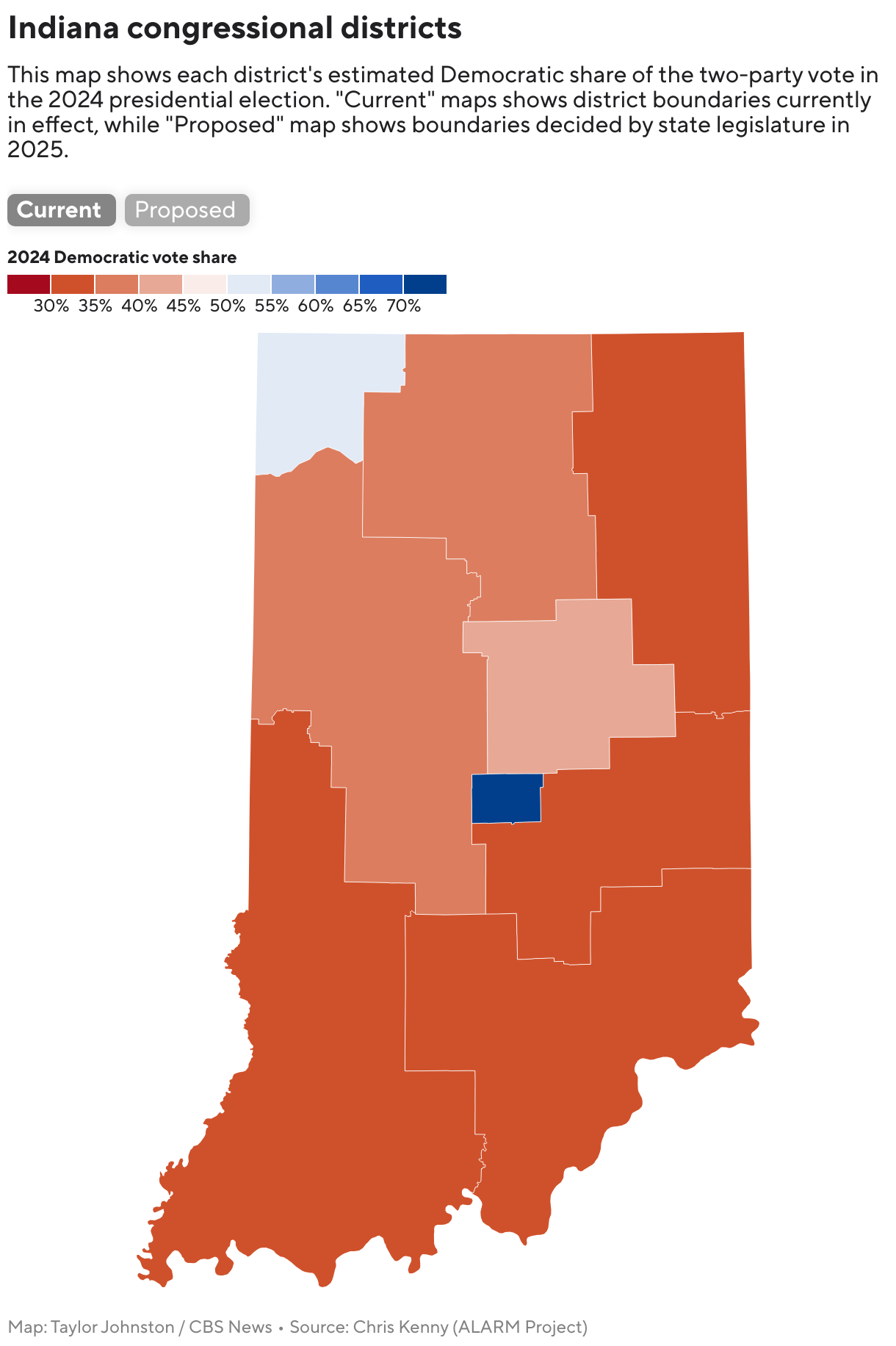
Indiana state lawmakers initially resisted the Trump administration's pressure to redraw their map to edge out the two Democratic seats. When Republican Gov. Mike Braun called a special session in November, Senate President Rodric Bray said publicly the votes weren't there, and when the legislature convened, it only agreed to meet again in January for the regular session.
But lawmakers reversed course in November and said they would reconvene to take up redistricting. On Dec. 1, Indiana House Republicans unveiled their proposed map, which significantly changes the boundaries of District 1 and District 7.
In the proposed map, District 1, which includes Gary, Indiana, and other Chicago suburbs, is redrawn so voters would have been spread through Districts 2 and 4. All three districts are between 40-44% Democratic under the proposed map. The map also broke up the heavily Democratic District 7, which currently includes most of Indianapolis and backed Harris with 71% of its vote. It would be split, with its population absorbed into several Republican districts.
Republicans have a trifecta in Indiana government, and although the map passed the Indiana House easily, it failed to garner support in the state Senate. During public hearings on the map, 127 people signed up to testify and of those, just 18 of them backed the bill, while the rest were opposed.
Despite Republicans; 40-10 advantage in the Indiana Senate, the bill failed, with 31 votes against and 19 in favor. Bray indicated it will not come up again during the regular session, saying after the vote "it's time to turn the page." Mr. Trump has vowed to primary Republicans who voted against the measure.