Americans got their biggest raises in 40 years. Inflation took most of it.

The typical American's paycheck has grown faster since 2019 than in any stretch since the early 1980s. Most of it didn't stick.
A CBS News analysis of Census data found the typical full-time worker earned $1,250 a week in the first half of 2026. That's up $342 from the year before the pandemic, a raise of 38%.
But prices climbed nearly as fast. Consumer costs rose 30% over the same seven years, swallowing about 80% of the typical worker's raise. What survives is roughly $70 more a week to spend in today's dollars. That's about 6% over seven years or a gain of less than 1% a year.
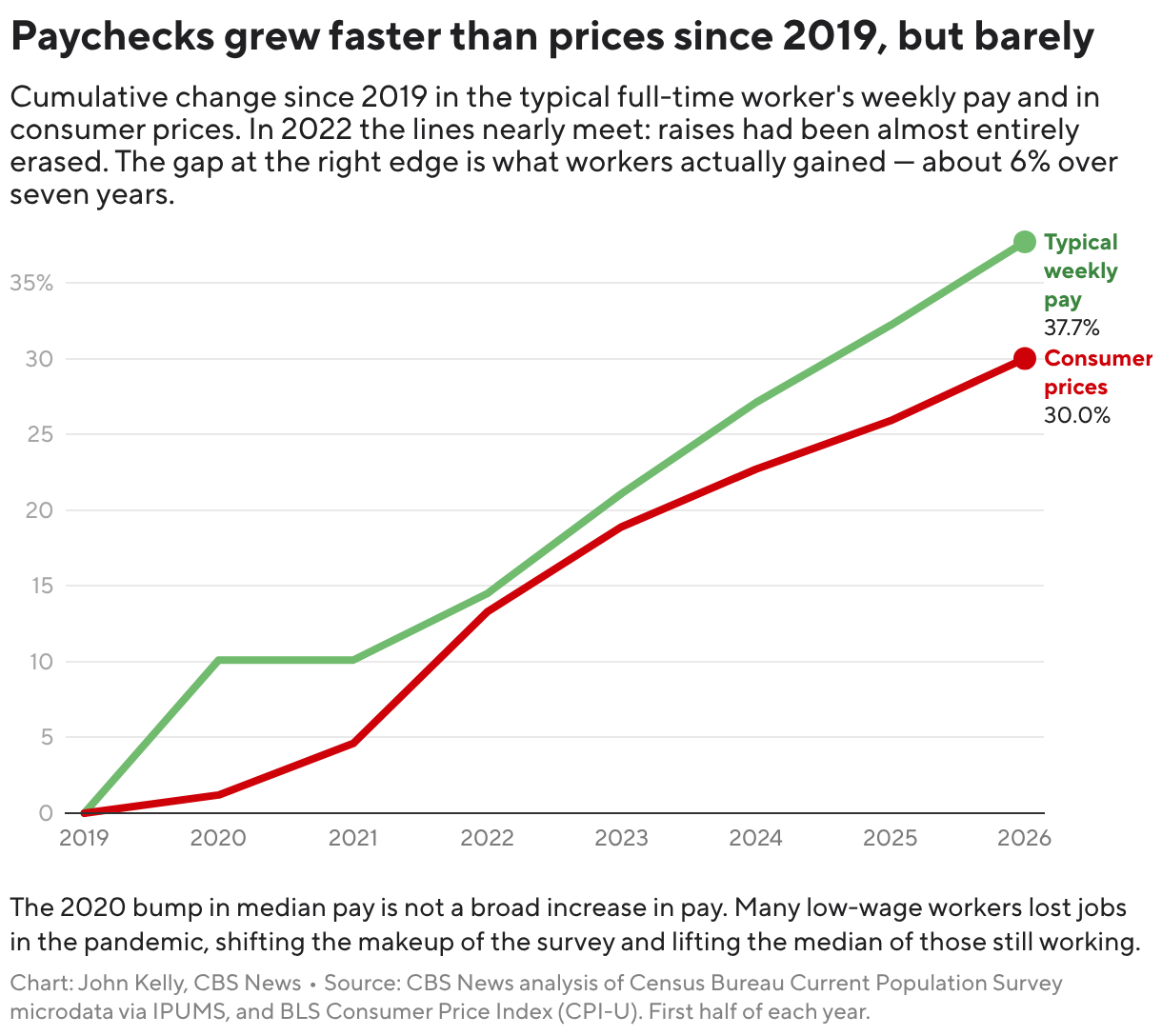
Over seven years, $70 more a week is a small gain placed in the context of a typical family's budget: about one gasoline fill-up for an SUV or less than one-third of a single week's grocery run for a cost-conscious family of four.
That gap explains a contradiction millions of households felt across the Trump, Biden and second Trump administrations: raises that never seemed to change the household budget.
Inflation peaked in June 2022, when prices jumped 9% over the prior year, the sharpest increase since 1981.
The gains were not evenly shared. Across the occupations CBS News could measure reliably, roughly half of the workers beat inflation, about a quarter came out about even, and the other quarter fell behind – even if their paychecks were rising.
The size and pattern of increases sometimes ran counter to what people might expect. Pay for the lowest-earning tenth of workers rose 9.4% even after the big inflation hit. For the typical worker it was 5.9%. For the best-paid quarter, just 2.6% — the further up the pay scale, the smaller the gain.
Two familiar jobs show how wide the gap got. Registered nurses and police officers both earn about $80,000 a year. Over these seven years, police pay rose nearly 10% after inflation. But nurses' pay barely moved when rising prices are factored in.
Some of the biggest gains came among traditionally lower-paid occupations.
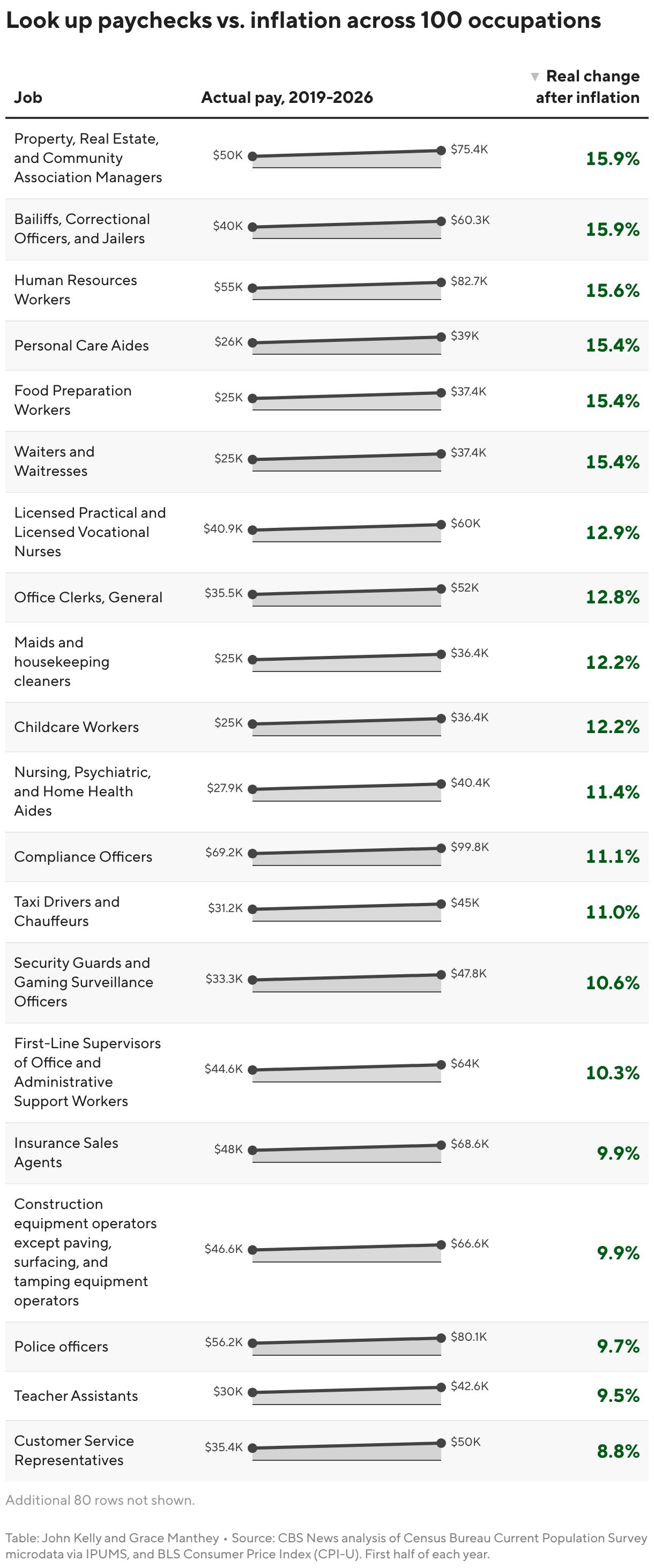
Nursing and home health aides, childcare workers and waiters all beat inflation by more than 10% in the seven-year period. For waiters, part of that is arithmetic: tips are a percentage of the bill, so when menu prices jumped, tips often rose with them.
Teachers went the other way. Elementary and middle school teachers fell about 5% after considering inflation; high school teachers slightly more.
So did the people delivering our mail. Letter carriers lost about 10% in buying power. In January 2025, they voted down a tentative national contract by more than two to one, their union's first rejection since 1978, after being offered base wage increases of about 1.3% a year.
A gain that small still counts as unusually good over the long haul. Adjusted for inflation, the typical worker's pay rose 5.9% from 2019 to 2026, better than most seven-year stretches dating all the way back to 1979. Pay fell 3.6% after inflation in the decade after 1979 and rose just 0.3% across the 1990s.


