Cannon Films
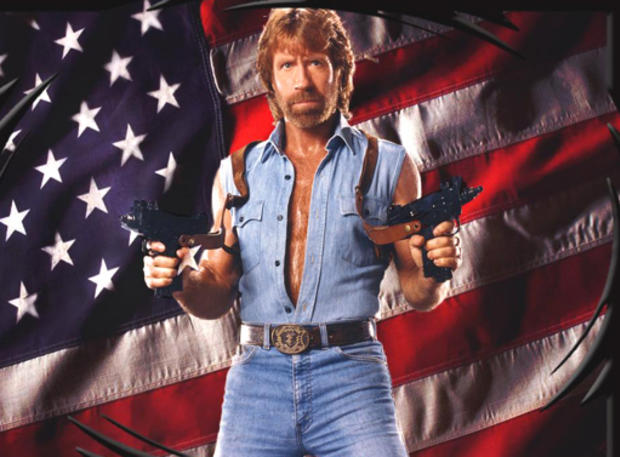
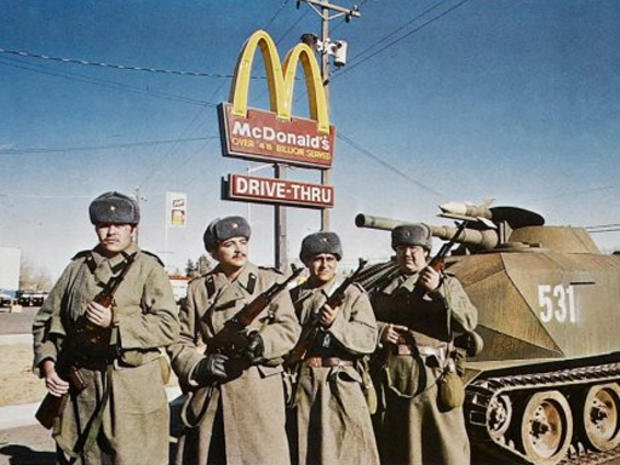
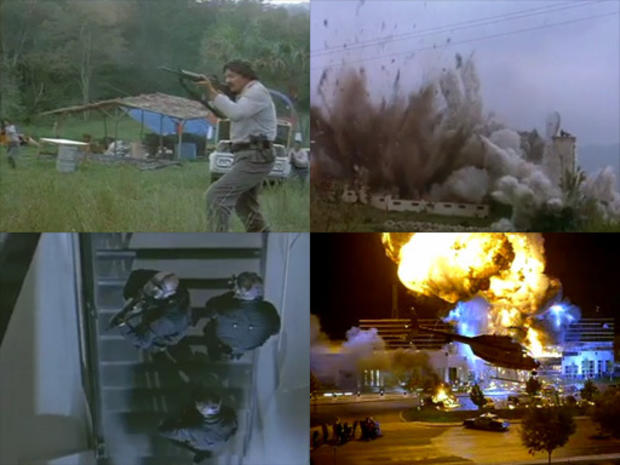
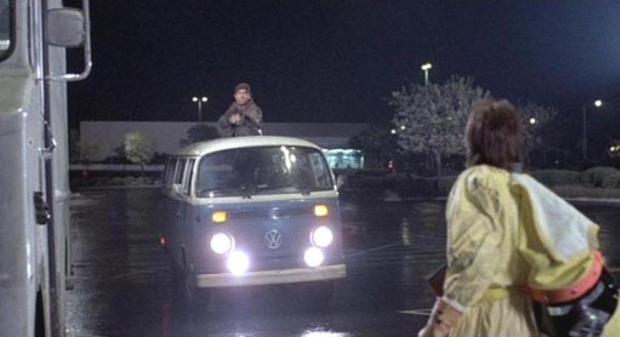
The 1985 film "Invasion U.S.A." starred Chuck Norris, who single-handedly defeated an invading army of Communist fighters out to terrorize Americans and destroy our way of life.
Terrorists had become a standard and reliable villain for Hollywood action movies, but when real-life terrorism struck within America's borders, the game changed.
By CBSNews.com senior editor David Morgan
ITN
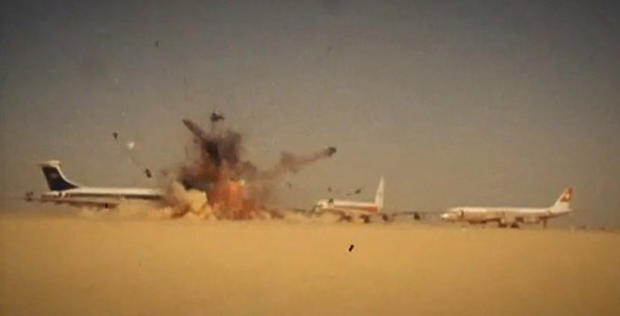
In the 1970s terrorism in movies usually referred to the Arab-Israeli conflict, after a series of extraordinary plane hijackings, including the coordinated hijacking of several jetliners in 1970 by the Popular Front for the Liberation of Palestine. Three of the aircraft were destroyed at a desert airfield in Jordan.
CBS
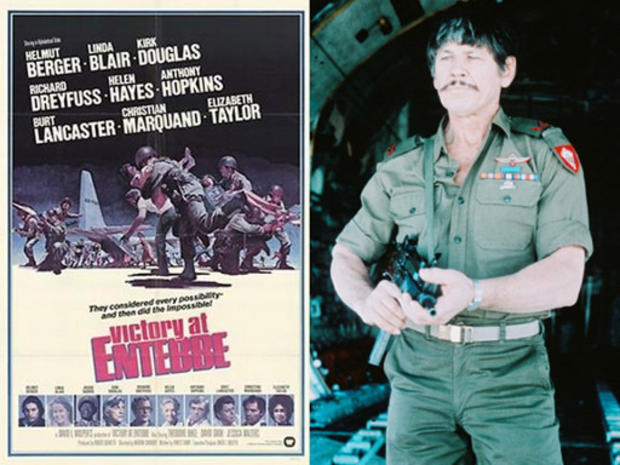
Such real-life incidents proved to be grist for movie treatments. When a team of Israeli commandoes executed a daring raid on a plane full of passengers held by Palestinian and German terrorists at Entebbe Airport in Uganda in 1976, the event prompted not one but TWO quickly-produced TV movies: ABC's "Victory at Entebbe" (starring Burt Lancaster), and NBC's "Raid on Entebbe" (starring Charles Bronson). An Israeli film on the raid, "Operation Thunderbolt" (1978), was nominated for a Best Foreign Language Film Oscar. The operation also inspired the Lee Marvin-Chuck Norris actioner "The Delta Force" (1986).
Paramount Pictures
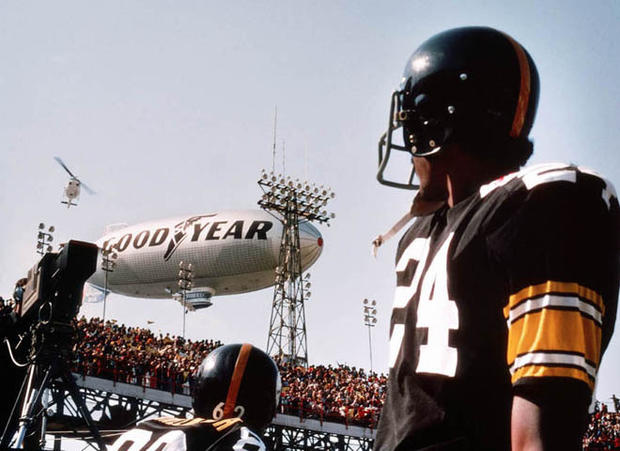
"Black Sunday" (1977), based on the debut novel of Thomas Harris (who later wrote "The Silence of the Lambs"), told of a Black September operative (Marthe Keller) who, with the aid of a mentally unstable Vietnam veteran (Bruce Dern), plots a terrorist attack on the Super Bowl. Their aim: Kill thousands, including the president of the United States, on live TV. An Israeli Mossad agent (Robert Shaw) is all that stands between a bomb and the end zone. John Frankenheimer directed the tense and realistic thriller, for which Goodyear allowed the use of its blimp (but only if the company's name was not visible in scenes of violence).
MGM/UA
With the fall of the Berlin Wall and, later, the collapse of the Soviet Union, the Communist menace was barely in play as a staple of spy thrillers and action movies, as they were in John Milius' 1984 "Red Dawn." In this, the first film released with a PG-13 rating (and boy, it earned it), the Red Army and their Central American comrades invade the U.S., only to have to contend with a bunch of high school students carrying their Second Amendment-protected firearms. Go Wolverines!
Universal Pictures
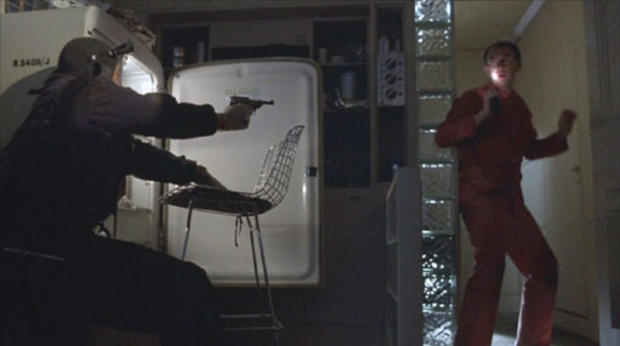
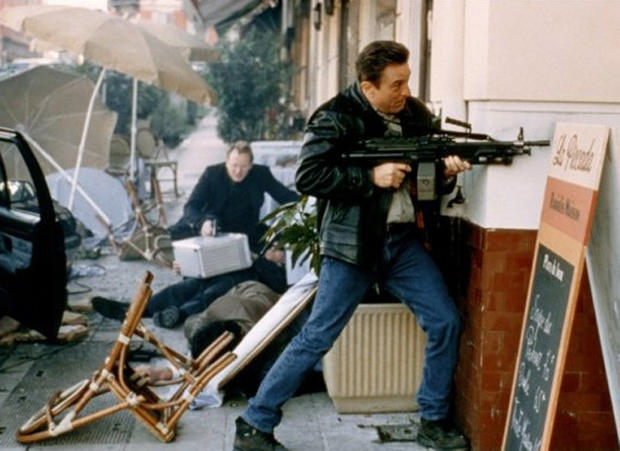
In the world of Terry Gilliam's spellbinding "Brazil" (1985), terrorism served a convenient political purpose: Anyone who operated outside the confines of the totalitarian, paperwork-littered society was labeled a terrorist, meaning any explosion (the result of bad plumbing) or form without the proper stamp is deemed subversive. Seen at left: Robert De Niro, a plumber who works clandestinely beyond the purvey of the bureaucratic Central Services ("Couldn't stand the paperwork!") makes an unofficial house call on Jonathan Pryce - and without the required copy of a 27B/6 form.
Cannon Films
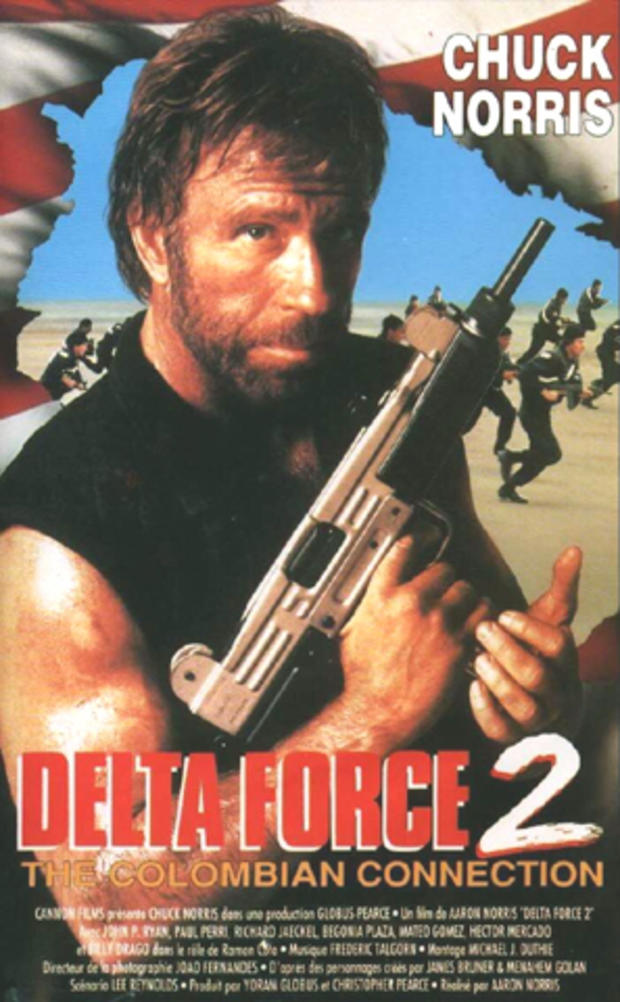
With the Reds no longer a menace, instead of duking it out with the Russians, U.S. military, police and intelligence operatives in the movies were now forced to fight drug traffickers or terrorists - or, even better, narco-terrorists. The title of the 1990 semi-sequel to "Delta Force," "Delta Force 2: The Colombian Connection," said it all.
Warner Brothers
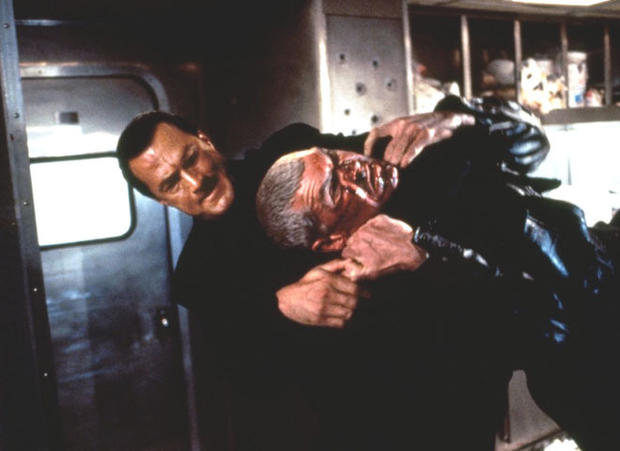
After thwarting the takeover of a military vessel in "Under Siege," Steven Seagal returned in "Under Siege 2: Dark Territory" (1995) to thwart the takeover of a passenger train by terrorists seeking to hijack a U.S. satellite.
Hollywood Pictures
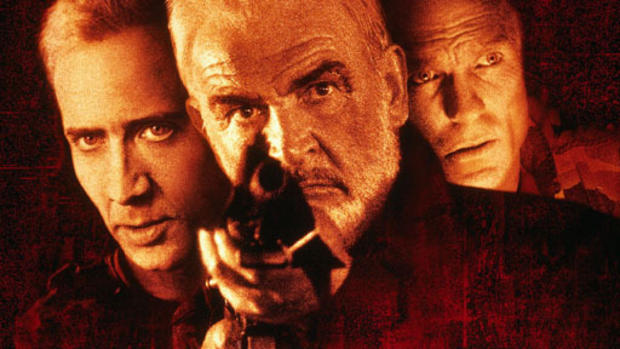
Domestic terrorism in "The Rock" (1996) came from rogue Marines led by Ed Harris who took hostages on Alcatraz Island, threatening to unleash nerve gas on San Francisco. It was up to Sean Connery and Nicolas Cage to take them out.
MGM/Sony Pictures
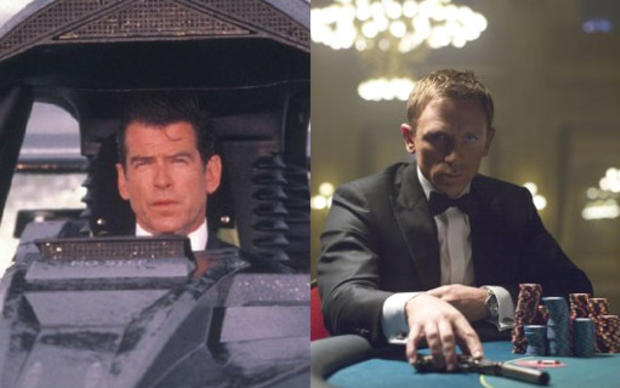
With the waning of the Soviets as a threat, even super agent James Bond found himself protecting queen and country from less exalted foes than SPECTRE. In "The World is Not Enough" (1999), Pierce Brosnan fought a renegade former KGB agent who is plotting terror strikes against oil pipelines. And in the 007 reboot "Casino Royale" (2006), Daniel Craig went head-to-head with the financier of terrorist groups, hoping to beat him in ... a card game!
"I miss the Cold War," muses M.
20th Century Fox
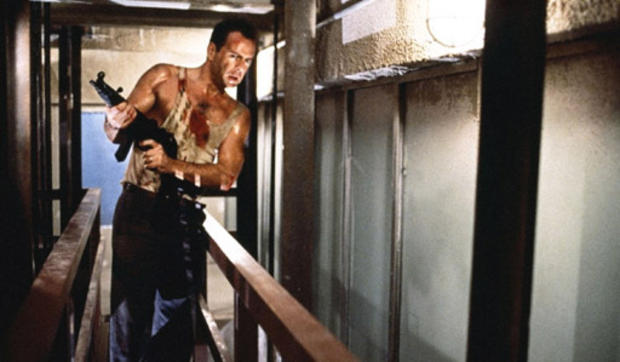
Terrorism was even used as a cover by clever criminals. In the Bruce Willis-starrer "Die Hard" (1988), a Los Angeles skyscraper is overrun by an armed group who demand the release of their "comrades in arms" - revolutionaries imprisoned in Northern Ireland, Quebec, Sri Lanka and elsewhere. Their true objective, however, is to liberate riches trapped in a safe.
TriStar/Sony Pictures
The evolving search for villainy can be seen in the continuing series of "Iron Eagle" films starring Lou Gossett Jr. The first one, in 1986, concerned an attempt to free an American pilot held by an Arab nation after his plane is shot down. The second, in 1988, involved a joint U.S.-Soviet strike against a nuclear installation in the Middle East. In 1992, "Aces: Iron Eagle III" showed Gossett going up again drug smugglers from Peru.
By the time the straight-to-video "Iron Eagle IV" arrived in 1995, Gossett was combating a right-wing conspiracy involving renegade U.S. military officials trafficking in "toxic biological agents" - weapons of mass destruction - which they plan to unleash against Cuba! Gossett and his band of teenage pilots save a grateful Communist nation.
Warner Brothers
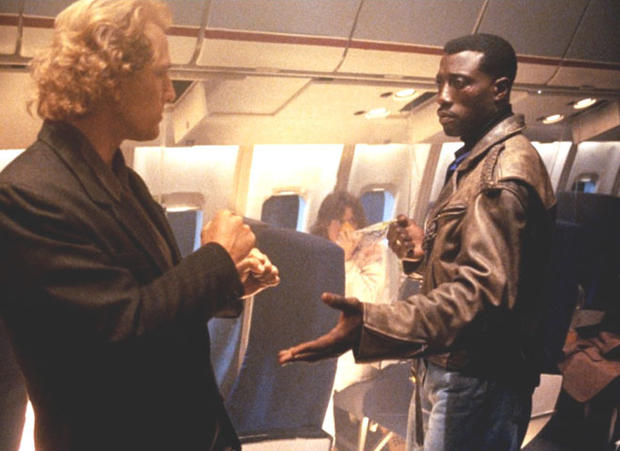
When terrorist Bruce Payne seeks to escape FBI custody during his flight towards his L.A. trial (with the help of incognito allies on board), getting in the way is Wesley Snipes, a security officer who happens to be "Passenger 57" (1992).
20th Century Fox
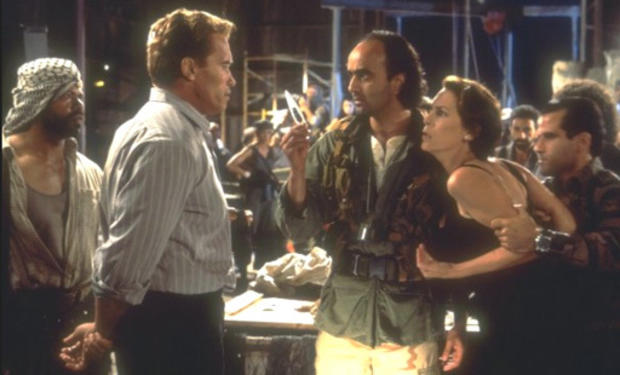
Arab terrorists of the Crimson Jihad group get the upper hand, but only temporarily, against a covert U.S. government agent (Arnold Schwarzenegger) and his unsuspecting wife (Jamie Lee Curtis) in James Cameron's action-comedy "True Lies." (1994).
Avalanche
Home-grown terrorism and storylines involving militia groups became more of a movie staple after the 1995 bombing of a federal building in Oklahoma City. "Militia" (2000) tells of ATF forces trying to stop a militia group, the Brotherhood of Liberty, that has stolen anthrax intending to launch a missile attack on the government. In addition to Dean Cain, Jennifer Beals, Frederic Forrest and Stacy Keach, the film features footage "borrowed" from "Terminator 2: Judgment Day" of the Cyberdyne labs blowing up.
Warner Brothers
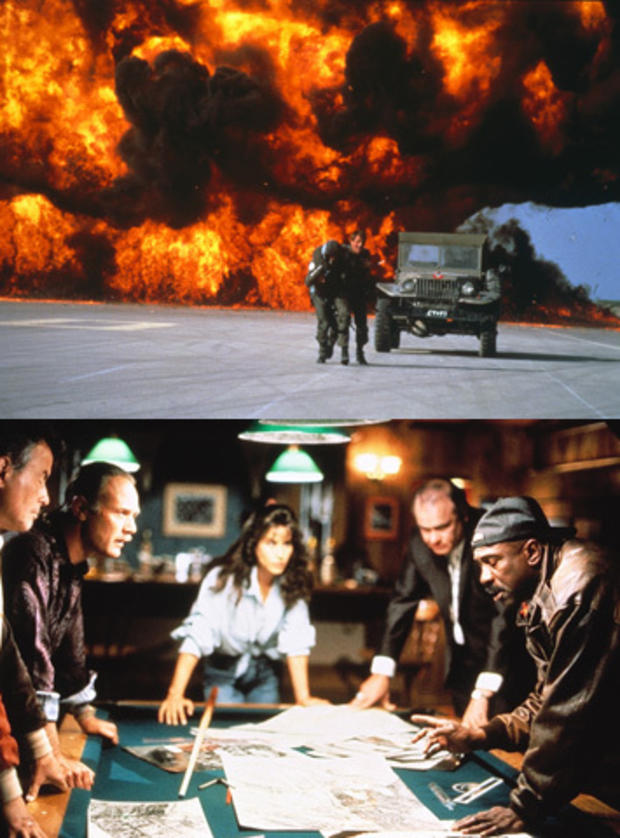
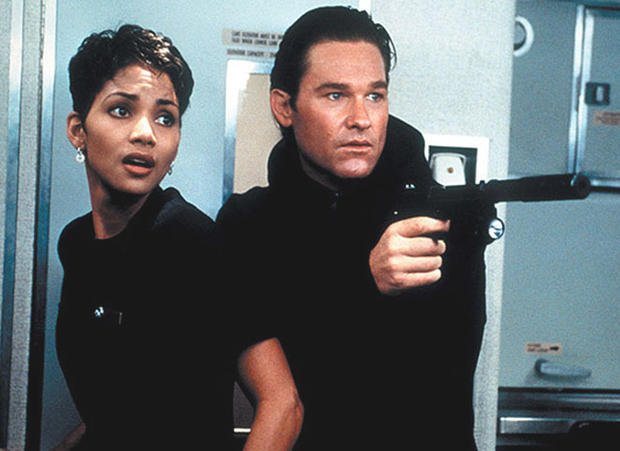
Evoking some prescience, the 1996 actioner "Executive Decision," starring Kurt Russell, Halle Berry and Steven Segal, told of a 747 hijacked by Arab terrorists. While demanding the release of one of their compatriots, their ultimate plan is to fly the plane - loaded with nerve gas - into Washington D.C. and detonate it.
Columbia Pictures
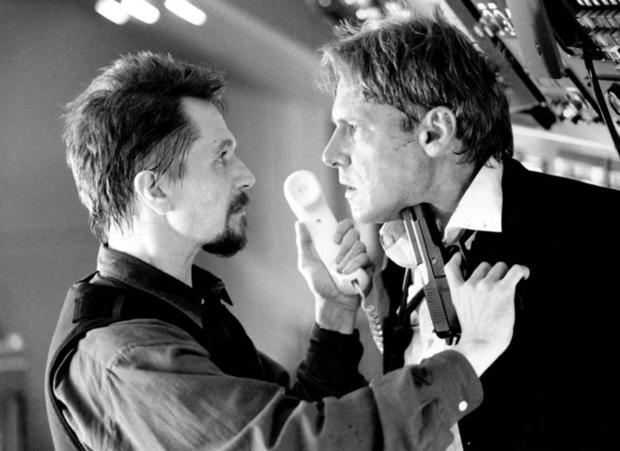
A terrorist (Gary Oldman) holds the president of the United States (Harrison Ford) and his family hostage aboard "Air Force One" (1997). Not even the henchmen of a "terrorist regime" in a former Soviet republic could beat THIS president, though, as Ford not only kills terrorists but pilots the plane himself. We suspect on his reelection bid Ford's Electoral College victory will be a landslide.
MGM
In "Ronin" (1998) Irish terrorists and black marketeers battled mercenaries over a mysterious package. The car chases and bullets spread over much of Europe.
20th Century Fox
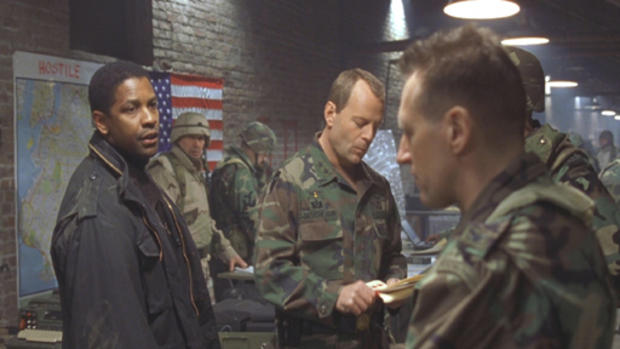
"The Siege" (1998), starring Denzel Washington, showed the repercussions of terrorist attacks on the United States as martial law is declared. Men of Arab descent are interned at a prison camp, while New Yorkers protest racial profiling.
Hollywood's history of depicting minority groups has been fraught with allegations of stereotyping, and pressure by activist organizations to protect their constituents. Just as Italian American groups chaffed at movie mafiosos and Asian American groups condemned depictions of Orientals as opium dealers, the Muslim American group Council on American-Islamic Relations (CAIR) campaigned to promote less stereotypical depictions of Muslims in films. Prior to the release of "The Siege," CAIR met with the producers requesting changes in the film's depiction of Muslims; when not all their requests were accepted, CAIR organized protests in advance of the film's opening. "Unfortunately, the producers refused to change the plot line associating Islamic practices with violence," CAIR said in a statement.
Warner Brothers
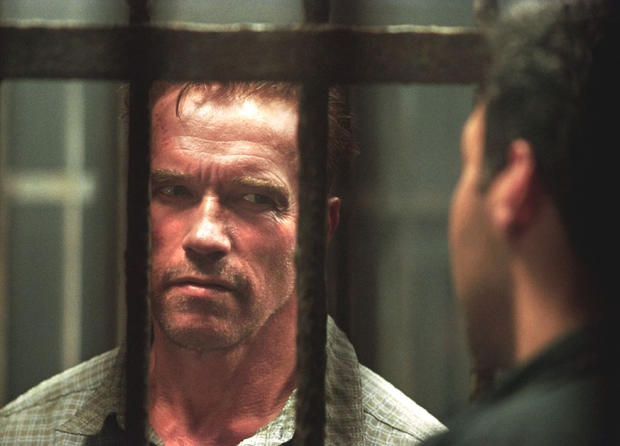
Following 9/11, action films were affected by rewrites and reshoots to tone down allusions to the real-life attacks. The release of the Arnold Schwarzenegger action film "Collateral Damage" (left) of a man seeking revenge against terrorist who murdered his family, was delayed for four months, and an airplane hijacking scene was cut. Miramax delayed release of "Buffalo Soldiers" (about U.S. troops dealing in arms with terrorists). The conclusion of "Men in Black II" was also rewritten - no longer to feature the World Trade Center towers opening up to release a slew of flying saucers.
Robert Ludlum's spy thriller "The Bourne Identity," starring Matt Damon as an amnesiac being hounded by assassins, was directly affected by the events of 9/11; reshoots scheduled in New York City for the Fall of 2001 had to be postponed.
Other films whose productions were halted or shelved altogether: "Tick Tock," about a terrorist bomber; and "Hellevator: Trapped in the World Trade Center," about the 1993 bombing of the Twin Towers.
CBS
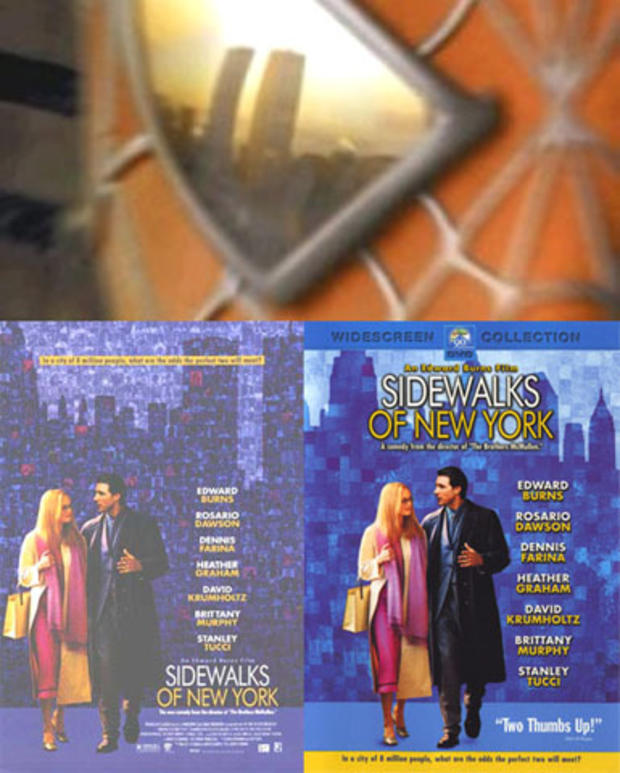
After the 9/11 attacks, Hollywood was very touchy about ANY depictions of the World Trade Center on film. Images of the Twin Towers in movies, trailers and ads were deleted - erasing the memory and, in a way, reiterating the loss of the towers themselves. (Above: Images from the trailer for "Spider-Man" show a scene cut from the final release depicting the Twin Towers; below, a movie poster with - and DVD box without - the World Trade Center in the skyline above the "Sidewalks of New York.")
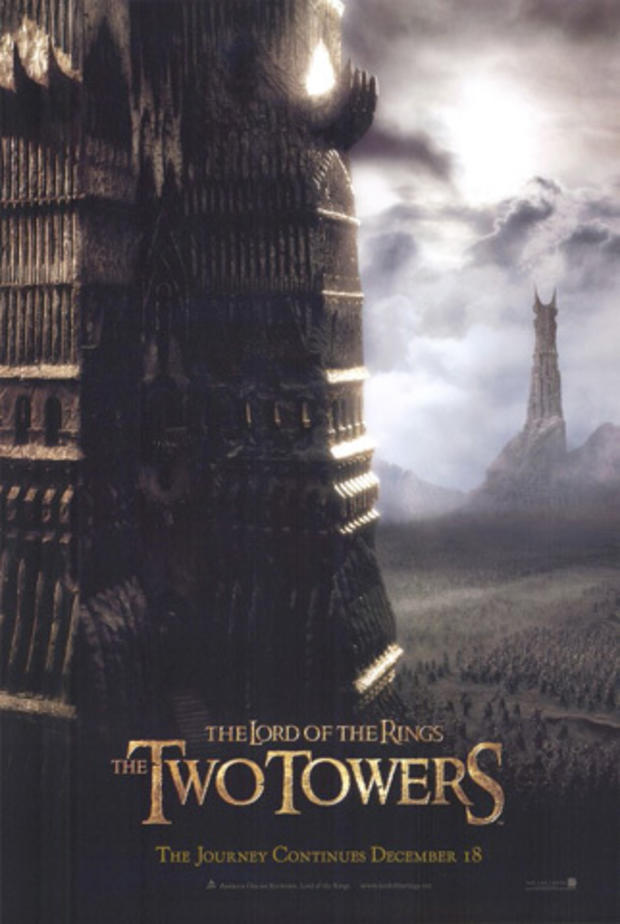
Though producers were wary of offending the ticket-buying public, not all attempts at forcing Hollywood to bow to the sensibilities of audiences were taken seriously. Prior to the release of the second "Lord of the Rings" film in 2002, someone began an online petition calling for Peter Jackson and New Line Cinema to change the title of the adaptation of the J.R.R. Tolkien fantasy from its original name, "The Two Towers."
"The title is clearly meant to refer to the attacks on The World Trade Center," the petition author wrote at petitiononline.com. "In this post-September 11 world, it is unforgivable that this should be allowed to happen. The idea is both offensive and morally repugnant."
The filmmakers didn't buy it - nor did the many who created snarky counter-petitions against censoring the title from a book published in 1954 - nearly two decades before the Twin Towers were built.
Paramount Pictures
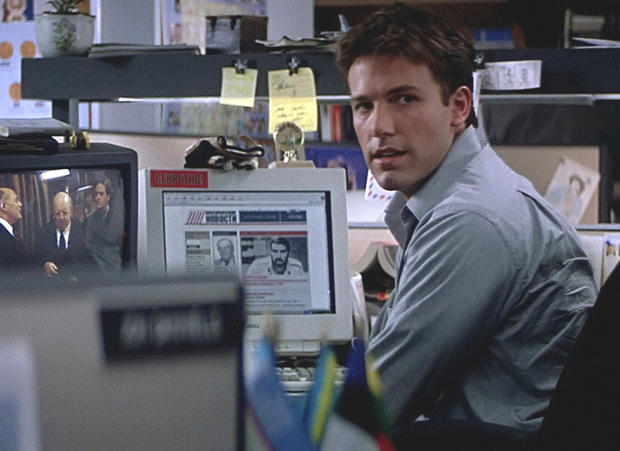
Filmed before 9/11 for a Summer 2002 release, "The Sum of All Fears" (starring Ben Affleck, left) changed the terrorists who deploy a nuclear device to blow up Baltimore. In Tom Clancy's original novel they were Arabs; in the movie, neo-Nazis pretending to be Russians, hoping the attack will justify rekindling the Cold War.
In a letter to CAIR, director Phil Alden Robinson promised that Muslims would not be depicted as terrorists, and that he had "no intention of promoting negative images of Muslims or Arabs."
CAIR's board chairman Omar Ahmad said he hoped the case of "Sum of All Fears" would serve as a precedent for other Hollywood movies. No word on the reaction from white supremacist groups.
Universal Pictures
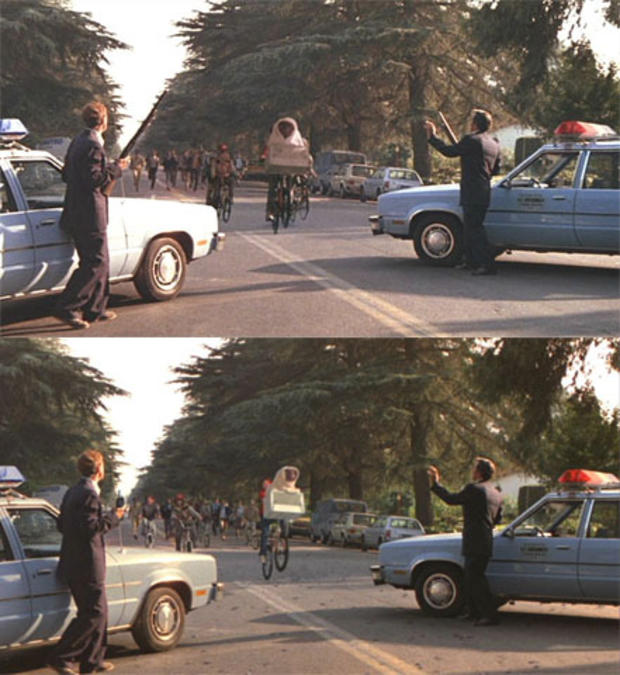
Among the more noticeable changes made to "E.T.: The Extra-terrestrial" prior to its 20th anniversary re-release in 2002 was the deletion of firearms carried by the agents chasing Henry Thomas and the alien (in some shots guns were digitally replaced with walkie-talkies). Dee Wallace's line to her son about his Halloween costume plans - "You are not going as a terrorist" - was changed to "hippie."
Universal Pictures
Post 9/11, no one was safe - not even dialogue from a six-year-old comedy. In broadcasts of "Back to the Future," references to "Libyan terrorists" - those who made a deal with Christopher Lloyd's scientist for nuclear material, and then shot him when they realized he'd given them pinball machine parts instead - were either cut or changed to "Libyan nationalists."
Fox Television
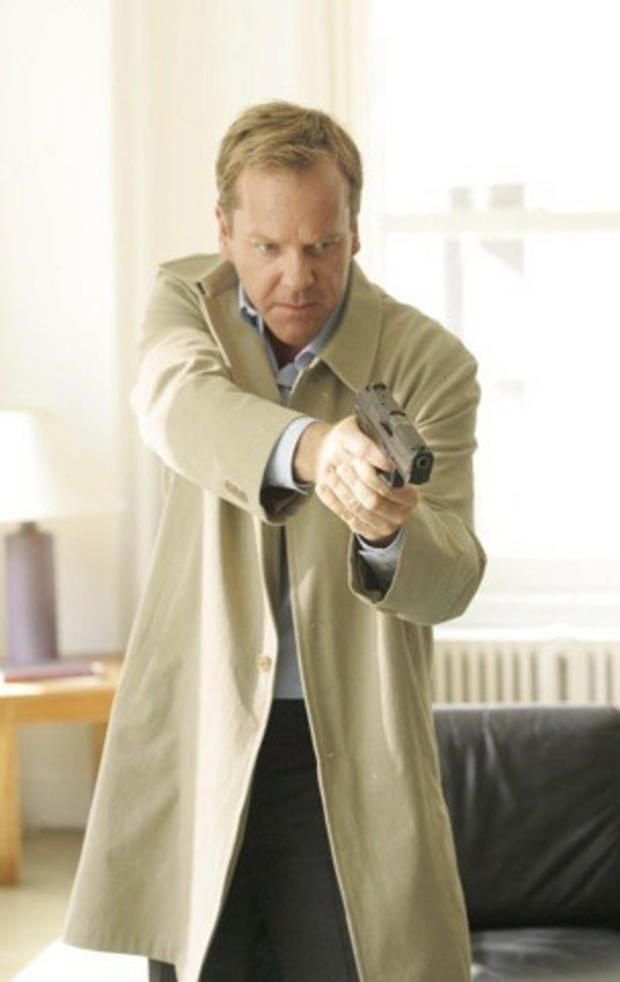
When it came to portraying terrorist immediately following 9/11, TV producers went where movie producers feared to tread. The pilot of "24" and several episodes had already been shot when the terror attacks occurred, and while the premiere on Fox Television was delayed a week, the series which starred Kiefer Sutherland as a counter terrorist agent soon became a huge hit.
Agent Jack Bauer's use of abusive (and highly illegal) interrogation tactics - suffocation, electrocution, etc - to get vital information from terror suspects was actually cited by Bush administration officials and lawmakers in their tortured reasoning for condoning unconstitutional treatment of prisoners.
In 2007, as the show was in its 6th season, General Patrick Finnegan of the U.S. Military Academy at West Point met with the show's producers to request they tone down the promotion of illegal behavior, saying it was having a negative effect on American troops overseas.
New Concorde
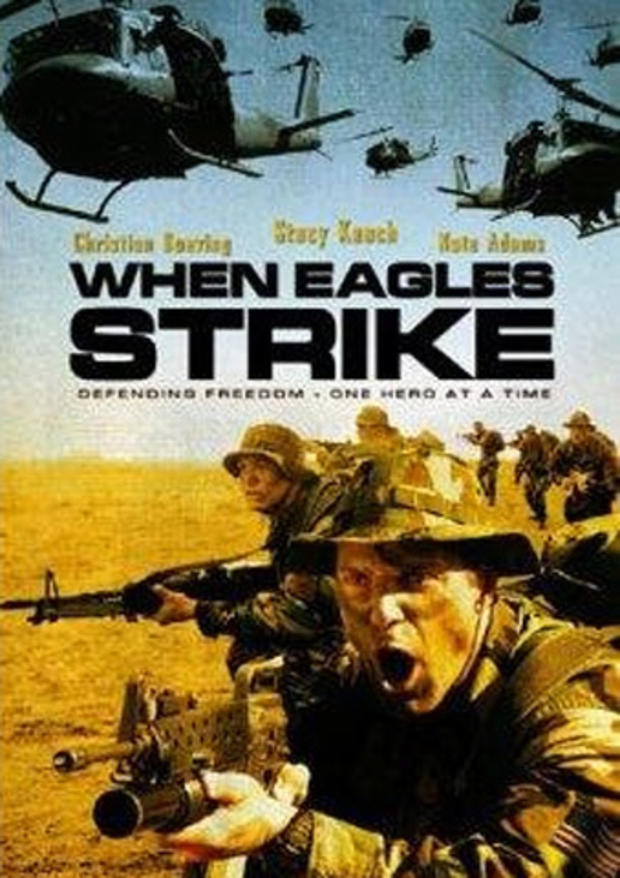
As American military might was unleashed against Afghanistan and then Iraq, producers slowly began to follow. Veteran B-movie maven Roger Corman produced "When Eagles Strike," a.k.a. "Operation Balikatan" (2003). Shot in the Philippines, the film ("Inspired by true events") concerns an elite group of U.S. Marines trying to rescue hostages, including an American politician, held by terrorists. Lots of stuff blows up.
Paramount
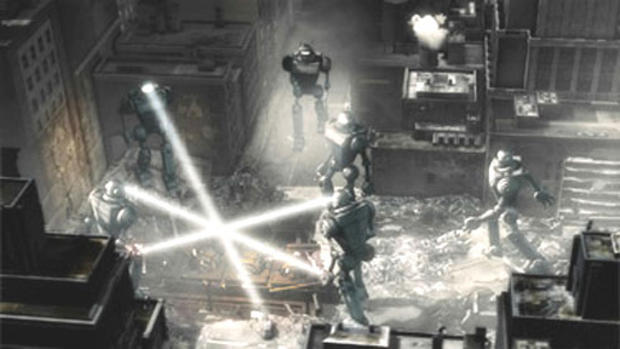
With 9/11 still a painfully close memory, contemporary terrorism was a difficult sell for producers, but retro-terrorism or sci-fi terrorism was less so. "Sky Captain and the World of Tomorrow" (2004) presented a retro-history of zeppelins and a mad scientist seeking to take control of the world in 1939 with an army of giant robots.
Paramount
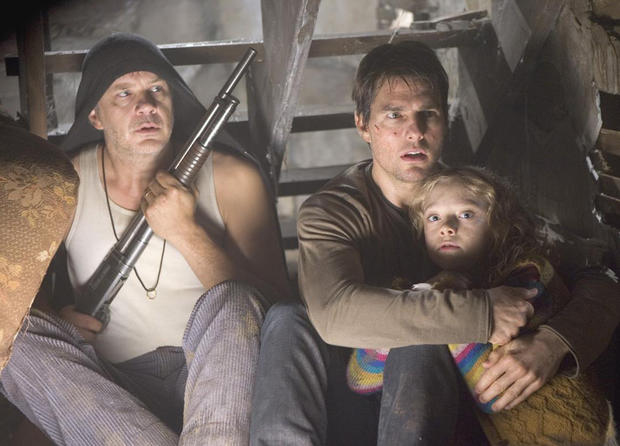
In Steven Spielberg's update of "War of the Worlds" (2005), an attack on their city by Martians leads a young child to ask her father, "Is it the terrorists?" Well, yes - terrorists with scaly skin and death rays, that is. (Pictured: Tim Robbins, Tom Cruise and Dakota Fanning.)
20th Century Fox
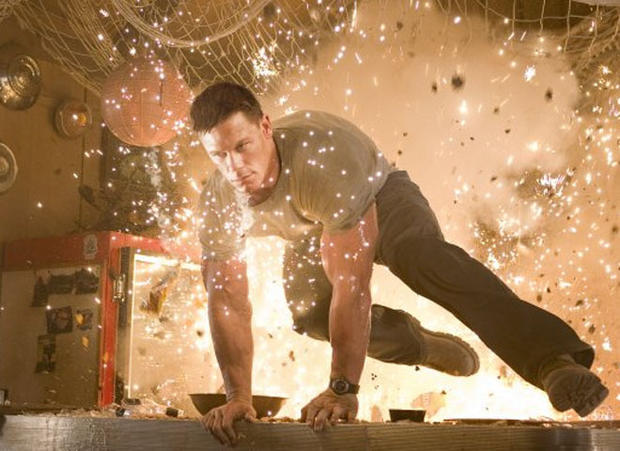
In the 1970s, movies about vets often painted them as haunted by the horrors they faced in Vietnam at the hands of Communist fighters. In "The Marine" (2006), John Cena is haunted by the horrors he faced in Iraq at the hands of terrorists. Back home, he gives criminal elements who cross his path what-for.
Warner Brothers
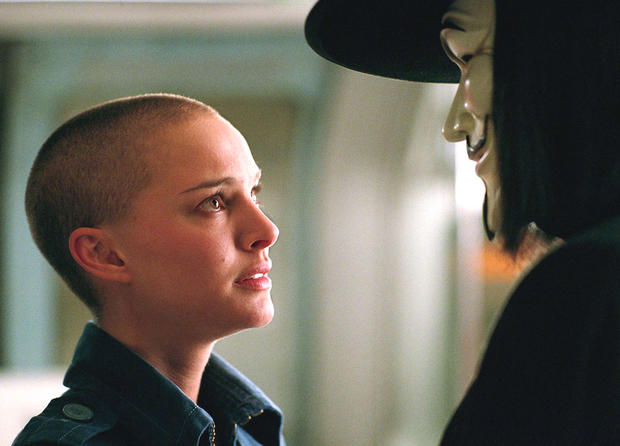
"V for Vendetta" (2006), based on the graphic novel by Alan Moore, is a futuristic dystopian tale of terrorists - sorry, "freedom fighters" - battling a totalitarian U.K. government in the year 2020. A box office hit, the film did not make Natalie Portman's shaved head a fashion icon, but the revolutionaries' Guy Fawkes masks were picked up by protest groups and anarchists, like the hackers group Anonymous. And if you think that bodes ill for capitalism, Warner Brothers - which produced "V for Vendetta" - gets a royalty for each Guy Fawkes mask sold!
Universal Pictures
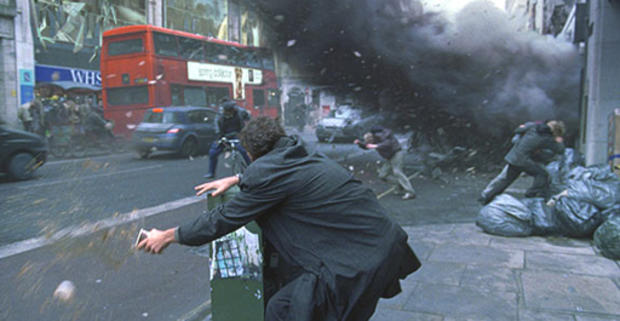
In "Children of Men" (2006), a mysterious malady that has befallen the human race, making it infertile, has precipitated the rise of a police state in England. The cloud of terrorism colors not only the dank hues of the film's gritty photography but also the lives of a small band of "terrorists" who are trying to help the seemingly sole pregnant woman escape alive. In this film's London, a city under siege, residents are not unlike those of Baghdad caught in the midst of gun battles between an occupying army and jihadist militants.
Warner Brothers
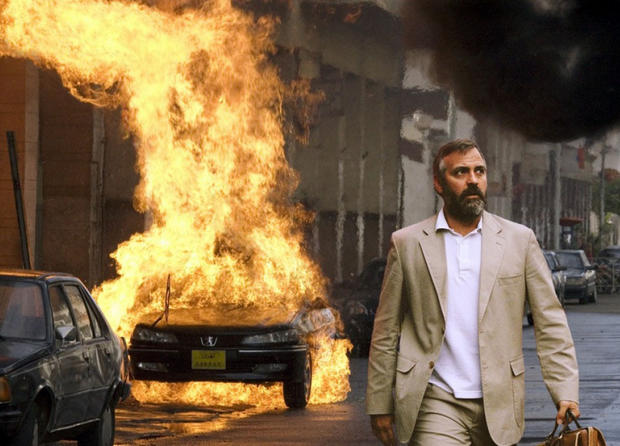
"Syriana" (2006) featured interwoven storylines of oil, Western business interests, and terrorism in the Middle East. Among the cast of characters is a CIA operations officer (George Clooney, in an Oscar-winning performance) whose efforts against arms trafficking lead him to being captured and tortured when sent to assassinate a financier for arms dealers.
Universal Pictures
While terrorism in general had crept back into the movies, often through fantasy, it was still several years before the actual events of 9/11 were depicted on film.
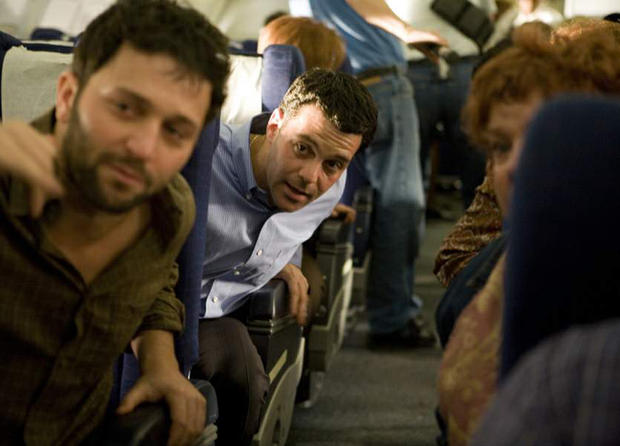
"United 93" (2006), directed by Paul Greengrass ("The Bourne Supremacy"), captured the terror, claustrophobia and resistance of the passengers of one of the four hijacked planes on Sept. 11, 2001 prior to its fatal plunge into the woods of Shanksville, Pa. Critics applauded, and Greengrass received an Academy Award nomination for Best Director. But box office was tepid - it was still too close to home for many.
Paramount Pictures
Oliver Stone tackled the horror of ground zero in "World Trade Center" (2006), in which Port Authority Police officers Nicolas Cage and Michael Pena are trapped in the rubble of the collapsed towers.
IFC
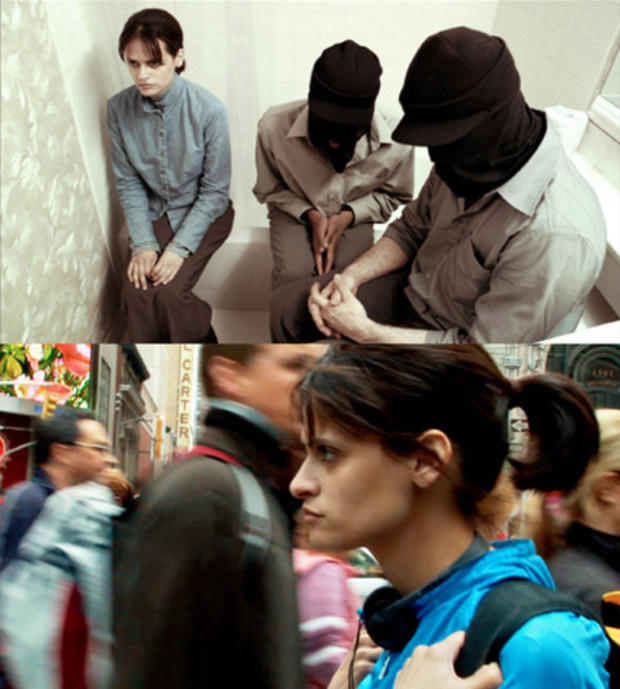
In "Day Night Day Night," a prize winner at the 2006 Cannes Film Festival, a 19-year-old girl (Luisa Williams) is recruited to serve as a suicide bomber in New York's Times Square.
20th Century Fox
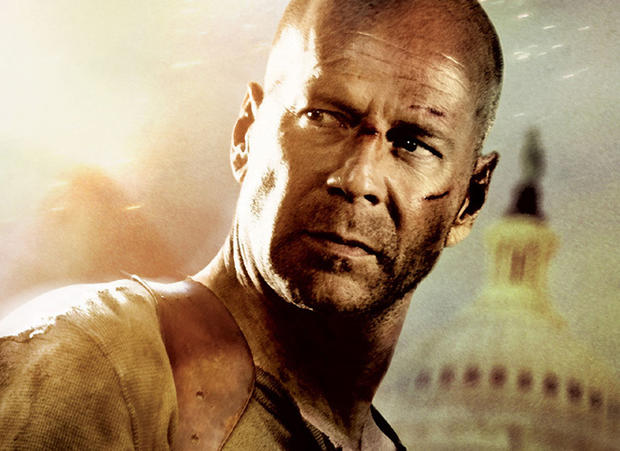
While in the first "Die Hard" John McClane (Bruce Willis) landed in a faux terrorist attack, in "Live Free or Die Hard" (2007) he comes up against a REAL terrorist attack upon the nation's computer systems. It just so happens the terrorist is actually a disgruntled former employee of the U.S. government, but that didn't make the computer hacking any less disruptive.
Universal Pictures
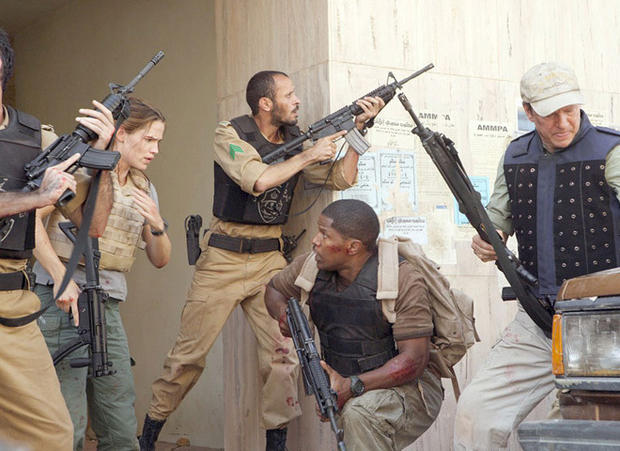
"The Kingdom" (2007), starring Jamie Foxx and Chris Cooper, was inspired by bomb attacks in Saudi Arabia, and told the fictional story of FBI agents investigating a terrorism attack on a foreign worker facility by al Qaeda members disguised as Saudi police.
Paramount Pictures
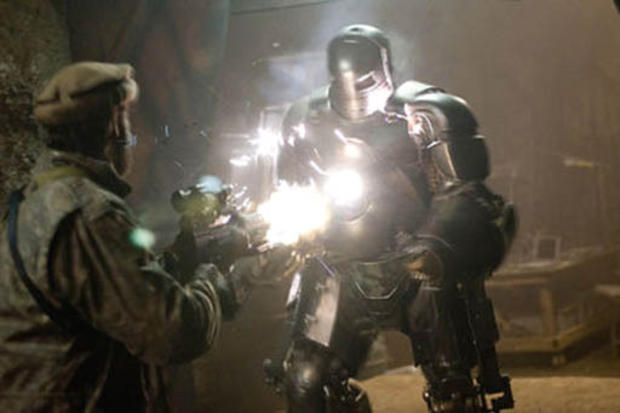
We actually have terrorists to thank for the creation of "Iron Man" (2008). After arms merchant Robert Downey Jr. is kidnapped by members of an Afghan militant group, he escapes his captors by constructing an invulnerable flying suit (pictured). That leads to his development of Iron Man v.2, which he uses for joy rides, battling corporate nasties, and wooing his comely assistant. In "Iron Man 2" (2000), he gets to battle a sort-of-terrorist, played by Mickey Rourke, who sports a pretty hefty battle suit of his own.
Universal Pictures
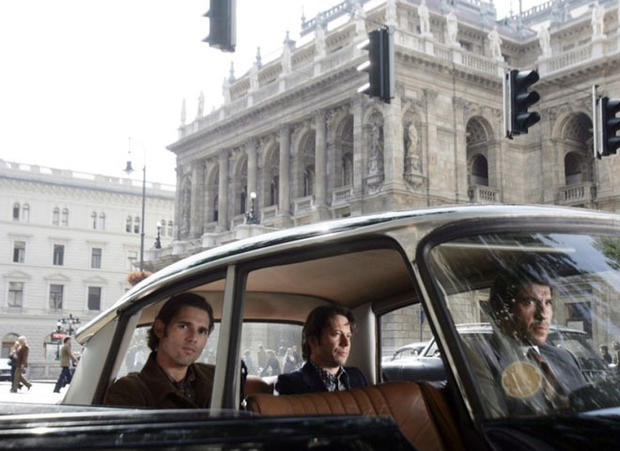
Some recent movies have looked back at terrorism of the past. In "Munich" (2005), directed by Steven Spielberg, Eric Bana (left, with Mathieu Amalric) leads a team of Israeli assassins out to avenge the terrorist attack at the 1972 Munich Olympics in which 11 Israeli athletes were killed.
Vitagraph
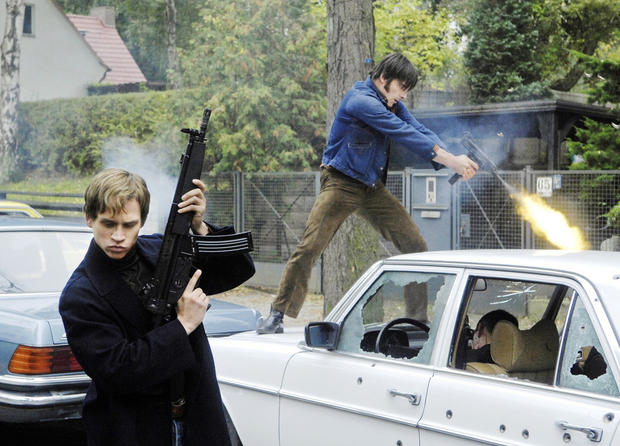
An Oscar nominee for Best Foreign Language Film, "The Baader Meinhof Complex" (2008) from director Uli Edel ("Last Exit to Brooklyn") looks at the German Red Army Faction (RAF), which organized bombings, robberies, kidnappings and assassinations in the late 1960s and '70s.
IFC Films
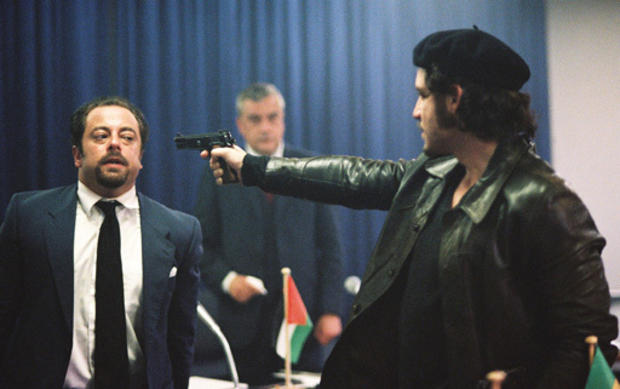
In "Carlos" (2010), the 1970s radical-mercenary Carlos the Jackal sells his services to the Palestinians to attack an OPEC meeting and kidnap the Saudi representative - but he can't find a safe haven in Muammar Qaddafi's Libya. A mesmerizing story, "Carlos" shows how a political revolutionary who became a gun-for-hire and a media celebrity found himself cast aside as political winds change around him.
(From Left: Badih Abou Chakra as Cheikh Ahmed Zaki Yamani, and Edgar Ramirez as Ilich Ramirez Sanchez, a.k.a. Carlos the Jackal.)
Senator U.S.
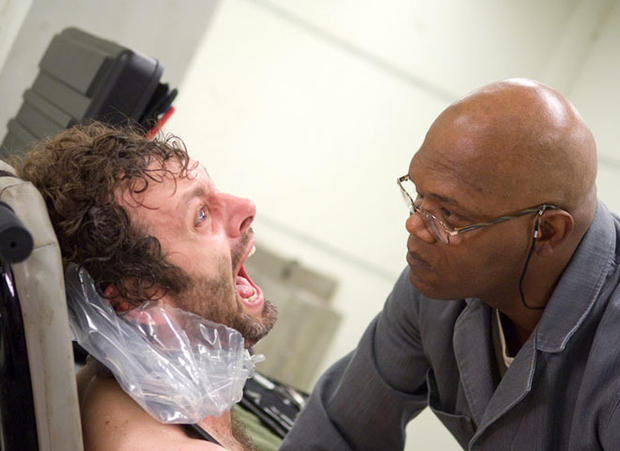
Do the ends justify the means? In "Unthinkable" (2010), Samuel L. Jackson interrogates a Muslim terrorist (Michael Sheen) and is not averse to using torture against him - and against his loved ones - to obtain information about a potential nuclear threat.
Summit
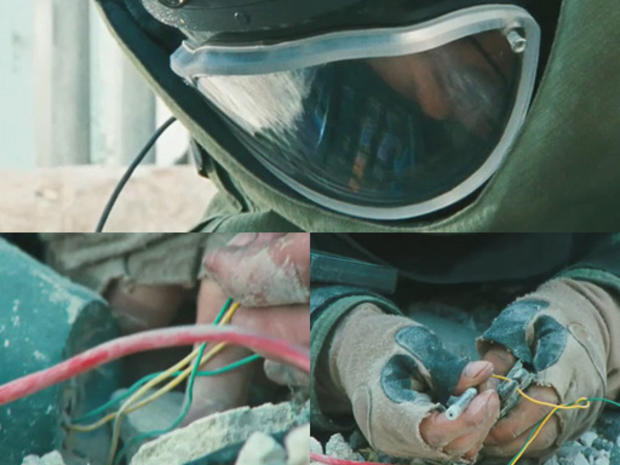
"The Hurt Locker," the Academy Award winner for Best Picture of 2010, was a gripping story of bomb disposal technicians in Iraq, who must contend with IEDs, snipers, and time bombs.
Director Kathryn Bigelow and screenwriter Mark Boal are following up their Oscar-winning success with a film about the Navy's SEAL Team Six and the raid that killed al Qaeda leader Osama bin Laden.
Congressman Peter King, the Republican Chairman of the House Committee on Homeland Security, sent a letter to the CIA asking for a probe of Bigelow's film and whether it would include sensitive information, for fear of "tipping off the enemy." King also expressed concern that the film's projected release date, October 2012, fell just a few weeks before the election.
Summit Entertainment
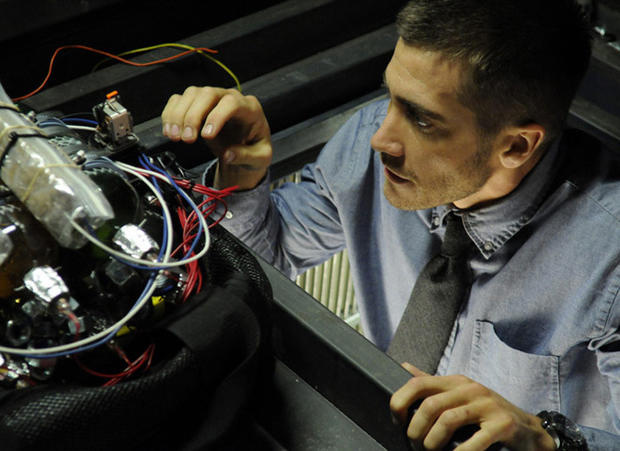
Domestic terrorism was the focus of the 2011 sci-fi thriller "Source Code," which starred Jake Gyllenhaal as an Afghan War veteran enlisted in a secret government project to enter the memory of a terrorist bombing victim, in order to discern the identity of the terrorist.