Meet the new Mars rover
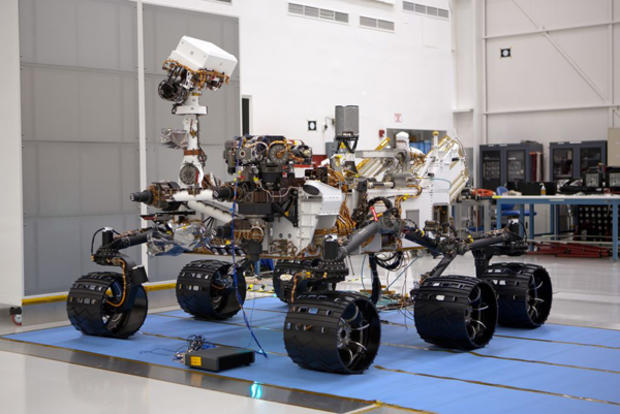
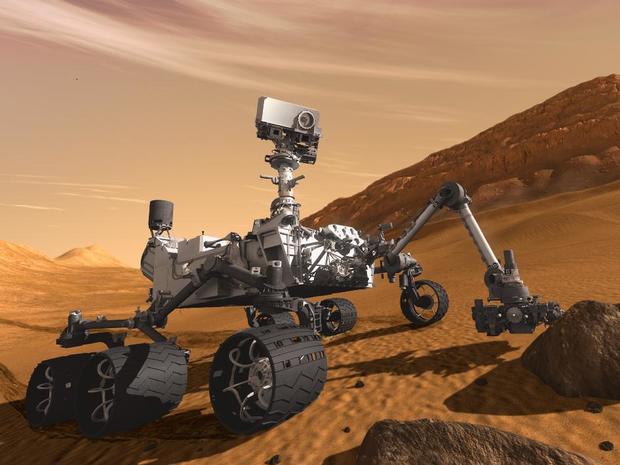
At 2.8 meters long, the nuclear-powered, Mini Cooper-sized rover called Curiosity is twice as long and four times as heavy as its Spirit and Opportunity predecessors, NASA says.
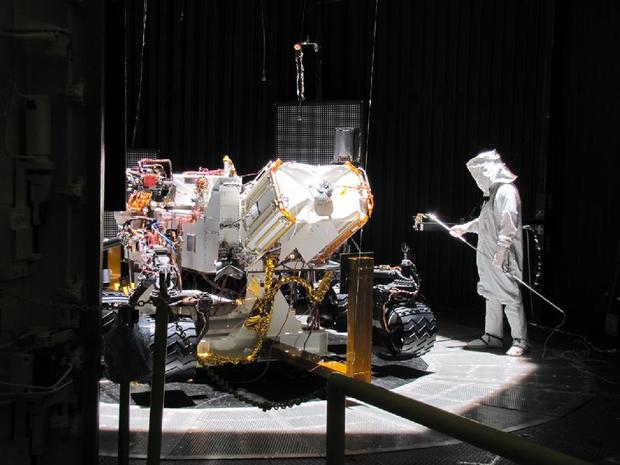
Inside a 25-foot-diameter space simulation chamber at NASA's Jet Propulsion Laboratory in Pasadena, Calif., during one of the final phases of testing of the Mars Science Laboratory rover last month, Curiosity was put through operational sequences in simulated Martian conditions.
Sealing in a near-vacuum environment, the chamber is filled with liquid nitrogen and cooled to minus 202 degrees Fahrenheit, and giant light panels simulate Mars' sunshine.
Seen here on March 8, with all of its primary flight hardware and instruments, technicians use a wand to map the solar simulation intensities at different locations inside the chamber prior to the start of tests, NASA says.
Eyes on Curiosity rover's driving
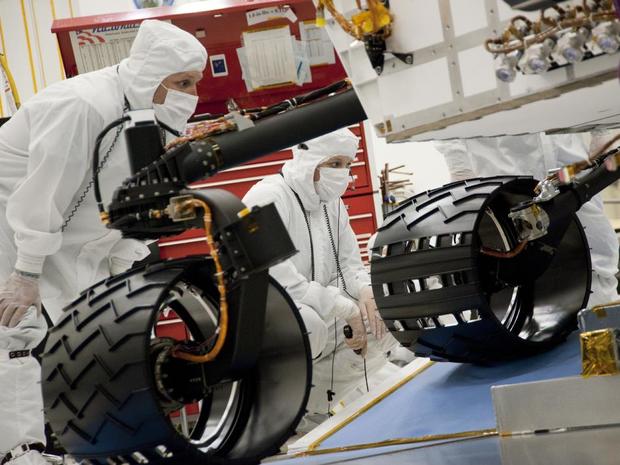
Each of Curiosity's six wheels has an independent drive motor. The two front and two rear wheels have individual steering motors that allow the rover to make 360-degree turns in place; it also has increased mobility with wheels that are double the wheel diameter on Spirit and Opportunity. That gives Curiosity the ability to more easily climb and roll over high terrain.
The nuclear power system on board will enable Curiosity to operate year-round and travel farther from the Martian equator than is possible with solar-powered rovers.
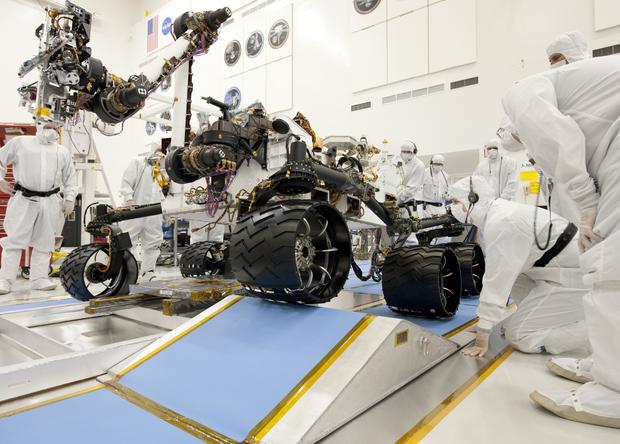
Navigation tests at NASA's JPL
Weather sensors from Spain on Mars rover Curiosity
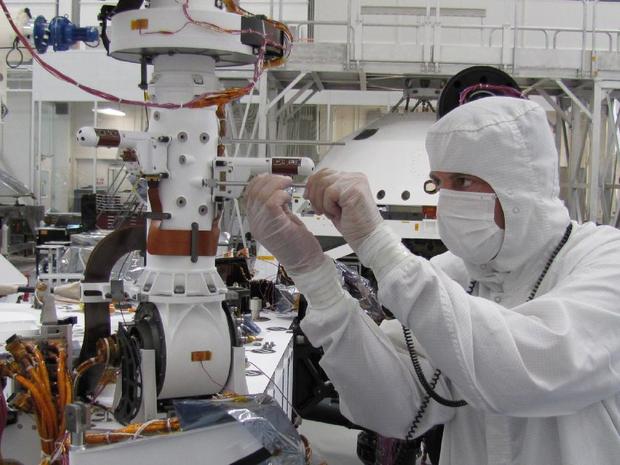
In this image, a technician installs the Rover Environmental Monitoring Station (REMS) in September 2010 inside a clean room at NASA's Jet Propulsion Laboratory in Pasadena, Calif.
Other sensors in the REMS, which is provided by Spain's Ministry of Science and Innovation and its Center for Industrial Technology Development, will monitor humidity and ground temperature, NASA says.
REMS also includes an ultraviolet-light sensor on the rover deck and an air-pressure sensor mounted inside the rover's body along with the instrument's data recorder and electronic controls.
A high-gain antenna on-board Curiosity allows direct communications between the rover and Earth, using X-band radio transmissions.
Sensor head on the Mars-bound APXS instrument
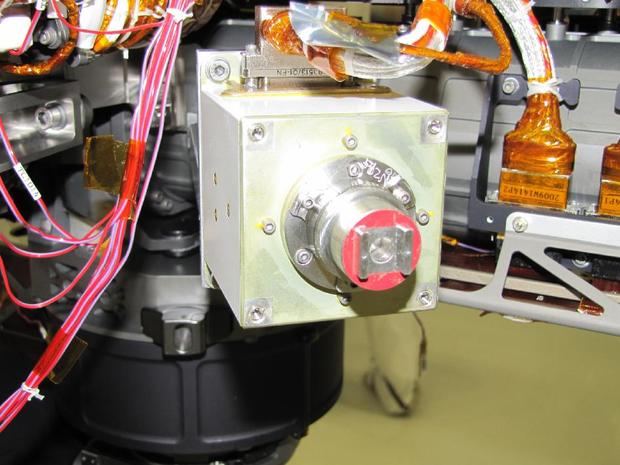
The instrument bombards targeted samples of rock and soil with alpha particles, or helium nuclei, and X-rays; NASA says it then reads the resulting signature alpha particle and radiation that is given off and revealing which elements and how much of each are in the rock and soil samples.
Preparing to install APXS sensor head
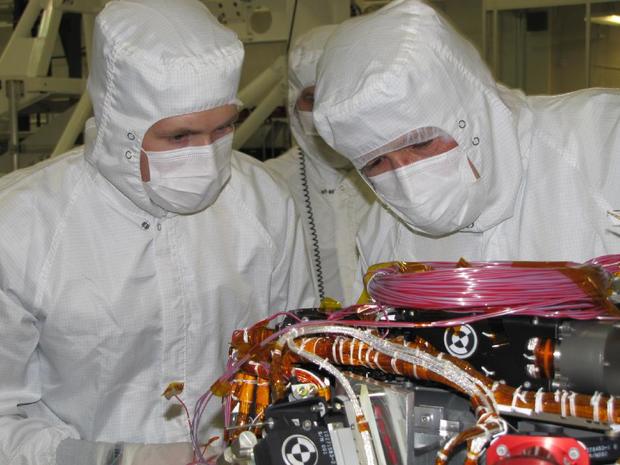
"APXS was modified for Mars Science Laboratory to be faster so it could make quicker measurements. On the Mars Exploration Rovers [Spirit and Opportunity] it took us 5 to 10 hours to get information that we will now collect in 2 to 3 hours," said Gellert, the instrument's principal investigator. "We hope this will help us to investigate more samples."
Installing SAM instrument on Mars rover
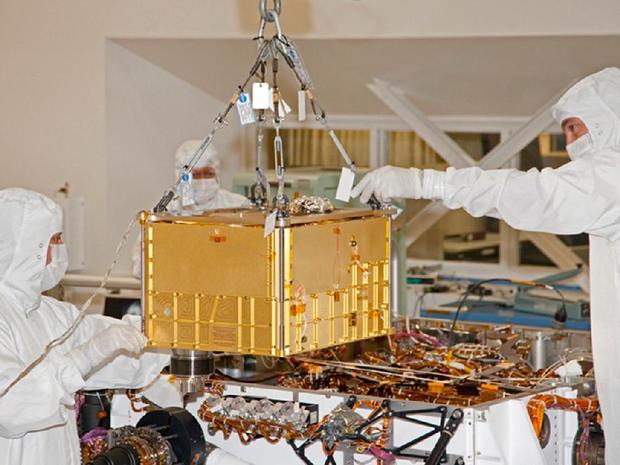
The SAM instrument includes a mass spectrometer built by NASA Goddard, a gas chromatograph contributed by France's national space agency, and a laser spectrometer built by JPL.
Robotic arms will deliver drilled rock and soil samples to 74 on-board sample cups, heating samples to about 1,000 degrees Celsius in its two ovens.
Installing SAM instrument into Curiosity Mars rover
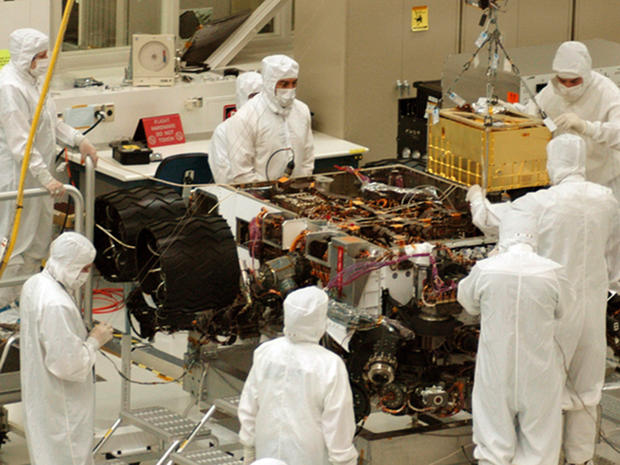
"It has been a long haul getting to this point," said Paul Mahaffy, from NASA's Goddard Space Flight Center, describing the engineering challenges involved in creating such complex, compact instrument clusters. "We've taken a set of experiments that would occupy a good portion of a room on Earth and put them into that box the size of a microwave oven."
One of SAM's primary objectives is to check for carbon compounds called organic molecules, which are among the building blocks of life on Earth.
The clean room suits prevent contamination of biological material from Earth from showing up in results from the highly sensitive SAM system, which has the ability to detect less than one part-per-billion of an organic compound.
Lowering SAM instrument into Curiosity Mars rover
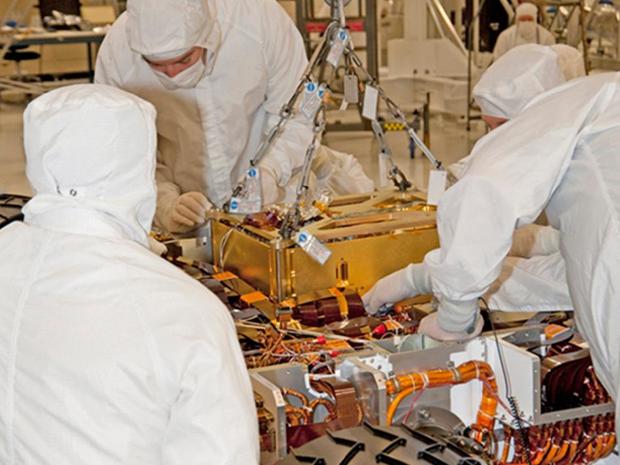
Here, technicians lower SAM into Curiosity at JPL.
ChemCam Mast Unit
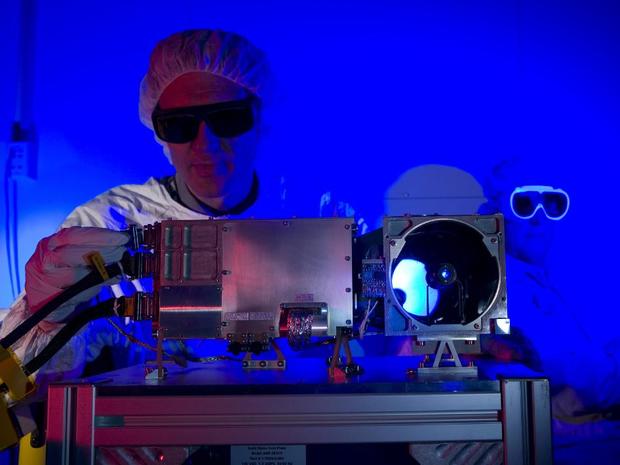
Here, researchers prep the laser, which was designed and built by Los Alamos National Laboratory in Los Alamos, N.M., for a firing test.
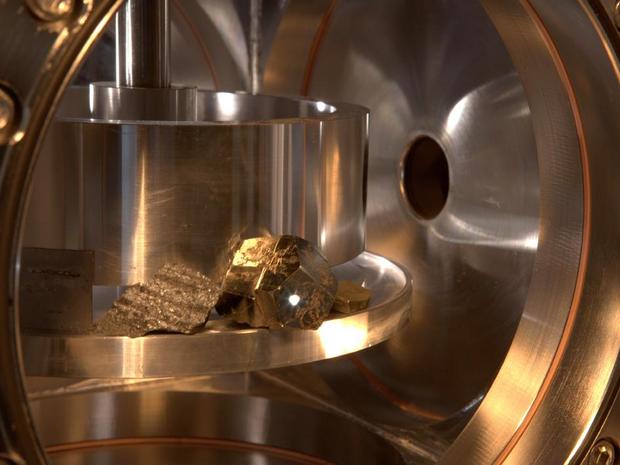
Spark generated by ChemCam laser during tests
Radiation Assessment Detector
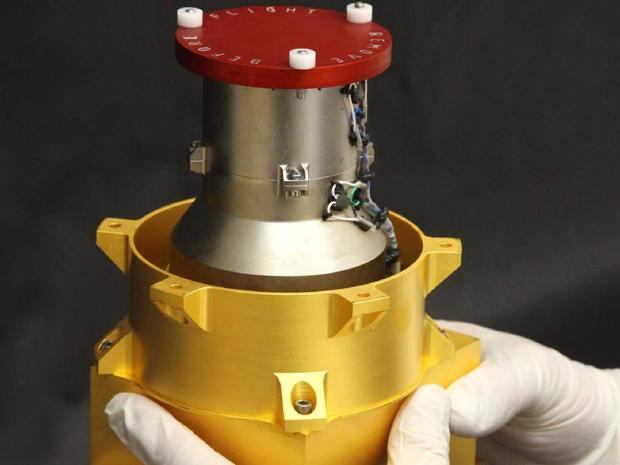
The instrument's telescope, seen here with a red "remove before flight" cover, faces upward with a 65-degree field of view. Two sensors monitor charged particles while a third detects the neutral particles produced by charged-particle radiation's interaction with the Martian atmosphere or ground.
Clean room at JPL
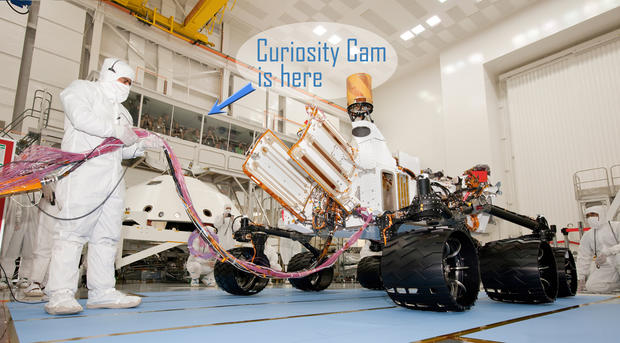
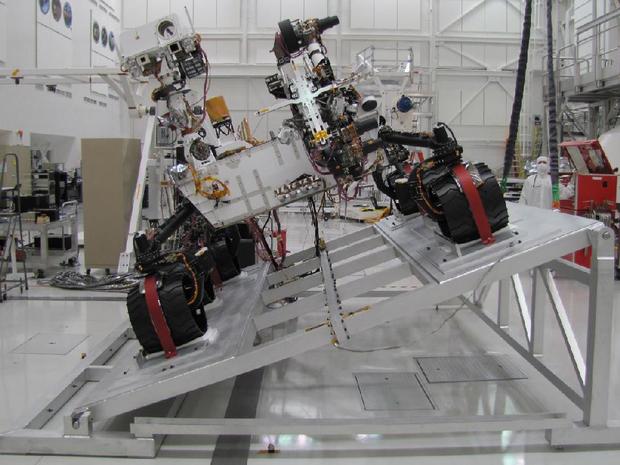
Curiosity on tilt table
With one smaller opening for the telephoto eye (focal length of 100mm) and a larger one for the wider-angle lens that has a focal length of 34 millimeters, the two cameras can provide color images, high-definition video, and a combination for stereo views.
Original plans for Curiosity to carry a high-resolution 3D camera that "Avatar" director James Cameron was helping to build had to be scrapped when NASA apparently ran out of time to test the camera properly.