Alberto E. Rodriguez/Getty Images
The civil rights leader, Baptist minister and politician was born Jesse Burns in Greenville, S.C., on Oct. 8, 1941, to Helen Burns Struggs, who was 16, and Noah Robinson, who was married to another woman. Jackson's mother later married Charles Jackson, who adopted Jesse when he was a teenager.
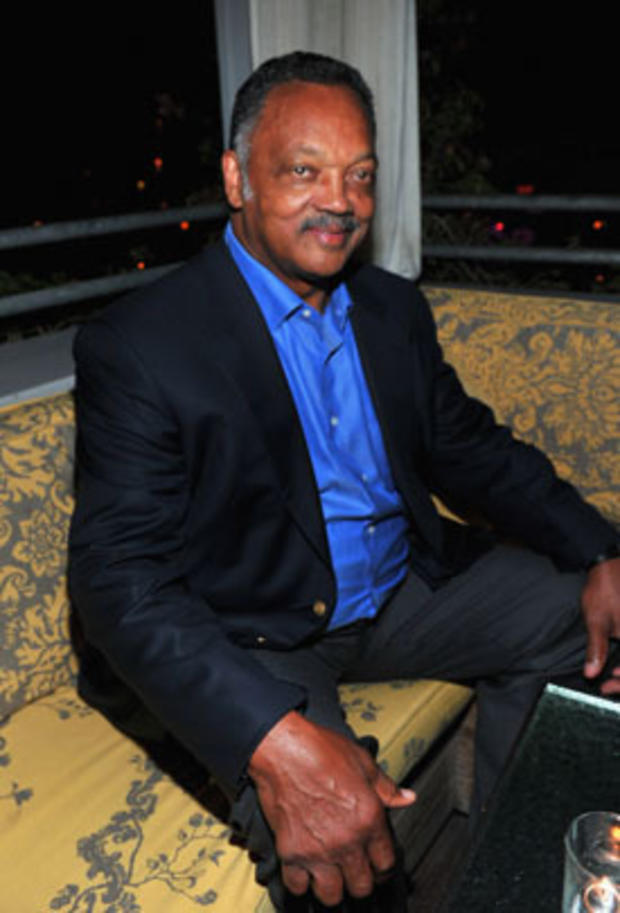
Photo: Jesse Jackson attends the after party for The Weinstein Company's "Our Idiot Brother," Aug. 16, 2011, in Los Angeles.
AP
Jackson attended the University of Illinois on a football scholarship and later transferred to the Agricultural and Technical College of North Carolina. He marched on Selma, Ala., with Martin Luther King Jr. in 1965.
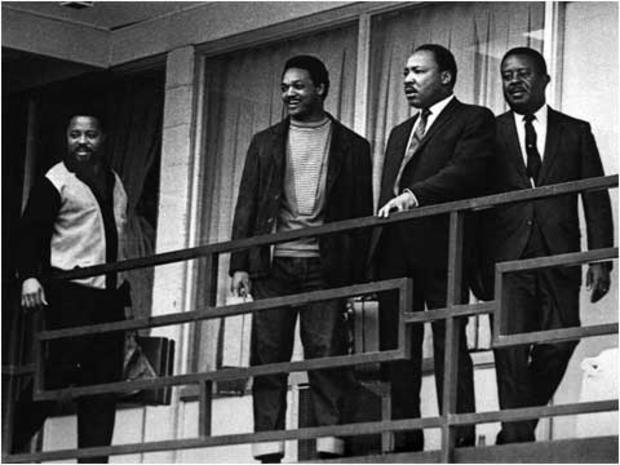
Photo: Martin Luther King Jr. stands with other civil rights leaders on the balcony of the Lorraine Motel in Memphis, Tenn., on April 3, 1968, a day before he was assassinated at approximately the same spot. From left: Hosea Williams, Jackson, King and Ralph Abernathy.
AP Photo
According to biography on the Rainbow/PUSH site, Jackson was ordained on June 30, 1968, by Rev. Clay Evans. He earned a Master of Divinity degree from Chicago Theological Seminary in 2000. Jackson began theological studies in the 1960s but deferred them to work with Dr. King in the civil rights movement.
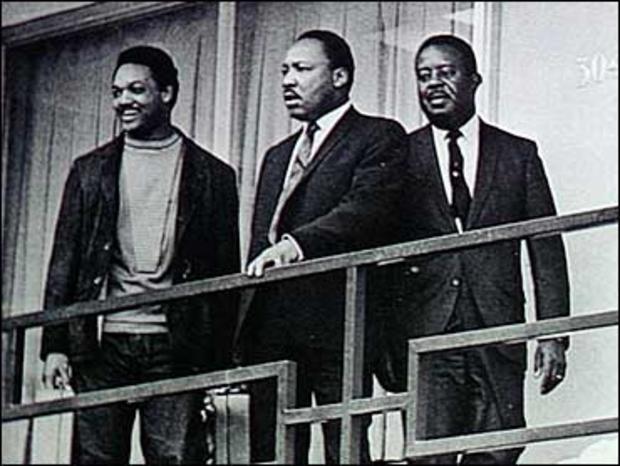
Photo: Jackson, King and Ralph Abernathy on the balcony of the Lorraine Motel in Memphis, Tenn., April 3, 1968, the day before King was gunned down on that same balcony.
AP
After a clash with Ralph Abernathy, Jackson split from Operation Breadbasket, a consortium of entrepreneurs and black ministers, in December 1971 and founded Operation PUSH. Jackson founded the National Rainbow Coalition in 1984. The two organizations merged in the mid-1990s and became Rainbow/PUSH.
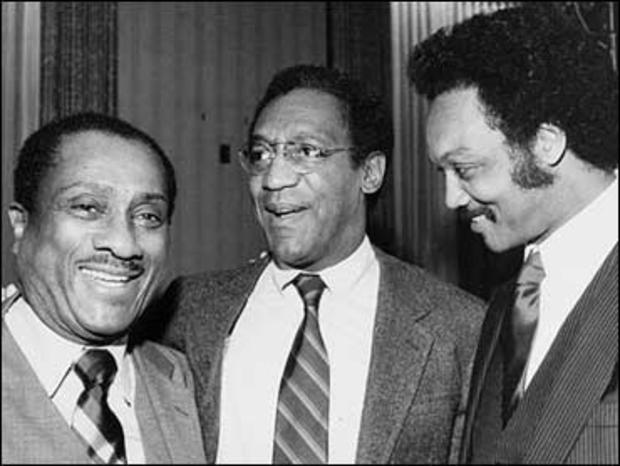
Photo: Publisher John H. Johnson, left, is seen with Bill Cosby, center, and Rev. Jesse Jackson at a benefit reception for Operation PUSH in Chicago on April 1, 1982.
AP
Jackson ran for the Democratic nomination for president in 1984 and 1988. He caused a firestorm of controversy when he called Jews "Hymies" and New York City "Hymietown" in a Washington Post story in January 1984. Still, Jackson received more than 18 percent of the primary votes. Walter Mondale won the Democratic nomination and was soundly defeated by incumbent Ronald Reagan.
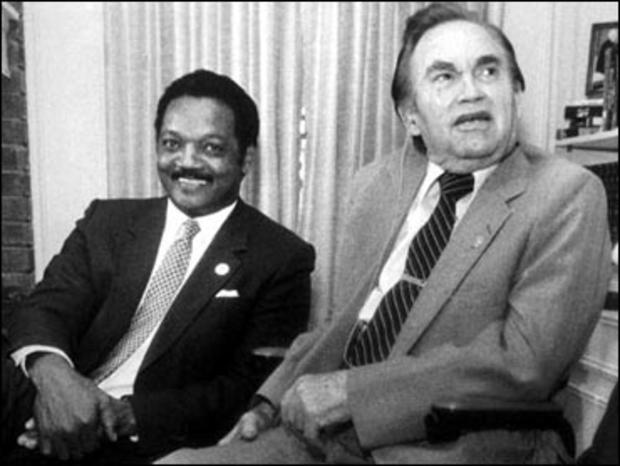
Photo: Alabama governor George C. Wallace, right, is shown at the Governor's Mansion in Montgomery with a meeting between Jackson when he was a presidential hopeful, July 21, 1987.
Jerome Delay/AFP/Getty Images
In 1988, Jackson ran for the Democratic nomination. After doing well in Michigan it looked as though Jackson could win but he lost Massachusetts to Michael Dukakis, who got the nomination and was defeated by George H.W. Bush.
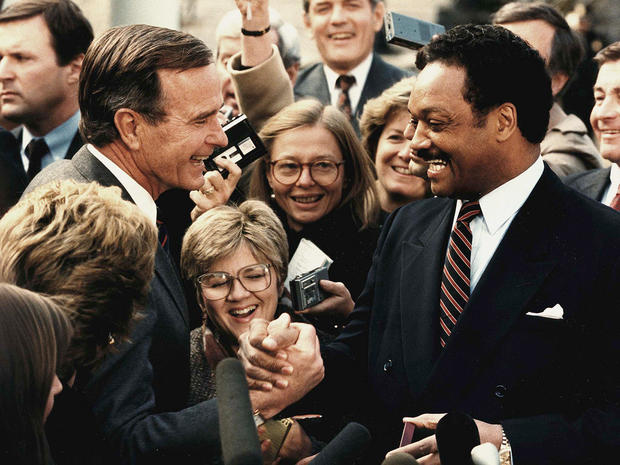
Photo: Then-president-elect George Bush shakes hands with Jackson, Nov. 30, 1988, after a luncheon meeting at the White House in Washington, D.C. Bush, who at one point in the presidental campaign called Jackson a "loose cannon," met with the civil rights leader after receiving a call from Jackson on Nov. 29.
Kevin Larkin/AFP/Getty Images
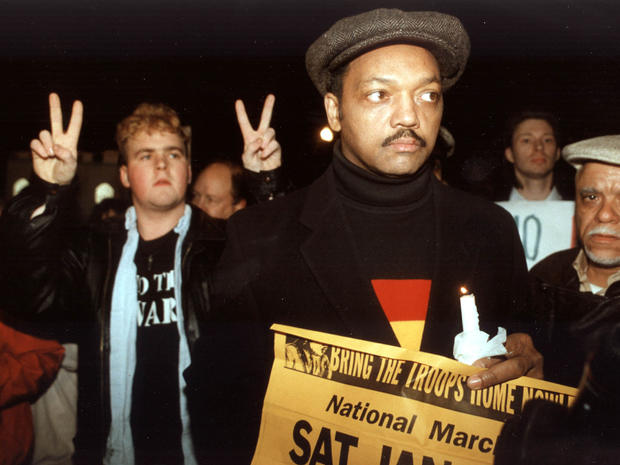
In this photo, Jackson talks to reporters moments before the midnight deadline for Iraq to pull out of Kuwait, Jan. 15, 1991, in Washington.
AP
Jackson, seen here on Sept. 21, 1991, won the release of hundreds of foreign nationals being held in Kuwait by Saddam Hussein that month.
Luke FrazzaAFP/Getty Images
Jackson was a shadow senator for the District of Columbia from 1991-1996. He decided not to run for president in 1992.
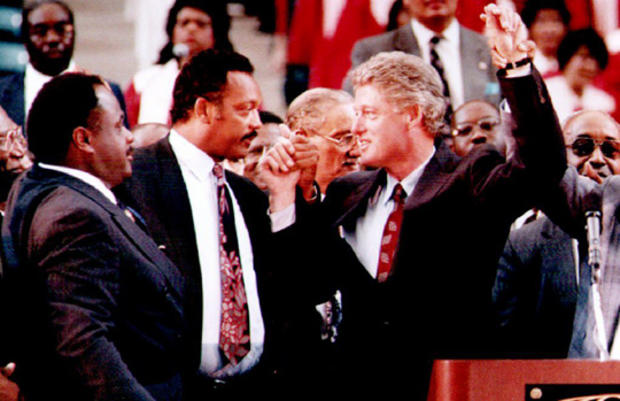
Photo: Then-Democratic presidential candidate Bill Clinton joins hands with Jackson in Atlanta, Sept. 9, 1992, before joining those attending the National Baptist Convention in a song. Later, Jackson told reporters that he and Clinton still had differences but would soon meet to try and work them out.
Getty Images
Despite his differences with President Bill Clinton, Jackson worked with him several times. In December 1997, Jackson went to Kenya to speak with Kenyan president Daniel arap Moi to promote peaceful national elections as Mr. Clinton's "special envoy for democracy." Jackson returned to Kenya in February 1988 to alleviate ethnic tensions.
In April 1999 during the Kosovo war, Jackson went to Belgrade to negotiate for the release of three U.S. POWs captured on the Macedonia border. They'd been with a UN peacekeeping unit. Yugoslav President Slobodan Milosevic released the POWs in May.
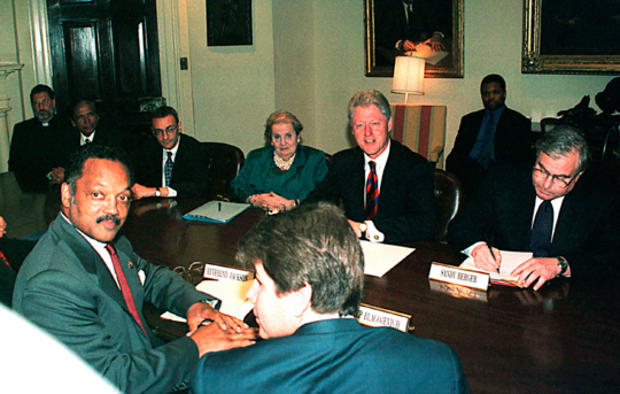
Photo: May 3, 1999, Jackson meets with Mr. Clinton following his trip to Belgrade, Yugoslavia. Others attending include White House Chief of Staff John Podesta; Secretary of State Madeleine Albright and National Security Advisor Sandy Berger.
AP
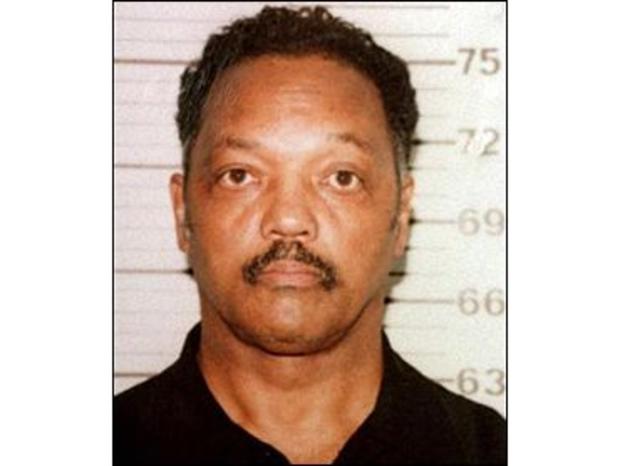
Jackson was arrested Nov. 16, 1999, at a high school in Decatur, Ill., when he attempted to go onto the school's campus, attempting to get six expelled students reinstated. The expulsion was the result of a fight that broke out at a school football game in September.
Jackson was arrested in June 2007 at a demonstration outside a Chicago gun shop. He had been protesting the shop after a 16-year-old honor student was gunned down on a city bus.
Photo: Jesse Jackson police booking photo for the 1999 arrest.
CBS
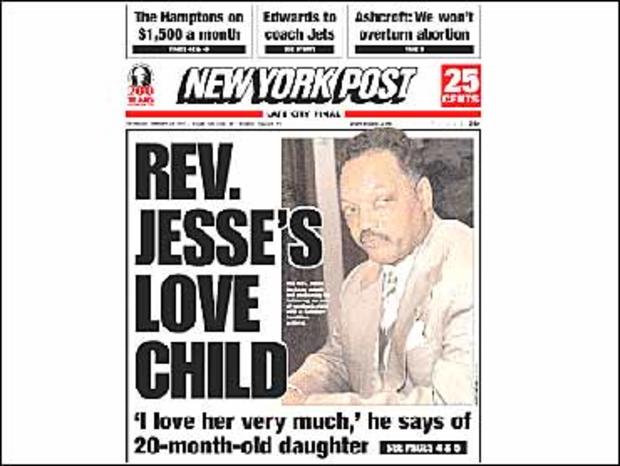
In January 2001 it was revealed that Jackson had fathered a child out of wedlock. The NY Post headline was typical of tabloid coverage. In a statement he said, "I fully accept responsibility and I am truly sorry for my actions."
Stan Honda/AFP/Getty Images
Not long after the revelation that he'd fired a child out of wedlock, Jackson was back in the public eye, appearing at a Rock the Vote event in February 2001. He also worked on behalf of former Enron employees.
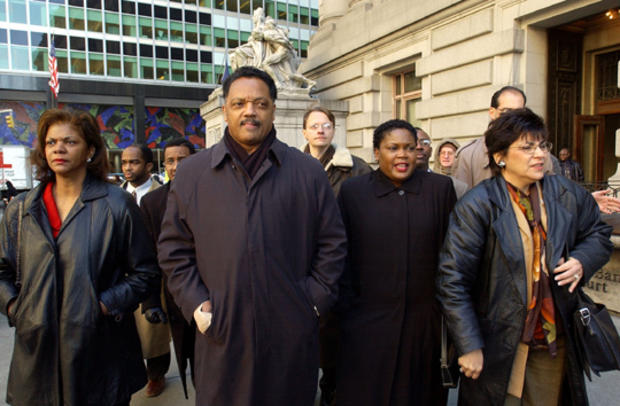
Photo: Jesse Jackson, center, walks with former Enron employees Debra Johnson, left, Gwendolyn Gray, second from right, and Debbie Perotta, right, out of U.S. Bankruptcy Court on Fe. 14, 2002, in New York. The former employees, Jackson and the workers' union AFL-CIO filed a motion Feb. 14 to obtain severance pay for laid off Enron employees.
David Silverman/Getty Images
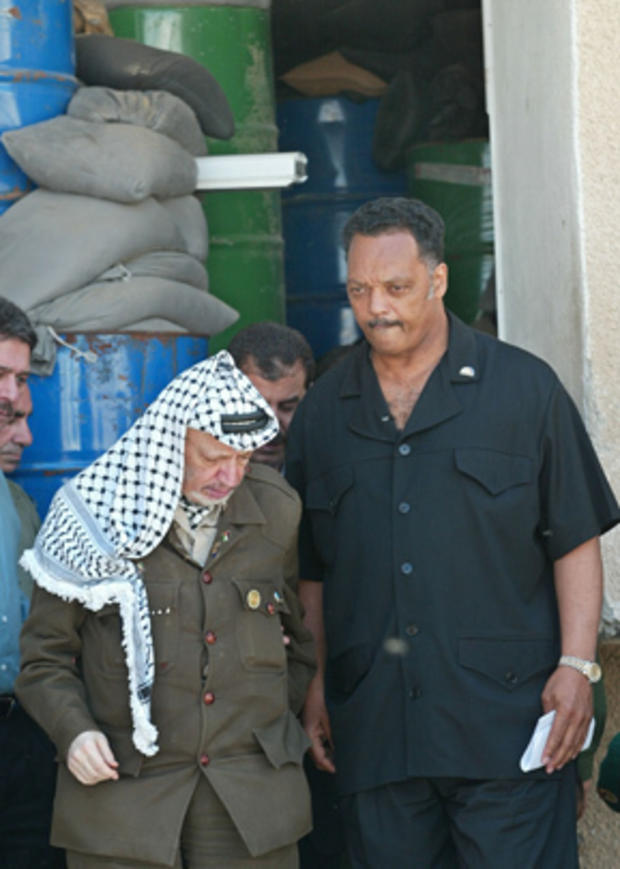
A longtime peace activist, Jackson went on a five-day peace mission the Middle East to encourage Palestinians to adopt non-violent forms of resistance in their 22-month-old uprising to end Israeli occupation.
Photo: Jackson with Palestinian leader Yasser Arafat, July 29, 2002, in the West Bank city of Ramallah.
Tim Boyles/Getty Images
In recent years, one of Jackson's more controversial moves was his decision to support Terri Schiavo's parents. Schiavo fell into persistent vegetative state in 1990 after suffering heart failure that led to severe brain damage because of lack of oxygen. Her husband insisted she wouldn't want to live on in that condition while her parents fought to have Schiavo kept on life support.
Jackson was quoted by CNN as saying Terri Schiavo was being done an "injustice." He supported her parents.
Photo: Jesse Jackson, right, with Mary Schindler, second from left, and Bob Schindler, center, the parents of Terri Schiavo, and their daughter Suzanne Vitadamo, left, March 30, 2005, in Pinellas Park, Fla.
Jason Reed/Pool/Getty Images
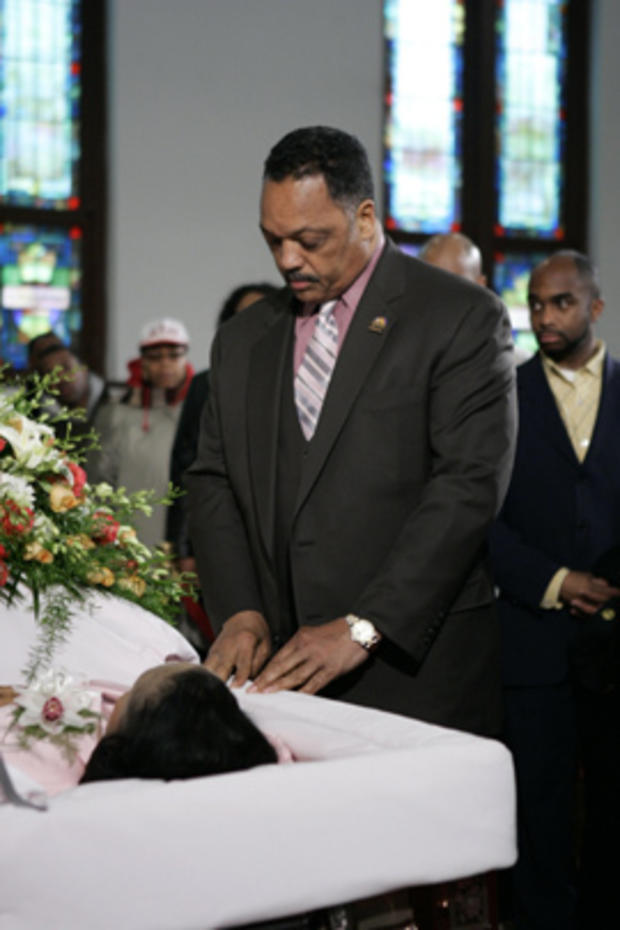
Jackson views the body of Coretta Scott King, the Rev. Martin Luther King's widow, at the new Ebenezer Church Feb. 6, 2006, in Atlanta.
Joe Raedle/Getty Images
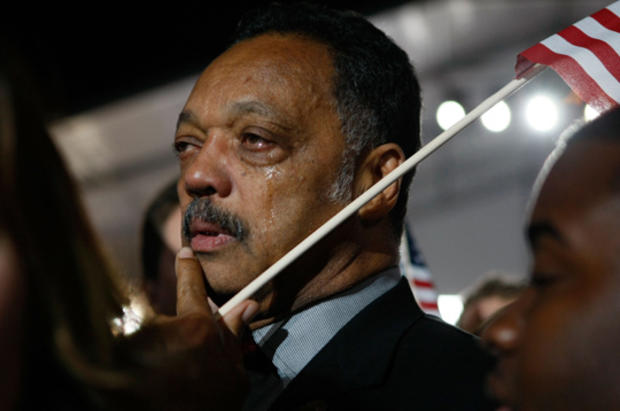
Jackson reacts after projections show that then-Sen. Barack Obama will be elected to serve as the next President of the United States of America during an election night gathering in Grant Park, Chicago, Nov. 4, 2008.
Chip Somodevilla/Getty Images
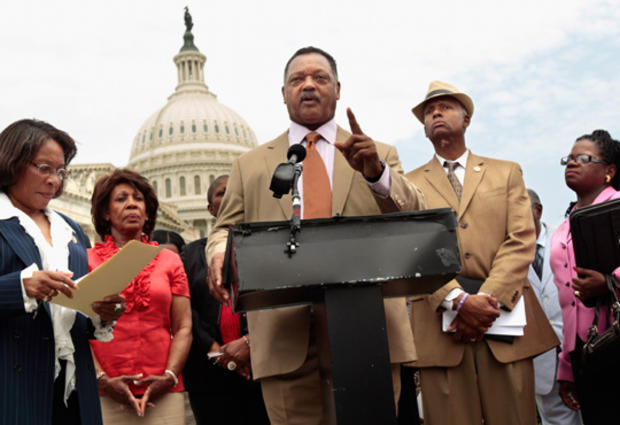
Still active, over the summer Jackson spoke out against laws that require photo identification in order to vote.
Photo: Jackson joins members of Congress, left to right, Rep. Marcia Fudge (D-Ohio), Rep. Maxine Waters (D-Calif.), Rep. Hank Johnson (D-Ga.) and Laywers' Committee for Civil Rights Under Law Executive Director Barbara Arnwine for a news conference to voice opposition to state photo identification voter laws at the U.S. Capitol, July 13, 2011, in Washington, D.C.
.jpg#)
.jpg#)