AP
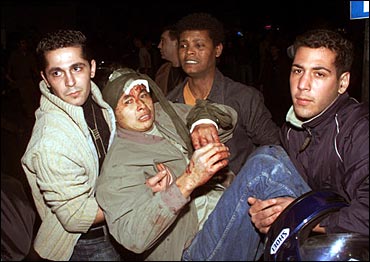
Israeli medics rush a wounded man to an ambulance after a double suicide bomber attack in Tel Aviv Sunday, Jan. 5, 2003. Two bombers blew themselves up downtown, killing 22 bystanders and injuring over 100 in the first such attack in an Israeli city since November.
AP
A wounded man is evacuated from the scene of a bombing. The blasts went off near Tel Aviv's former central bus station, a crowded area where many foreign workers live.
AP
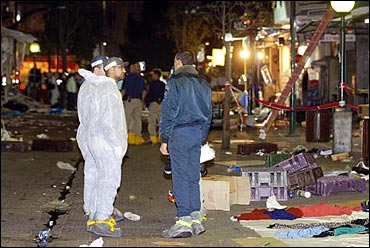
Israeli investigators check the scene of the explosion. The two attacks occured a block away from each other.
AP
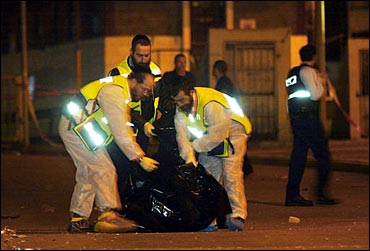
A special crew of orthodox Jewish emergency workers remove body parts of the victims. The parts collected from the scene are to be identified and buried later.
AP
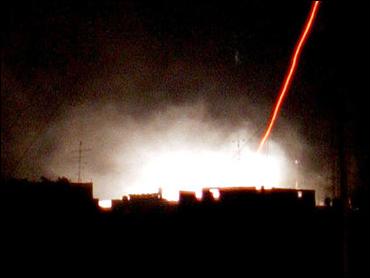
A building is hit by a missile in Gaza City early Monday, Jan. 6, 2003. Israel targeted a metal works factory which, it claimed, was involved in producing bombs for Palestinian militants.
AP
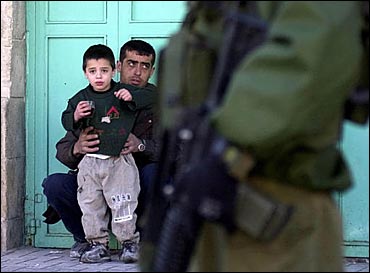
A Palestinian man and his son sit while Israeli soldier calls in the man's identification details by radio, in the Israeli-controlled section inside the West Bank town of Hebron.
AP
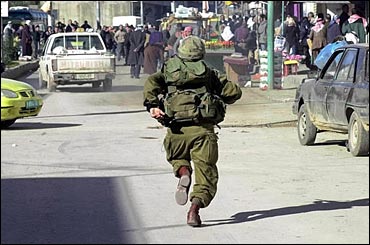
An Israeli soldier runs after suspected stone-throwers, unseen, in the Palestinian sector of Hebron. In response to the suicide bombings in Tel Aviv, Israel decided to intensify raids against militants and bar Palestinian officials from holding key meetings in the West Bank and abroad.
AP
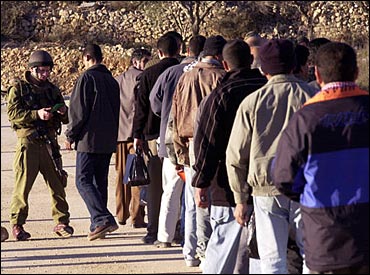
An Israeli soldier checks the identification of Palestinian men at the Israeli Surda checkpoint on the main road leading to the Bir Zeit University on the outskirts of the West Bank town of Ramallah. As another act of retaliation, Israel closed down three major Palestinian universities.
AP
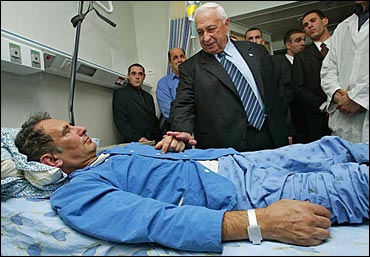
Israeli Prime Minister Ariel Sharon visits Yvgeny Schreiber, a 53-year-old Israeli man, who lies wounded in a hospital bed at Ichilov hospital, Tel Aviv. Schreiber was one of those injured in the attacks.