AP
An Iraqi boy stares at a U.S. soldier searching a neighborhood following an early morning rocket-propelled grenade attack in al-Khadra'a, west of Baghdad, Iraq, July 14, 2003. One soldier was killed and six others wounded in the attack on an army convoy.
AP
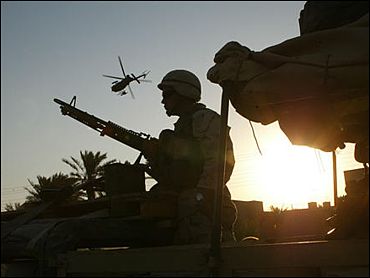
A U.S. attack helicopter hovers above as a soldier from the 3rd Infantry Division 3/7 Infantry Regiment guards the scene of an early morning rocket-propelled grenade attack in al-Khadra'a, Iraq, July 14, 2003.
AP
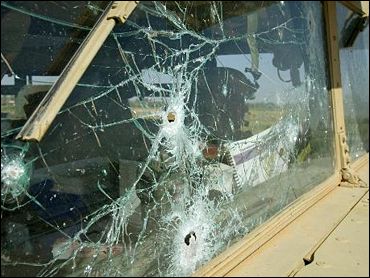
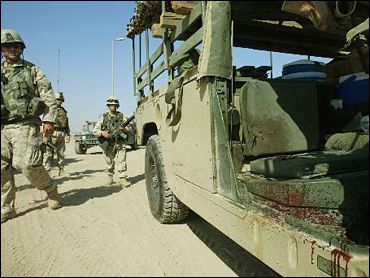
A U.S. soldier sits in a Humvee after it came under attack at the Khan Azad area of Baghdad, Iraq, July 14, 2003. One soldier was injured in the attack. Insurgents have been attacking U.S. vehicle convoys and launching mortar attacks on U.S. bases in Iraq.
AP
U.S. Marines take a look at a blood-stained seat of a Humvee after a vehicle used by U.S. soldiers came under attack at the Khan Azad area of Baghdad, Iraq, July 14, 2003. One soldier was injured.
AP
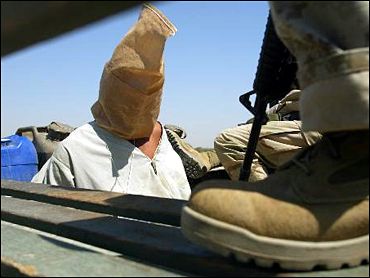
U.S. Marines guard a local Iraqi suspected of setting up improvised explosive devices after a vehicle used by U.S. soldiers came under attack at the Khan Azad area of Baghdad, Iraq, July 14, 2003. One soldier was injured in the attack.
AP
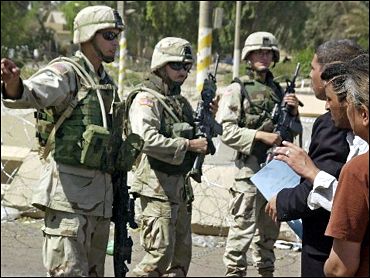
Former Iraqi government employees try to submit their petition to U.S. soldiers guarding the former Presidential Palace which now houses the U.S. administration in Iraq, July 14, 2003, in Baghdad. The former employees, who lost their jobs following the ouster of Iraqi ruler Saddam Hussein, are demanding they be rehired.
AP
Shiite Muslims hold anti Governing Council slogans during a meeting at Al Kadhimiya holy mosque in Baghdad, Iraq, July 15, 2003. The Governing Council, selected with major imput by L. Paul Bremer, the American administrator of Iraq, was announced Sunday as a first step in returning political power to the Iraqis.
AP
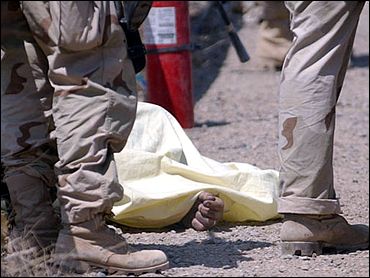
U.S. soldiers try to cover the body of a soldier killed in an attack on a convoy on a main highway, July 16, 2003, in west Baghdad. A U.S. soldier was killed and two others were injured when a powerful explosion went off as their supply convoy made its way along the main highway west of Baghdad, soldiers at the scene said.
AP
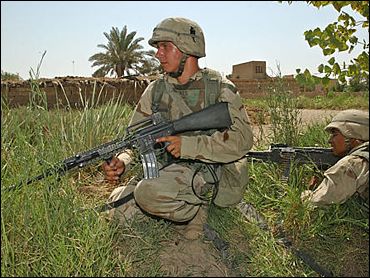
A U.S. Army soldier belonging to the 32nd Group, U.S. Army Reserve, from Puerto Rico guards a road near the town of Abu Ghraib, west of Baghdad, July 16, 2003, after insurgents attacked a supply convoy, killing one soldier.
AP
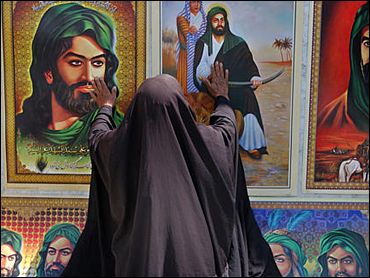
A woman touches posters showing Shiite holy figures Imam Hussein, left, and Imam Ali on sale outside of the Imam Hussein Mosque in the holy Shiite Muslim city of Karbala, about 60 miles south of Baghdad, July 12, 2003. An old rivalry between two Shiite groups is rapidly woresening as both seek to control Karbala's holy sites and gain leverage over its 500,000 inhabitants.
AP
Soldiers belonging to the 1st Armored Division keep watch as others inspect homes situated near the site of an attack near the town of Abu Ghraib, west of Baghdad, July 16, 2003. One soldier was killed and two others were injured in the attack on a Army supply convoy.
AP
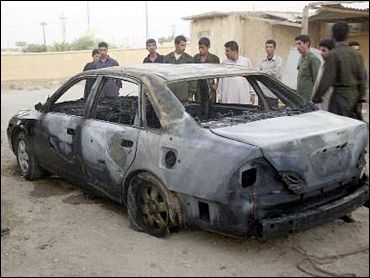
Iraqi police gather near the bullet-riddled car of pro-American Mayor Mohammed Nayil al-Jurayfi of Haditha, after he was killed, along with his son, in an ambush, July 16, 2003, 186 miles northwest of Baghdad, Iraq.
AP
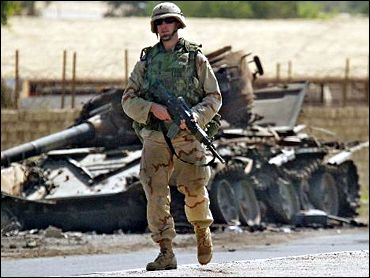
A U.S. soldier patrols a street next to a destroyed Iraqi tank in Baghdad, Iraq, July 17, 2003, on the anniversary of the 1968 Baathist revolution that brought Saddam Hussein's political party to power
AP
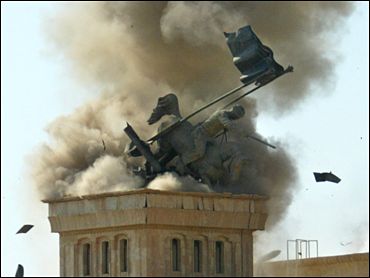
A 30-foot statue of Saddam Hussein on horseback is seen as it is toppled by plastic explosives in Tikrit, 110 miles northwest of Baghdad, Iraq, July 18, 2003.
AP
A soldier of the 4th Infantry Division poses for a photograph on the toppled 30-foot statue of Saddam Hussein on horseback, July 18, 2003.
AP
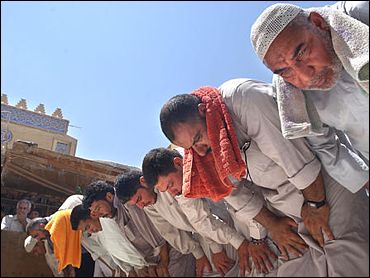
Devout Shiite Muslims pray after a speech given by the revered Ayatollah Muktada al-Sadr at the Al-Kufa Mosque, July 18, 2003, in the holy city of Najaf, 99 miles south of Baghdad, Iraq. Thousands of faithful gathered to listen to the speech given by the Ayatollah, a prominent Shiite cleric who called on Iraqis to oppose their new U.S.-appointed government, vowing to establish a competing council "of the righteous."