White House: Payroll tax fight "kabuki theater"
Updated: 5:34 p.m. ET
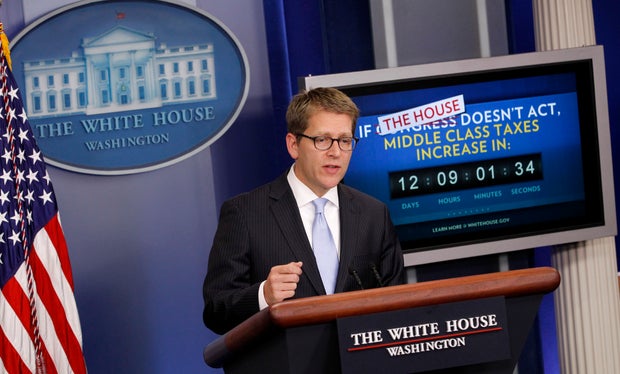
White House spokesman Jay Carney on Monday accused House Republicans of turning the fight over the a bill extending the payroll tax cut into "kabuki theater," and urged House Republicans to break with party leadership and vote for the measure.
With less than six days to go before Christmas, Congress is locked in a stalemate over the Senate-passed bill- which, until Sunday, was largely expected to sail through the House.
But amid objections from Republican lawmakers in the House, Speaker John Boehner on Sunday announced that the bill would not get Republican support after all.
"There's a bit of a kabuki theater going on here," Carney told reporters Monday in a White House briefing. "It makes getting things done on behalf of the American people pretty difficult when you have that kind of volatility and have that situation where the things that have broad bipartisan support, have broad, broad American public support cannot get done because of a sub- faction of one party in one house basically dictating the direction of the majority in that house. It makes it very difficult."
In an overwhelming - and increasingly rare - show of bipartisanship, the Senate on Saturday passed a two-month payroll tax cut extension that had previously been negotiated by Senate leaders Harry Reid, D-Nev., and Mitch McConnell, R-Ky.
The bill, which passed 89-10 with the support of all but seven Republicans, one independent and two Democrats (Sen. Rand Paul, R-Ky., was reportedly attending a family wedding and abstained), was presumed to have Boehner's support - particularly amid reports that he had at one point urged his caucus to support it.
On Sunday, however, Boehner made it clear that he expected House Republicans to reject the bill on the grounds that only a long-term extension was acceptable.
"It is simply perplexing, I think, for all of us, and I think for a lot of you, to understand why the House Republicans would not support a measure that garnered -- I did the calculations on my iPhone -- 83 percent Republican support in the Senate," Carney said. "We have some Senate Republicans now coming out today saying, you know, 'Please,' to their colleagues, 'Please,' to the House Republicans, 'Pass this. This is crazy not to do this.'"
"Not only did we have reason to believe that because of the... nature of the negotiations that were taking place on Capitol Hill, but as many of you have reported, the speaker of the House in his conference call with House Republicans urged them to support this measure, said it was a victory and the right thing to do," he continued. "So he was for it before he was against it."
When asked if President Obama had spoken with Boehner about the breakdown of the negotiations, Carney said it "is not our job to negotiate between him and Senate Republicans."
Reid pledged Monday that the Senate would not return to Congress even if the House does vote down the bill, which is scheduled for a vote Monday evening, warning House Republicans that they would be held responsible -- at least by Democrats -- if Americans saw their taxes go up on January 1st.
"My House colleagues should be clear on what their vote means today," he said in a Monday statement. "If Republicans vote down the bipartisan compromise negotiated by Republican and Democratic leaders, and passed by 89 senators including 39 Republicans, their intransigence will mean that in ten days, 160 million middle class Americans will see a tax increase, over two million Americans will begin losing their unemployment benefits, and millions of senior citizens on Medicare could find it harder to receive treatment from physicians."
"Senator McConnell and I negotiated a compromise at Speaker Boehner's request. I will not re-open negotiations until the House follows through and passes this agreement that was negotiated by Republican leaders, and supported by 90 percent of the Senate," he added.
Carney declined to say whether or not the White House supports Reid's position, or how it would proceed in the likely event that the House bill is voted down, saying only that the administration maintained hope that some Republicans might break ranks and support the legislation.
"We remain hopeful that tonight enough House Republicans will, you know, not vote in lockstep for a position that is supported by almost no one out there and will instead pass a payroll tax cut extension, make clear that they are committed, as we are, to a full- year tax cut for the American people," he said.
"I was told that it was impossible for the Kansas City Chiefs to beat the Green Bay Packers," Carney quipped when pressed on how the White House would deal with the vote's expected outcome, referring to the Chiefs victory over the previously undefeated Packers yesterday.
"All it would take would be for 25 or 30 Republicans to do what their constituents overwhelmingly want them to do, which is grant this extension of a payroll tax cut, to follow the overwhelming bipartisan majority that was established in the Senate in support of this measure, and allow this bill to reach the president's desk and to have him sign it into law," Carney added.
Carney did not say definitively whether or not Mr. Obama would remain in Washington over the holidays in the absence of an immediate deal, but he emphasized that passing an extension of the payroll tax cut was the president's "number one priority."
"The president has made clear that he wants Congress to get this done, that he is here now and will be here as Congress tries to sort this out, because it's essential to him," he said. "It is his number-one priority right now that Americans don't have -- middle-class Americans don't have their taxes go up on January 1st."
In an effort to pressure Republican lawmakers on the vote, Democratic Congressional Campaign Committee (DCCC) on Monday launched robocalls in 20 targeted districts across the United States.
"If House Republicans block this bipartisan compromise it will be a middle class mugging of $1,000 from 160 million middle income Americans," said DCCC Chairman Steve Israel in a statement. "After 39 Republicans in the Senate voted for this compromise, House Republicans have the chance tonight to stop this $1,000 middle income tax hike from happening on January 1. If they fail, their extreme partisanship will have cost Americans money."