U.S. Links Reveal Rising Pakistani Terror Hub
This story was filed by CBS News' Farhan Bokhari, based in Islamabad.
In a dimly lit room, in a private apartment in central Karachi, a local security official barked at eight young men summoned at short notice. The Thursday night encounter was just one of many interrogations based on leads into Islamic militant activity in this booming city of 18 million.
"You must remember, if I ever found you hiding crucial information, I will personally come to your homes and beat you up. You will not find any place to hide, so you must always be forthright and honest," the official warned his attentive audience.
Drills such as this are now commonplace as the Pakistani police and intelligence services widen their network of informants in a cosmopolitan center increasingly under the spotlight for possible links to the nexus of global Islamic militant groups.
After weeks of repeated requests to Pakistan's government, CBS News was allowed to witness one of the many "debriefing sessions," as they're called, on condition that the location and the identities of all those involved remain secret.
The session offered insight into how the Pakistani authorities work with informant networks, at street level, in one of the countries at the very front line of the fight against violent Islamic extremism.
The interrogations are of huge potential interest to U.S. officials, who have expressed consternation over mounting evidence that Karachi is emerging as a hub for militants.
Earlier this year, the arrest of Mullah Abdul Ghani Baradar, the head of the Afghan Taliban's military cadre, in a suburb of Karachi prompted U.S. and other Western officials to refocus their gaze on the city as a destination for Taliban hardliners -- including some fleeing U.S. forces in Afghanistan.
Baradar's Capture a Major Blow to Taliban
The Significance of Baradar's Capture
More recently, the arrest of Faisal Shahzad in the attempted bombing of Times Square forced American officials to look closely at links between the suspect, an American citizen of Pakistani descent, and militants in the thriving southern port city, which is closer to the border with India than Afghanistan.
Special Section: Terrorism in the U.S.A.
Shahzad Waived Rights Daily, Gov't Says
Shahzad Had Other U.S. Targets in Sight
One of Shahzad's Pakistani contacts -- a member of the Jaish-e-Mohammad militant group called Mohammad Rehan -- was subsequently picked up by Pakistani intelligence officials in Karachi. Jaish-e-Mohammad is among the Islamic groups with a history of sending volunteers to fight for the Taliban in Afghanistan, as well as with Islamic separatists in India's predominantly Muslim border state of Kashmir.
Rehan is being questioned on his role in facilitating a visit by Shahzad in the summer of 2009 to the Khyber-Pakhtunkhwa province, previously known as the north west frontier province (NWFP), along the Afghan border. Investigators believe he met there with hardcore Taliban militants who taught him how to build crude bombs. A senior Karachi police official says the arrest of as many as eight suspects, including Rehan, is at the center of Pakistan's ongoing investigation into Shahzad's Pakistan links.
"We all want to know exactly how these people facilitated Faisal Shahzad," the official told CBS News on condition of anonymity. "Once we have a solid knowledge of the way these people operated in Faisal Shahzad's case, and in other cases of militancy too, our ability to penetrate militant groups will undoubtedly improve."
But politicians from the ruling coalition in the southern province of Sindh, of which Karachi is the capital, defend the city as a diverse metropolis with a combination of interest groups -- a sharp contrast to the image of an increasingly attractive destination for hardliners.
"In some ways, Karachi is like New York, we are a melting pot. Islamic militants may be present here but they are by no means the over-riding force," a politician from one of the main parties in the ruling alliance told CBS.
"More and more information about Islamic hardliners is coming out because of our widening network of informants. We have a much better handling of the situation," the government official said. "Would you rather see us not succeed in hunting down Islamic militants and just pretend that they do not exist here at all?"
In Islamabad, the Pakistani capital, Western diplomats refused to discuss the issue on the record for fear of upsetting local authorities, but they said on background that Karachi's prominence as a monetary capital in the region, not just the country, could make it key to the Shahzad investigations on both sides of the world.
U.S. law enforcement and intelligence agents have honed in on the money trail left behind by the Times Square suspect, which may lead directly to supporters in Pakistan.
"Karachi is a large cosmopolitan city, and this is Pakistan's business capital. Naturally, it is the biggest place in the entire Afghanistan-Pakistan region from where you are able to send or receive funds overseas," one Western diplomat in Islamabad said. "So far, I am not aware of any specific links between Shahzad and Karachi that definitely point toward a specific spot in Karachi as a definite point for the money trail, but it is a likely city for anyone who wants to hide among 18 million people, and also to manage their money without attracting too much attention."
Combined with these practical, if circumstantial, red flags, is strong anti-U.S. sentiment in parts of Karachi, particularly in the poverty stricken neighborhoods. Though statistics on the number of poor people in Karachi have not been compiled formally in recent years, local officials say anywhere between a quarter to a third of the city's residents live in poverty.
Typically, these are people who face daily electricity cuts that can last eight hours, many are unemployed, and there's no air conditioning in their homes as summer daytime temperatures in Pakistan's tropical south soar above 104 degrees.
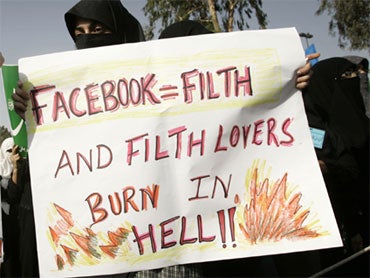
On Thursday, protesters gathered in Karachi's streets to demonstrate against Facebook, the social networking site which has infuriated many Muslims by hosting a web page featuring caricatures of the Prophet Muhammad. Images of Muhammad are strictly forbidden by the tenets of Islam, and illegal under Pakistan's Islamic government.
The rage expressed by the Karachi residents underscored the anti-Western sentiment, and the deep tension festering in the city.
"America is against Muslims and we are now protesting because Facebook, which is based in America, has insulted Muslims," Sabir Umar, a Karachi shopkeeper, told CBS News. "I am a poor man, but I shut down my shop to join this protest because it is time for us to demonstrate against the Americans." he said.
Sami Khattak, a bicycle store owner who also joined the protests, went a step further. "If I had to help my brother Muslims from Afghanistan or Iraq, where the U.S. has attacked Muslims, I will of course do everything to help them. That is my right and also my duty."
Such feelings show a potential sympathy for Islamic hardliners prevalent in many Karachi neighborhoods.
Back in the dimly lit police "debriefing" room, however, the interrogating officer told CBS his growing network of informants gave him some hope that the efforts were paying off.
"As we enroll more and more people, at least these informers know that our ability to strike deep inside neighborhoods is improving. I don't believe any one of these guys will indulge in the fanciful idea of supporting Islamic militants."