Trump doubles number of countries facing travel bans or restrictions, bringing list to 39 nations

President Trump on Tuesday more than doubled the list of countries subject to his travel ban or to heavy restrictions, bringing the total number of nations affected by the sweeping set of immigration and entry limits to 39.
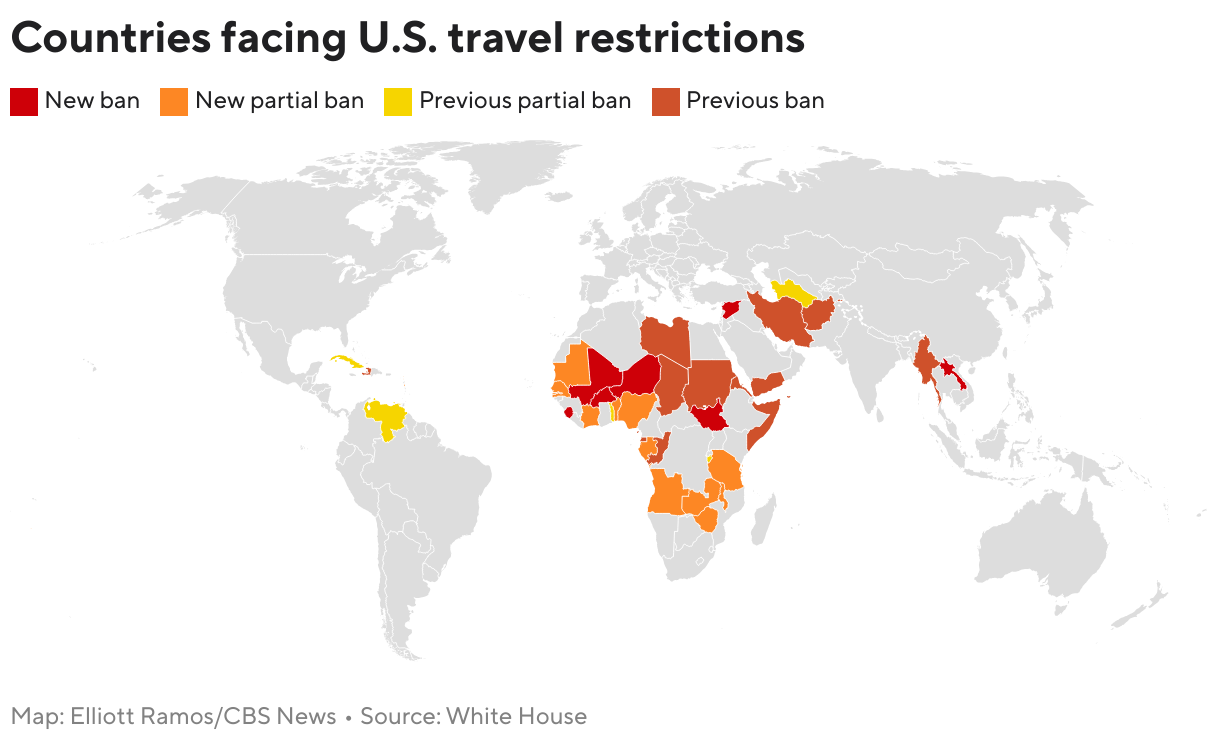
The first iteration of the travel ban Mr. Trump issued in June included 19 countries, fully barring the entry of immigrants and travelers from Afghanistan, Myanmar, Chad, the Republic of the Congo, Equatorial Guinea, Eritrea, Haiti, Iran, Libya, Somalia, Sudan and Yemen. It also partially suspended the entry of nationals of Burundi, Cuba, Laos, Sierra Leone, Togo, Turkmenistan and Venezuela.
The proclamation signed by Mr. Trump on Tuesday added seven countries to the list of states facing full entry restrictions: Burkina Faso, Mali, Niger, Laos, Sierra Leone, South Sudan and Syria. It imposed partial entry limits on immigrants and travelers from another 15 countries, including Angola, Antigua and Barbuda, Benin, Cote d'Ivoire, Dominica, Gabon, Gambia, Malawi, Mauritania, Nigeria, Senegal, Tanzania, Tonga, Zambia and Zimbabwe.
Mr. Trump's proclamation also enacted an entry ban for those traveling with documents issued by the Palestinian Authority, which governs parts of the West Bank. The restrictions on travelers from Turkmenistan were eased, after Mr. Trump said that country had improved its information-sharing with the U.S.
The immigration and travel restrictions include some exceptions, including for permanent U.S. residents from the countries on the list and athletes and staff participating in major sporting events like the FIFA World Cup next year. But Tuesday's proclamation also eliminated an exception, included in the June travel ban, that exempted the children, spouses and parents of U.S. citizens who had requested visas on their behalf.
CBS News had reported earlier this month that the Trump administration was considering expanding its travel ban following the shooting of two National Guard members in Washington, D.C., on Thanksgiving week. The suspect in that attack, which killed one of the soldiers, is an Afghan man who entered the U.S. in September 2021 and was granted asylum in April 2025.
In his decree on Tuesday, Mr. Trump cited multiple reasons to justify the travel ban's expansion, including concerns about the ability to adequately vet immigrants from the impacted countries and the lack of reliable record-keeping and information-sharing in some of those nations. He also referenced armed conflict, corruption, fraud and terrorism in certain countries on the list.
Mr. Trump said Antigua and Barbuda and Dominica also offer citizenship to foreigners without a residency requirement, creating the risk that someone from the countries subject to the travel ban could seek to gain status in those Caribbean nations to bypass the U.S. entry restrictions.
During Mr. Trump's first administration, versions of his travel ban faced significant public backlash and legal challenges that alleged the policy was discriminatory in nature. In 2018, however, the Supreme Court upheld the president's power to suspend the entry of foreigners on national security grounds through a legal authority known as 212(f).