Tobacco-Loving Syria Tries to Ban Smoking
This story was filed by CBS News' George Baghdadi in Damascus.
Syria's long-held image as a smokers' paradise may be consigned to the pages of history.How long it will last, or how strictly it will be enforced remains unclear, but as of Wednesday the tobacco-loving Arab nation is a lot less smoke-filled thanks to a presidential decree banning people from lighting up in public places.
The decree also outlaws smoking in cafes, restaurants, educational institutions, health centers, sports halls, cinemas and theaters, and places of worship.
Only cafes with designated outdoor spaces or specified levels of indoor ventilation can allow smoking.
The idea was to align Syria's tobacco use legislation with that of many other Arab and European countries. The Syrian government has already passed several laws regulating the tobacco industry and smoking. A 1996 decree banned tobacco advertising and in 2006 Syria banned smoking in government offices and public transport.
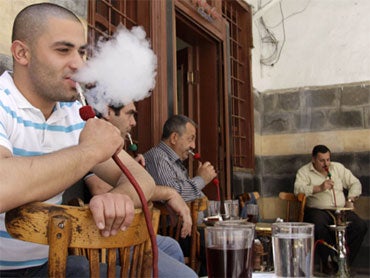
Above: Syrians smoke narghiles, or hookah pipes, outside a cafe after a law banning smoking in most public places went into effect, in Damascus, Syria, April 21, 2010.
The rules were often flouted, prompting the government to consider stricter legislation.
This time, restaurants and hotel owners breaking the ban will be fined up to 40,000 Syrian pounds (about $900) for every violation, while the law also imposes a fine of 2,000 Syrian pounds ($46) on the actual offending smoker.
It all amounts to a profound culture shock for at least five million Syrians used to lighting up about 10 million cigarettes each day, wherever they may be.
And for a country as hooked on tobacco as this one, it's hard to fathom this ban working.
In Syrian soap operas -- the most popular in the Arab world -- a police officer always lights up before solving a crime, and officials can't make decisions without burning a chain of cigarettes.
Many from the gigantic army of smokers say the new regulations are against the law and that the love affair with smoking will continue.
"We come here to drink tea, talk and smoke," said Mohammed, a 38-year-od client at Aroma Cafe in the upscale Abu Rumaneh street. Ashtrays have disappeared from the place.
"This is not acceptable. They are interfering in our private lives. The law will not work, anyway. It is typical wishful thinking," he said.
Health Minister Rida Said has hailed the measure as an important step forward in the battle against addiction in the country, noting the decree gave parties concerned a period of six months to carry out the necessary procedures.
"This shows Syria's commitment to the framework agreement on combating smoking signed with the U.N. The decree will protect non-smokers, particularly children, women of childbearing age and teenagers from smoking damages," he said.
Some 60 percent of adult men and 23 percent of women smoke, according to the Syrian Society for Countering Cancer, with 20 percent of men and 6 percent of women regular smokers of narghiles, or hookah pipes, which are favored among teens, local adults and tourists, partly because of the flawed assessment they are safer ways of consuming tobacco.
Syria's Minister of Tourism, Saadalla Agha al-Qalaa, said hotels will have specific rooms for smokers. Thirty percent of rooms will be allocated for smokers.