Three MORE Cool Products that Failed to Sell
Last week, I posted three cool "retro-tech" products that were way ahead of their time, because they illustrate eternal truths about sales and marketing. Here are three more favorites, each with a brief description of what went wrong and how they might have sold more successfully:

The world's first mass-produced home robot (1981). The Heathkit Hero Robot was originally released as a build-your-own kit. Equipped with an articulated gripper arm, an on-board computer and multiple sensors, the Hero could connect to your PC, react to your commands, speak thousands of words, move around, turn its "head," follow a light, and even act as a smoke alarm. And, unlike the Aibo and the SDR-3X, the Hero was fully programmable (it had an on-board PC) and could be customized to your heart's content. Why it failed: It was a kit that required considerable expertise to assemble. It was also complicated to program and had no useful built-in functions. They should have offered it assembled, with some function to make it practical (like the RoomBot vacuum cleaner).
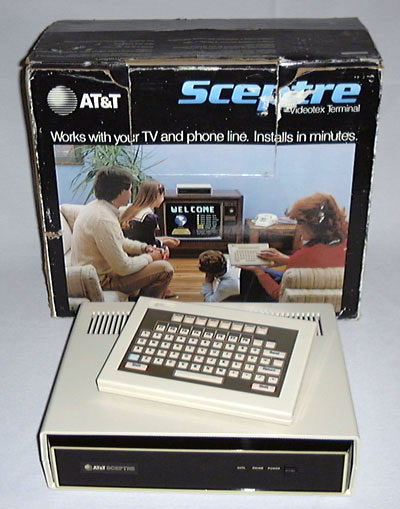
The world's first "Internet" access device (1983). The Sceptre Videotex Terminal was a wireless keyboard-controlled system which delivered news, weather, sports, stock reports, banking, shopping, email, and other information to an ordinary television. The Sceptre was about the same price as today's broadband connection ($39.95 a month) but it never seemed to catch on, although it was eventually marketed in a dozen cities. The interface was a bit crude by today's standards but, hey, it did pretty much all the Internet-type stuff that we'd want to do today. Why it failed: The idea of interacting with a computer was simply too "odd" for the public at large, and without an audience base there was no reason to advertise on it. They should have bootstrapped it by offering it for free for the first year.
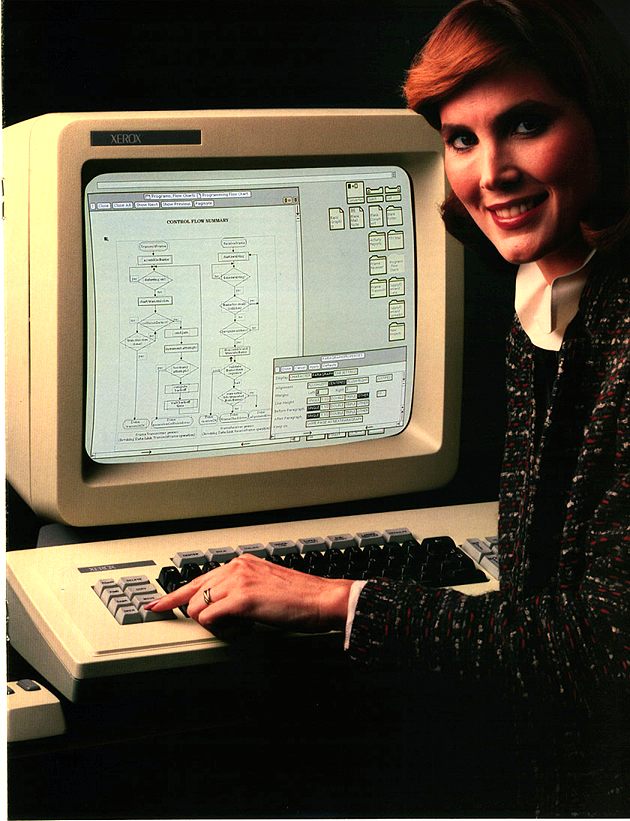 The world's first production WYSIWYG computer (1981). The Xerox Alto had a bit-mapped screen, a mouse and a graphical user interface. After prototyping similar designs in its Palo Alto laboratories, Xerox tried marketing it as an office automation device. Later, Apple Computer grabbed the design for their now-forgotten LISA computer and later (and more famously) for the Macintosh. Why it failed: No marketing and no sales education. Xerox had no idea what to do with the device and were afraid it might eat into revenues of their word processors. They should have dropped the price to gain share and cannibalized their installed base.
By the way, I think the publicity photo for the Hero Robot is a stroke of marketing brilliance, of a sort. (Click on the small photo to get a full-sized version.) Think of it: a computer, a robot, a chick in a bikini, and a bad haircut. If there's a special place in heaven for computer nerds, it would look like that.
