"The Oracle of Stamboul" by Michael David Lukas
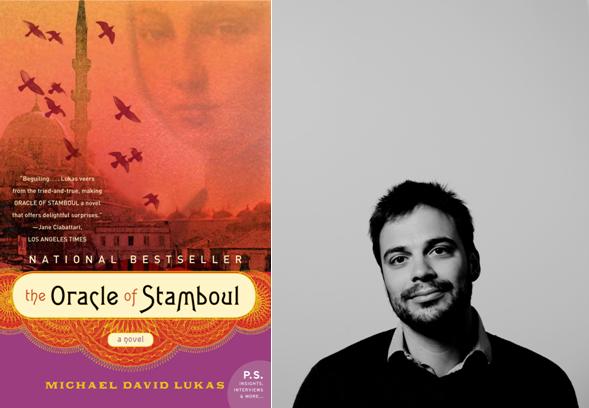
Jeff Glor talks to Michael Lukas about, "The Oracle of Stamboul," a historical novel about a girl who changes the course of the Ottoman Empire.
Jeff Glor: What inspired you to write the book?Michael Lukas: I started writing "The Oracle of Stamboul" in early 2004. At the time I was living in Tunisia, studying Arabic, applying to MFA programs, and generally trying to figure out what to do with my life. A few days after I handed in my MFA applications, the protagonist of the novel, Eleonora Cohen, came to me on a run through the outskirts of Tunis. She was hazy in that first glimpse, a slight, precocious child playing backgammon with two older men. I didn't know anything about her--where she lived or when, who these men were, why she was playing backgammon with them--but I knew as soon as she came to me that I had found the protagonist of my novel.
At first, I thought of her as a mix between Alice from "Alice in Wonderland" and Roald Dahl's Matilda. A few months later, rummaging through an antique store in Istanbul, I came across a picture of a young girl from the 1880s. When I saw this picture, everything clicked. Here was Eleonora, staring out across history with a laconic, penetrating gaze. Over the next seven years, she took on a life and character of her own. Eleonora still has elements of Alice, Matilda, and the girl in the picture, but she has since become her own person.
JG: What surprised you the most during the writing process?
ML: What surprised me most was how much of myself is in the characters, even though they live such different lives than my own. Sometimes writing can feel like that scene in "Being John Malkovich," when John Malkovich enters his own mind and finds himself in a restaurant filled with John Malkovichs saying "Malkovich, Malkovich." I guess what I am trying to say is that we can't help but imbue our characters with our own thoughts, feelings, and characteristics, whether the character is a preternaturally intelligent orphan or the Sultan of the Ottoman Empire. And that, in itself, is pretty surprising.
JG: What would you be doing if you weren't a writer?
ML: I think I would probably be a fourth-grade English teacher. I've always enjoyed teaching and I'm lucky enough to be able to teach a few days a week in addition to writing. When I first started teaching writing to children -- through an afterschool program called Take My Word For It! -- I was going through a bit of a quarter-life crisis. My students' wide-eyed enthusiasm and seemingly infinite imaginations helped me to regain my sense of wonder and possibility in the world. I also love that children don't second guess their own ideas. Last semester I had students writing novels about ghost dog tooth fairies and moldy pickles trying to escape the refrigerator. And they all worked!
JG: What else are you reading right now?
ML:I'm in the midst of reading three wonderful and very different books: "The Hummingbird's Daughter" by Luis Alberto Urrea; "The Buddha in the Attic" by Julie Otsuka; and "The Line of Beauty" by Alan Hollinghurst.
JG: What's next for you?
ML: I am currently working on a novel about the Jews of Cairo. The book, which is tentatively titled "The Forty-Third Name of God," tells the story of an Egyptian Muslim family charged with guarding the Ben Ezra Synagogue and its famous Genizah (a treasure trove of medieval Jewish manuscripts found in the 19th century by Solomon Schechter). A multigenerational chronicle, this novel will tell the story of the Genizah, its discovery, and the cosmopolitan Mediterranean world it sheds light on. It is a novel about Muslim-Jewish relations, Cairo, the hidden secrets of the Kaballah, and the sometimes conflicting ties of family and religion.
For more on "The Oracle of Stamboul," visit the Harper Collins website.