"The Beaver" review: Mel Gibson puts teeth into this role
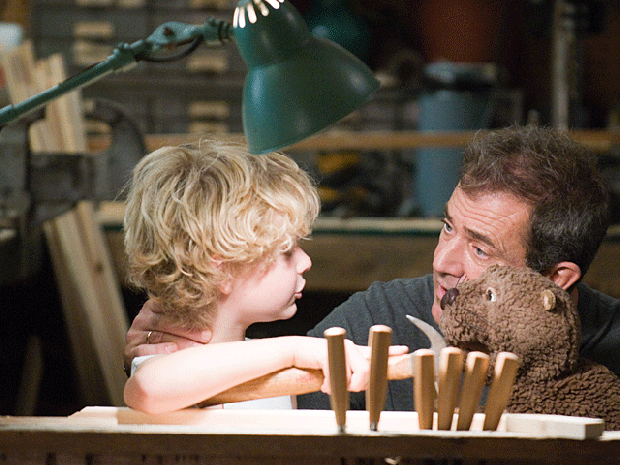
(CBS) "The Beaver, "Jodie Foster's long-delayed, third- time directorial outing survives obvious art-imitating-life parallels. The result is a curiously absorbing dramedy, that though at times unsettling, delivers the goods.
The reason for this lies in the incomparable acting skills of its star, Mel Gibson and, frankly, the fact that he lets a hand puppet do most of the talking.
The tabloid fiasco that is Gibson's personal life and those now infamous audio tapes between him and ex-lover Oksana Grigorieva arose just as final re-shoots for "The Beaver" were being completed. It is virtually impossible to watch him on screen now without replaying in our minds his disastrous self-implosion then.
Lucky for him that his character, Walter Black, adopts a beaver hand-puppet as an alternate personality. Save for a couple of short lines, Gibson speaks entirely through this puppet in a British accent.
Along with two-time Oscar winner Gibson, "The Beaver" also showcases the work of two-time Oscar winner Foster, who both directs and co-stars as Meredith, Gibson's long suffering wife. The film is the intense, emotionally charged story of a man trying desperately to come to terms with his fractured life and repair the bonds between himself and his estranged wife and children.
Walter, CEO of a once successful toy company, suffers from suicidal tendencies and deep, chronic depression. The film opens with him trying numerous ways in which to commit suicide. He can't even get that right.
Meredith, kicks him out of the home they share with two their sons, teenage Porter (Anton Yelchin) and grade schooler Henry (Riley Thomas Stewart).
After finding a beaver puppet in the trash, Walter embarks on a strange kind of self-help therapy to try to rid himself of his depression. Speaking only through the puppet he calls "The Beaver," he is suddenly able to cope with the stresses of family and work. Not just cope, though, he thrives.
He revives his flailing toy company and rebuilds relationships with Merwdith and his sons.
But without The Beaver, Walter retreats back into depression. As the film progresses, the relationship between Walter and his puppet grows stronger and more intense. Eerily, Walter seems to be ceding control to the puppet, which can be menacing.
Over the course of her directorial career ("Little Man Tate" and "Home for the Holidays") Foster has shown she can hit a nerve when it comes to exploring family dynamics, making her films resonate with audiences.
. "The Beaver" clearly follows in this tradition. Add to that the insight she is able to lend to the script from her own accomplishments as a character actress and it is easy to see how the richness of each character is allowed to come through.
Underpinning Walter's struggle with depression is the story of a family trying to mend. At its heart is the tale of a father trying desperately to reconnect with his older, estranged son.
Porter doesn't want anything to do with his dad. He spends his time in his room, fearful that he might become as neurotic as his dad and angry with his mom for allowing Walter back into their home . He seeks distraction at school, where he falls for the complicated cheerleader-valedictorian (Jennifer Lawrence).
Despite the predictability of Kyle Killen's script, Gibson turns in a triumphant performance. In a recent interview, Foster told me that after reading the script, she knew immediately Gibson was the man for the role.
She said he was the only actor capable of doing justice to a role that demanded equal parts tragedy and comedy without blinking an eye. And Gibson delivers with a punch, aided, oddly enough, by the public controversy that surrounds him.
Though they may find it unsettling and uncomfortable in parts, viewers will be drawn in bit by bit, thanks to Gibson. They will find themselves rooting for him to emerge from the darkness.
If only life will imitate Gibson's art in this respect!