Syria to lift repressive emergency law
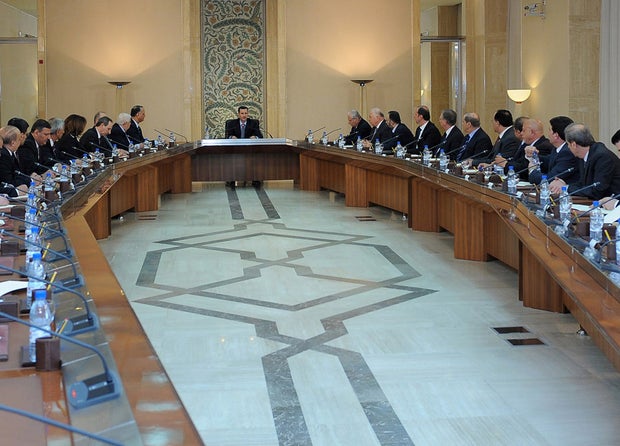
In a speech Saturday to the new government he named last week, Syrian President Bashar al-Assad said next week he would lift the emergency law - in effect in the country for almost half a century - a month after protests demanding greater freedoms first broke out in a rare challenge to his 11-year rule.
"Syria is passing through a very delicate time," Assad said in his second public address since anti-government protests began on March 15. "There is a conspiracy and there are demands and reforms. What matters is the internal immunity. The citizen needs services, security and dignity. These are three connected elements that we should accomplish all together."
Assad was chairing the first meeting of the new cabinet.
"The juridical commission on the emergency law has prepared a series of proposals for new legislation, and these proposals will be submitted to the government, which will issue a new law within a week at the most," he told the cabinet in an address that was later broadcast on state TV.
Lifting the 48-year-old state of emergency has been a key demand during a wave of protests over the past month.
The emergency laws give the regime a free hand to arrest people without charge, and extends the state's authority into virtually every aspect of Syrians' lives.
Complete coverage: Anger in the Arab World
Assad appointed a new cabinet on Thursday, around two weeks after he asked the former government of Naji Ottari to resign.
Headed by Premier Adel Safar, a former minister of agriculture, the new cabinet includes new ministers of the interior, finance, and information and was expected to carry out broad reforms. Key positions of the foreign and defense ministers remained the same.
The new cabinet is part of several overtures by Assad that have failed to appease protesters. The government has no significant political weight in Syria, where power is held by the security apparatus.
"In my talks with the people I have realized there is a huge gap between the institution of the state and the people," he said. "I realize we need to narrow that gap and fill that space with trust."
The Syrian leader has also tried over the past month to face down the protests using promises of reform, salary increases, moves to replace emergency law and concessions to minority Kurds and conservative Muslims. Only a couple of days ago, Syria also announced an amnesty for scores of
prisoners detained since protests first broke out.
As part of Friday's protests, thousands again demonstrated in the southern city of Daraa, which has been the focal point of unrest in the city. An eyewitness said security forces were not visible in the city, and that the protesters were being allowed to hold their demonstration.
Protests were also held Friday in Baniyas, Latakia, Deir ez-Zor and Baida after the weekly noon prayers. Despite weeks of violence against protesters, in which dozens of people have been killed, Friday's protest was notably peaceful.
Among other demands the activists said they want the abolition of Article 8 from the constitution, which states that the Baath Party "is the leader of the state and the society." They said it prevented the formation of other parties and was obstructing political life.
Rights groups say at least 200 people have been killed since the protests started last month. Authorities blame armed groups for stirring up unrest at the bidding of outside players, including Lebanon and Islamist groups.
"I must say that the current situation has caused a lot of pain in the hearts of each and every citizen for those who have been martyred," Assad said in his speech today. "Investigations are continuing to find out those who are responsible and find those who are responsible."
Assad acknowledged Syria's serious economic troubles. "There is no doubt that unemployment remains the biggest problem in the country," he said. "Of course the improvement of the economy will create more jobs, but this will take a long time to develop," he said, adding that corruption and bribery was another headache.
"The world is rapidly changing around us and we have to keep up with developments," he said. "We have to focus on the demands and the aspirations of the people or there will be a sense of anger".
Syria, bordered by Lebanon, Israel, Turkey, Jordan and Iraq, maintains an anti-Israel alliance with Iran and supports militant groups Hamas and Hezbollah, despite seeking a peace deal with Israel and the end of U.S. sanctions imposed on Syria in 2004. Assad's rule faced external pressure and isolation after the 2005 killing of former Lebanese Prime Minister Rafik al-Hariri. Syria was initially blamed for the killing.
Activists acknowledge such a stance has given Assad some popularity among ordinary Syrians but said that was not enough.
Hillary Clinton, the U.S. Secretary of State, urged Syria to halt its deadly crackdown on protesters and respond to the democratic hopes of its people.
"We call on the Syrian authorities once again to refrain from any further violence against their own people," she told reporters in Berlin after a NATO meeting, referring to the protesters' demands as "legitimate."
"It is time for the Syrian government to stop repressing their citizens and start responding to their aspirations," she said.