Spain deploys military to Ceuta after thousands of migrant crossings at Morocco border; at least 34 dead
Ceuta, Spain — At least 34 migrants died trying to reach the Spanish territory of Ceuta as tens of thousands of people breached the frontier with Morocco and poured into the tiny Spanish territory, prompting Spain to deploy its military to restore the border.
The border crisis boiled over Thursday and overnight into Friday. Spain's state broadcaster RTVE broadcast images of burned cars on the Moroccan side of the border after reported clashes.
Some 60,000 migrants have entered Ceuta from Morocco during the border crisis, Ceuta President Juan Jesús Vivas said. That is equivalent to 70% of the city's regular population.
"The situation that Ceuta is going through is absolutely unsustainable," he said.
Spain's Interior Ministry said Friday that more than 25,000 of the migrants have been sent back and that departures are taking place at a rate of 150 people per minute.
Rachid Sbihi, who leads a local workers association representing Civil Guard officers, called the situation a "serious humanitarian crisis," saying thousands of migrants, including unaccompanied children, were left sleeping in parks and on sidewalks, with others roaming the streets aimlessly.
"People are still entering. The reinforcements that have arrived are only helping the injured and other humanitarian efforts," he said. "It's chaotic."
In a news conference Friday morning, Spanish Prime Minister Pedro Sánchez said, "The Government of Spain stands with the city of Ceuta. ... What happened yesterday [was] an attack, a violation of Spain's territorial integrity. Ceuta is a Spanish city, and what happened yesterday deserves our full reproach, our condemnation at the strongest possible level of rejection, condemnation, and consideration as deplorable."
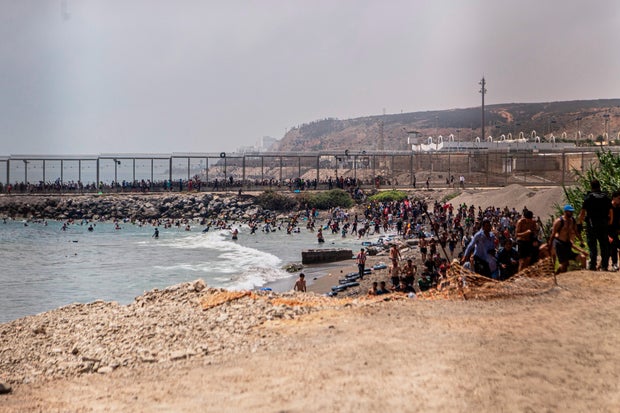
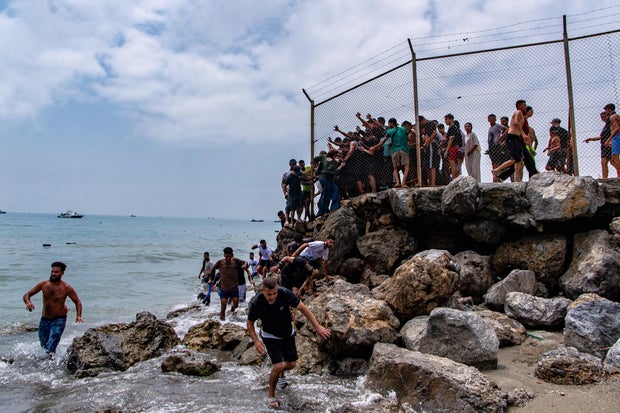
Sbihi said that, among those who died, many drowned, but some were also killed in a stampede to cross the breakwater fence at Tarajal beach, an urban beach near a border checkpoint with Morocco.
Video footage on Thursday showed throngs of people, mainly Moroccans, walking around the breakwaters onto local roads. While most appeared to be young men, there were also families with women and small children.
"Viva España!" some shouted to a freelance photographer working for The Associated Press. Late Thursday into Friday, the photographer saw people amassed on the Moroccan side of the border trying to cross into Ceuta but also people walking from Ceuta toward Morocco, trying to return.
It was not immediately clear what prompted so many people to cross to Ceuta.
Spain is a main point of arrival into Europe for migrants seeking better economic opportunities or an escape from violence in their home countries.
Reaching Ceuta, a Spanish enclave
To reach Ceuta, located on the northern African coast of the Mediterranean, migrants often swim from the Moroccan town of Fnideq, covering about 3.1 miles to reach Spanish territory. Others attempt the crossing from the nearby town of Belyounech, where the distance is shorter.
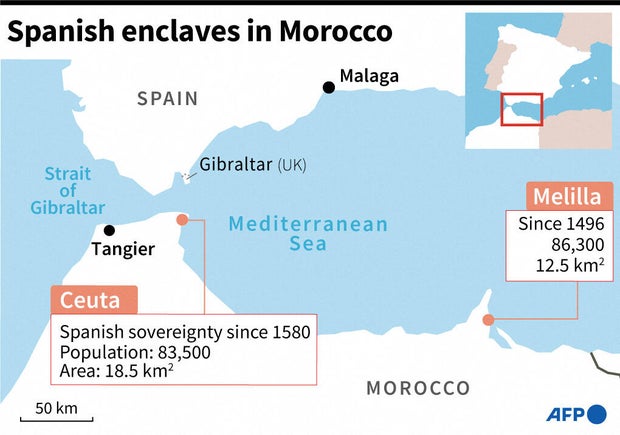
Ceuta, along with the larger Spanish territory of Melilla, about 250 miles (400 kilometers) to the east, it is an autonomous city belonging to Spain and shares the European Union's only land borders with Africa.
In Spanish possession since 1580, Ceuta is home to a mixed population of Christians and Muslims, and Spanish and Moroccan residents and day workers who live in relative harmony.
Morocco does not officially recognize Ceuta and Melilla as Spanish territory, and often refers to them as occupied lands.
Italy calls for crackdown
The chaos had ripple effects in Italy, another key destination for migrants. Premier Giorgia Meloni threatened to suspend Italy's open-border Schengen agreement with Spain "to defend our borders and ensure the safety of our citizens," though Italy doesn't share a border with Spain.
Ceuta authorities had previously linked the increase in migrants to a Spanish Supreme Court ruling earlier this month that barred authorities from immediately returning migrants who arrive by sea without due process. The ruling doesn't apply to migrants who enter Spain by land, including by climbing over the border fence.
But some activists in Morocco expressed doubt that the ruling was behind the crossings, arguing most migrants would have been unaware of such legal decisions.
Juan Jesús Vivas, the head of Ceuta's regional government, had called for the national government to declare an emergency on grounds of national security, asking for more police and for the army to be deployed on the border "to guarantee the inviolability of the frontier and citizen safety."
He had warned that migrant reception centers were already overwhelmed on Wednesday, with hundreds of people sleeping on the streets. Thousands or even tens of thousands are believed to have arrived since then.
Legislation covering a declaration of national emergencies does not consider migration flows as a risk to national security, according to the ministry, which said government agencies are "coordinating to respond with speed and efficacy to the situation in Ceuta."