Scientists: We're Going About Contacting Aliens the Wrong Way
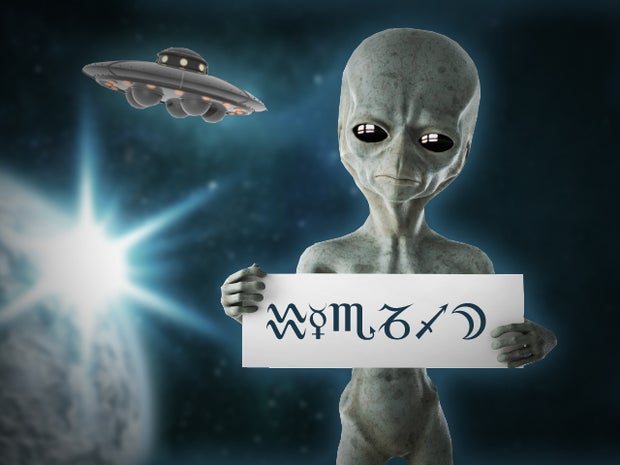
If extraterrestrial life forms exist somewhere in the universe, then we're not getting through. When it comes to getting responses from messages sent into outer space, humanity remains 0 for 4. So far. music, pictures, drawings - nothing's garnered a response. But now a team of scientists, perhaps borrowing from the movie "Cool Hand Luke," is offering an explanation for our failure to communicate.
In a paper published in the journal Space Policy, a trio of researchers argues that future messages sent to extraterrestrial intelligence should follow a specific protocol. Humans began sending messages into space, starting in 1994 with transmission sent using the Arecibo radio telescope to a star cluster 25,000 light years from Earth.
The scientists - Dimitra Atri from the University of Kansas, Julia DeMarines from the International Space University in France, and Jacob Haqq-Misra from Pennsylvania State University - contend that as the broadcasts became more complex and the types of content increased, the absence of an established protocol "has produced unorganized or cryptic messages that could be difficult to interpret."
They make the case that any future messaging protocol for messaging to extraterrestrial intelligence should account for a myriad of attributes, such as signal encoding, message length, and information content.
In their paper, the authors say that after being developed, the protocol would be disseminated for testing on humans around the world, cutting across cultural boundaries. "An effective message to extraterrestrials should at least be understandable by humans, and releasing the protocol for testing will allow us to improve the protocol and develop potential messages," they write. "Through an interactive website, users across the world will be able to create and exchange messages that follow the protocol in order to discover the types of messages better suited for cross-cultural communication."