Russia Seeks Bigger Mideast Role, Via Syria
This story was filed by CBS News' George Baghdadi in Damascus.
Russian President Dmitry Medvedev arrives in Damascus Monday to try and renew Moscow's political influence in the Middle East. Syria's leaders, for their part, are aiming to expand Damascus' international reach after Israeli warnings of a possible new war in the region.
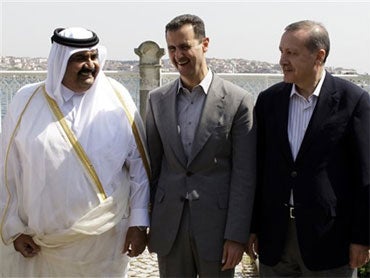
Accompanied by a large business delegation and his wife, Medvedev was to meet President Bashar Assad, who's just ended a tripartite summit in Istanbul with Turkish Premier Recep Tayyip Erdogan and the Emir of Qatar.
Russian diplomats said the long-stalled Mideast peace process, Iran's nuclear program and bilateral arms trade between the two countries were expected to be key topics for the two-day visit, the first ever to Syria by any Russian or Soviet head of state.
Syria has expressed readiness to reopen peace talks with Israel, with Turkey serving as a mediator, but Israel has not asked Ankara to resume that role, according to Turkish President Abdullah Gul who spoke after talks with Assad on Saturday.
Above: From left, Qatar's Emir Sheik Hamad bin Khalifa Al-Thani, Syrian President Bashar Assad and Turkish Prime Minister Recep Tayyip Erdogan pose outside the Ottoman-era Ciragan Palace in Istanbul, Turkey, May 9, 2010.
Medvedev's visit comes a few days after Washington renewed long-standing U.S. sanctions against Syria for another year, accusing Damascus of supporting terrorist groups and pursuing missile programs and weapons of mass destruction. Republicans in the Senate, meanwhile, blocked a Democratic attempt on Friday to confirm President Obama's nominee, Robert Ford, as the first U.S. ambassador to Syria in five years.
Israel has accused Syria of providing the Lebanese militant group Hezbollah with scud missiles and some officials even warned the move could start a war.
A scud has a far longer range and can carry a much bigger warhead than the rockets Hezbollah has used in the past, and could reach anywhere in Israel from Hezbollah bases in southern Lebanon. Syria has denied the charge, as has Lebanon's Western-backed prime minister.
Foreign Ministers of Spain, Germany and France were expected to fly into the Syrian capital separately in a couple of weeks to discuss the tension. The Emir of Kuwait was also expected in Damascus.
Analysts say Moscow's influence in the Middle East will in many ways depend on its relations with Syria, an increasingly important regional player with tight ties to Iran, Hezbollah and the Palestinian militant group Hamas, which has its political headquarters in Damascus.
Russia, with the European Union, the United Nations and the United States, is a member of the international quartet for Middle East peace and has long sought to expand its clout in the region.
Israeli President Shimon Peres was said to have relayed a message to Assad, via the Russian leader, that Tel Aviv was not interested in a confrontation with Damascus, nor did Israel intend to escalate tensions along its shared border with Syria.
Medvedev's visit comes amid reports that he he'll honor a deal with Damascus for the sale of an advanced anti-aircraft defense system.
Israel has eyed Syria's ambition to acquire Russian weapons with unease, fearing the erosion of its military edge. There's also concern in Israel that weapons systems obtained by Syria could end up in the hands of Hezbollah. The Shiite militant group used advanced Russian antitank missiles to deadly effect against Israeli armored vehicles during the 2006 war.
Israeli Prime Minister Binyamin Netanyahu has personally flown to Moscow in the hope of preventing the weapons deal, but Medvedev would only agree to a delay, unwilling to cancel the deal. The Russian leader justified the sale by saying the weapons system is a defensive one, not an offensive one.
Western diplomats say Moscow and Damascus have also been mulling the possibility of building a Russian naval base in Tartous, on Syria's Mediterranean coastline, granting the Russians a key warm-water facility.
The Soviet Union was once Syria's main weapons supplier, leaving Damascus saddled with a $13.4 billion arms-sales debt at the end of the cold war in 1990. In 2005, Russia wrote off almost three quarters of the debt, launching a new era of improved cooperation and fresh arms deals.
During the past five years, the Syrian leader has visited Russia three times. His latest visit took place in August 2008, when he met Medvedev in the Black Sea city of Sochi.
Acquiring Russian armaments, analysts say, could strengthen Syria's hand as it negotiates a peace deal with Israel.
Syria accused Israel of being an "untrue partner" in the peacemaking process. Turkey brokered four rounds of indirect talks between Syria and Israel in 2008 -- the first such contacts since previous peace negotiations were broken off in 2000 over the fate of the Israeli-occupied land in the Golan Heights, along Syria's border.
Syria froze communications at the beginning of last year when Israel launched a devastating three-week offensive against the Gaza Strip, controlled since June 2007 by Hamas. Hamas' exiled leader, Khaled Mashaal, lives in Damascus.
Syria has insisted that the promise of an Israeli withdrawal from the Golan Heights be a precursor to any renewed peace negotiations between the two countries. Netanyahu has vehemently rejected the notion of a withdrawal.