House GOP's campaign arm touts record $47 million fundraising haul to kick off midterm push

House Republicans' campaign arm is touting a record-breaking fundraising haul to start the 2026 midterm cycle, the committee chairman told CBS News in an interview.
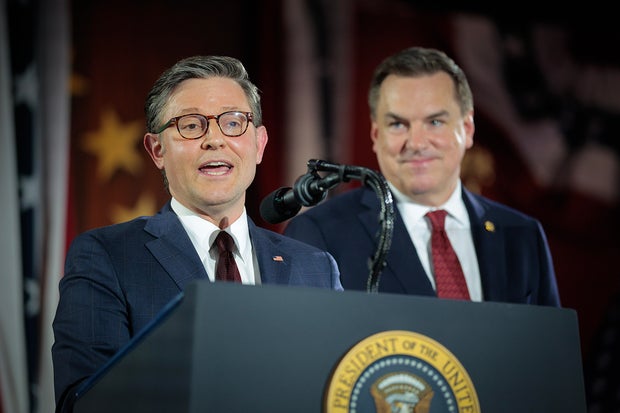
Rep. Richard Hudson, chairman of the National Republican Congressional Committee, said the group raised $47.1 million in the first three months of the year, the largest amount for the NRCC in the first quarter of any year. Hudson added that the committee posted its strongest March in its history with $28.1 million. It now has $78.2 million cash on hand and $164.4 million for the entire cycle.
"This is the best first quarter we've ever had," Hudson said, arguing the numbers reflect growing momentum for House Republicans as they look to defend their slim majority in a tough political climate for Republicans and stave off historic midterm headwinds. "Republican donors are investing. They understand that the House majority is a firewall against Democrat overreach."
Hudson, who represents North Carolina's 9th Congressional District, is predicting Republicans will defy the Democrats' forecast that they will flip the House in November.
"If you look at the map of the entire Congress, 435 seats, there's only somewhere between 30-40 seats that are up for grabs. The rest of the seats are safe seats. And so the map has evolved and gotten smaller and smaller as Republicans and Democrats have gotten more sophisticated. They are redistricting, and so a much smaller map, I think, changes the dynamics that we've seen traditionally," Hudson said. "House Republicans are going to hold our majority. We've got all the momentum right now. And the fact that we just recorded our best first quarter in the NRCC history, I think, demonstrates this."
The Democratic Congressional Campaign Committee, meanwhile, said Monday it raised $45.3 million in the first quarter, just shy of the NRCC's haul. The group says it has raised $160.6 million so far in this cycle and has $70 million on hand. Rep. Suzan DelBene of Washington, who chairs DCCC, wrote in a statement her party has "the momentum, message, and resources to take back the majority in November."
"America is ready for change and the public is souring on House Republicans' broken promises as life continues to be too expensive for far too many hardworking families," DelBene said. "Across the country, we're seeing overwhelming support for House Democrats and our candidates."
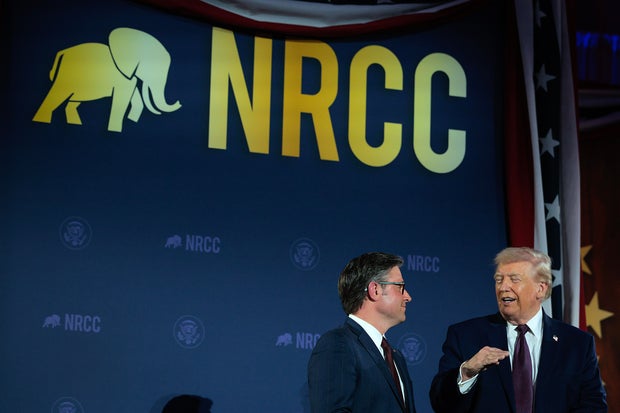
Hudson credited President Trump with playing a central role in boosting the committee's fundraising efforts, including headlining a recent NRCC fundraising dinner in Washington that raised nearly $37 million.
Hudson told CBS News he speaks regularly with the president and sits down with him in person roughly once a month to "talk through" the House races.
"Our meetings typically will last an hour or more because he just really wants to get into the details. His level of knowledge about these individual congressional races is astonishing," Hudson said. "He understands how important it is to hold the House."
Mr. Trump took a western swing to Arizona and Nevada last week to help rally for Republican congressional candidates in battleground seats.
"This November, we gotta win the midterms," the president told the crowd at a Turning Point USA event in Phoenix. "We're going to win and win like never before."
But Democrats point to both polling and a slew of elections over the last year to argue they have momentum going into the midterms.
"From special elections for Congress to state legislature races, to public service commissioners, and even state supreme courts. Democrats are not only overperforming in turnout, they are winning these elections," said Hyma Moore, a former senior official for the Democratic National Committee. "President Trump and the Republican Congress said they would lower costs on day one. Instead, they have focused on everything except lowering everyday costs. Americans are still hurting, but they are starting to trust Democrats again. That's a good sign for November."
The party that holds the White House has historically lost seats in midterm elections. Over the past 50 years, there have been only a few notable exceptions to that trend, including 1998 under President Bill Clinton and in 2002 under President George W. Bush.
Recent polling highlights those challenges, with roughly two-thirds of Americans saying the economy is in bad shape and a majority disapproving of Mr. Trump's handling of economic issues. That includes about 65% of Americans who say they disapprove of his handling of the economy overall, and nearly 70% disapproving of his job on inflation. The president's overall job approval had hovered in the low 40s in recent CBS News polling but hit a low of 39% earlier this month.
Those numbers showcase the potential vulnerabilities for Republicans, particularly as economic concerns – especially cost of living issues – remain top of mind for voters heading into the fall, while the war in Iran continues to impact gas prices across the country.
Hudson predicted that "people's pocketbook issues are going to remain predominant issues." He argued that Republicans have enacted economic policies that will make "people's lives better" compared to former President Joe Biden's tenure, which he blamed for record inflation and record gas prices. He also contended that national polling does not always reflect the dynamics of individual House races.
"Democrats like to point to national polls, national generic ballot tests, to try to tell you what's going to happen in these 30 or 40 congressional races. But the fact is, if you look race by race, every one is an individual race, and every one of these we have the advantage in candidate quality. There are more Democrat seats up for grabs than Republican seats," Hudson said. "As we go to the election this fall, we can tell the voters: we promised you that we would bring down your taxes, we promised you that we would unleash American energy, we promised you that we'd secure the border and make your neighborhood safer, and we delivered on those promises."
The broader House Republican fundraising network is also reporting strong numbers. Outside groups aligned with House GOP leadership, including the Congressional Leadership Fund super PAC and the American Action Network, have raised nearly $193 million so far this cycle. Top Republican leaders have also posted sizable fundraising totals in the first quarter, led by Speaker Mike Johnson, whose $34 million set a record. According to NRCC, he has now raised more than $116 million in hard dollars for House Republicans this cycle. Hudson also highlighted the first-quarter fundraising performance from vulnerable GOP incumbents in swing seats — dubbed the "NRCC Patriots" — as a sign of early financial strength heading into the midterms.
Meanwhile, Democrats point to key battleground races — the kinds of races they would likely need to win to take back the House majority in 2027 — where their challengers are outraising Republican incumbents. According to first-quarter filings with the Federal Election Commission, in Pennsylvania, Janelle Stelson collected $2.2 million, topping Rep. Scott Perry's $1.1 million. In Arizona, JoAnna Mendoza raised $2.4 million, more than double Rep. Juan Ciscomani's total. In Wisconsin's 3rd District, Rebecca Cooke brought in $2.4 million, compared to $1.3 million for Rep. Derrick Van Orden.
On the Senate side, many of the Democrats in competitive Senate races outraised their Republican rivals, including in Texas, where Democratic Senate nominee James Talarico raised $27 million in the year's first fundraising quarter — the largest sum ever for any Senate candidate during that period. In Georgia, incumbent Democratic Sen. Jon Ossoff raised $14 million and has $31.7 million cash on hand for his reelection bid, according to public FEC filings.