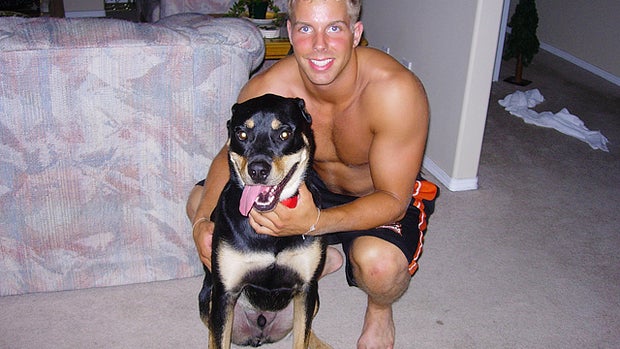
Paralysis breakthrough helps Rob Summers stand, walk after years in wheelchair

(CBS/AP) "It was the most incredible feeling." That's Rob Summers describing what it was like to stand and take a few steps after years of paralysis. "After not being able to move for four years, I thought things could finally change."
PICTURES - Rob's miracle: Paralyzed man's first steps
Summers, 25, was paralyzed below the chest in a car accident in 2006. Despite three years of physical therapy, his condition hadn't improved. So in 2009, doctors implanted an electrical stimulator onto his spinal cord to try "waking up" his damaged nervous system.
Within days, Summers stood without help. Months later, he wiggled his toes, moved his knees, ankles and hips, and was able to take a few steps on a treadmill.
But for now, Summers still uses his wheelchair to get around. He can stand only during therapy sessions, with the stimulator turned on, and doctors currently limit his use of the device to a several hours at a time.
His case is described in a paper published Friday in the English medical journal The Lancet.
For years, certain people with incomplete spinal cord injuries, who have some control of their limbs, have experienced some improvement after experiments to electrically stimulate their muscles. But such progress had not been seen before in someone with a complete spinal cord injury.
"This is not a cure, but it could lead to improved functionality in some patients," said Gregoire Courtine, head of experimental neurorehabilitation at the University of Zurich. He was not connected to Summers' case. Courtine cautioned Summers' recovery didn't make any difference to the patient's daily life and that more research was needed to help paralyzed people regain enough mobility to make a difference in their normal routines.
The electrical stimulator surgeons implanted onto Summers' spinal cord is usually used to relieve pain and can cost up to $20,000. Summers' doctors implanted it lower than normal, onto the bottom of his vertebrae."
The stimulator sends a general signal to the spinal cord to walk or stand," said Dr. Susan Harkema, rehabilitation research director at the Kentucky Spinal Cord Injury Research Center in Louisville and the study's lead author.
Dr. John McDonald, director of the International Center for Spinal Cord Injury at Kennedy Krieger Institute in Baltimore, said the strategy could be rapidly adopted for the 10 to 15 percent of paralyzed patients who might benefit. He was not connected to the Summers case.
"There is no question we will do this for our patients," he said. McDonald added that since the electrical stimulators are already approved for pain relief, it shouldn't be difficult to also study them to help some patients regain movement.
For now, Summers does about two hours a day of physical therapy.
"My ultimate goal is to walk and run again," he said. "I believe anything is possible and that I will get out of my wheelchair one day."
The Christopher & Dana Reeve Foundation has more on paralysis.