Pakistan to Reopen Border for NATO Supplies
Pakistan's government on Saturday ordered the reopening of a crucial northern route through a crossing known as Torkham for fuel and other supplies for Western troops including U.S. troops deployed to Afghanistan.
The government on September 30 ordered the crossing to be shut after Pakistan accused NATO's Afghanistan-based troops of the International Security Assistance Force (ISAF) of killing three of its paramilitary soldiers in a helicopter attack.
Though the exact circumstances surrounding the attack remain unclear, some Pakistani and Western defense officials believe, the attack may have followed a hot pursuit of Islamic militants whom NATO and U.S. officials claim routinely cross the Afghan-Pakistan frontier.
Pakistani officials said their decision to orders the border closure was meant to highlight the anger shared by the country's civil and military officials over the attack.
The 10-day standoff saw Anders Fogh Rasmussen, NATO's Secretary General, and Admiral Mike Mullen, Chairman of the U.S. Joint Chiefs of Staff, formally apologize for the incident.
On Saturday Pakistan's foreign ministry said in a statement: "After assessing the security situation in all its aspects, the Government has decided to reopen the NATO/ISAF supply from the Pakistan-Afghanistan border at Torkham with immediate effect. Our relevant authorities are now in the process of coordinating with authorities on the other side of the border to ensure smooth resumption of the supply traffic."
A senior Pakistani government official who spoke to CBS News on condition of anonymity said, "We hope our friends in the West, especially the U.S., will realize there are certain steps which can never be kosher. Any incursion which brings foreign troops on our soil or manned aircrafts will always be resisted."
A second senior Pakistani government official, who also spoke to CBS News on condition of anonymity, said, "We have forcefully conveyed the fundamental message to our Western allies. A repeat of anything even remotely similar to the September 30 attack will see a similar response."
The September 30 attack once again highlighted prevailing anti-U.S. and anti-Western sentiment across Pakistan, Washington's key ally for the past decade in confronting hardline militants belonging to al Qaeda and the Taliban.
Ahead of Saturday's announcement, Naeem Siddiqui, an Islamabad college student, echoed a popular view by telling CBS News, "I am so glad Pakistan has taken this stand and blocked supplies for NATO. The Americans are basically anti-Islam and they have killed Muslims in Iraq and Afghanistan. They (U.S.) also back Israel which kills Palestinians. How can these people, particularly the Americans as well as other Westerners, be our friends?"
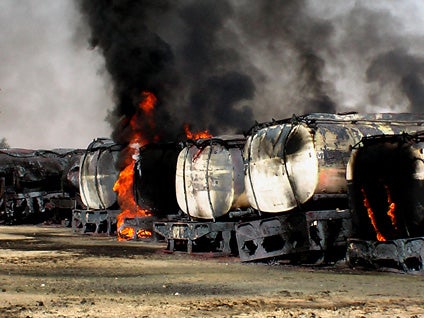
Earlier on Saturday, at least 29 fuel tankers heading for NATO troops in Afghanistan were set on fire by unknown militants in the town of Sibbi in the south-western Baluchistan province. This was the latest of a number of similar attacks that have targeted NATO's supply trucks stranded in Pakistan since the closure of the border crossing on September 30.
Western diplomats say NATO has sought to establish other supply lines to landlocked Afghanistan, through the central Asian former Soviet republics.
But the route through Pakistan from the country's southern coastline along the northern Arabian Sea to Afghanistan offers the shortest distance.
By CBS News' Farhan Bokhari reporting from Islamabad