Observers head to Syria as crackdown continues
An advance team of Arab observers finally arrives in Damascus on Thursday as part of an effort to end the nation's nine-month-old crisis, but government opponents remain skeptical that President Bashar Assad's regime will actually allow the mission full, unrestricted access to troubled cities and flashpoints.
The 100-man delegation, to be headed by Arab League Assistant Secretary General Samir Seif al-Yazal, includes legal, administrative, financial and human rights experts to prepare the way for a group of monitors expected at the end of the month.
Faisal al-Maqdad, Syria's deputy foreign minister, and Ahmed Ben Helli, the Arab League assistant secretary-general, signed the document at the Arab League headquarters in Cairo, Egypt on Monday, a significant concession from a regime that loathes outside interference.
But serious questions remain about how effective Damascus will allow the mission to be.
White House: Assad doesn't deserve to rule Syria
Syria activist: "Organized massacre" kills dozens
Complete Coverage: Anger in the Arab World
Regime opponents accused Damascus of waffling on the deal before it was signed as a way to gain time to their crackdown, and they say the regime will never fully cooperate, even after signing the initiative.
Burhan Ghalioun, leader of the Syrian National Council, an umbrella opposition group which is seeking international recognition from a base in neighboring Turkey, called the Arab League deal "worthless" in light of the brutal crackdown underway in Syria, and called upon the United Nations to "immediately intervene."
Neighboring Turkey, a formerly close ally which has been outspoken in its criticism of Syria's crackdown, continued to condemn Assad for the "bloodbath" going on in the country and questioned Syria's "true intentions" despite the Arab League agreement.
"We strongly condemn the Syrian leadership's policies of oppression against its own people, which are turning the country into a bloodbath," the Turkish Foreign Ministry said.
Reports of widespread, orchestrated killings of opposition members can not be confirmed independently, as Syria has banned most foreign correspondents and greatly limited movement by others around the country.
To the Syrian government, the goal of allowing observers to enter its territory is to prove to the world its version of events, which it has repeated since the crisis began, namely that "armed terrorist gangs" are driving the political unrest and causing the violence.
This was claim was repeated by Syrian foreign minister Waleed Mouallem Monday, when he said that the observers would see for themselves that the demonstrators are not peaceful. Mouallem rejected accusations of Syrian stalling tactics and said the delay was caused by the Arab League's refusal until now to accept amendments Syria requested.
"Sovereignty is protected now in the text of the protocol," he added.
Syria's acceptance of observers following weeks of delay came after a warning from Arab leaders that they would turn to the UN Security Council for action to try to end a government crackdown that the UN says has killed at least 5,000 people since mid March, raising fears the country of 22 million is slipping toward civil war.
The attacks have continued, with activists claiming Syria has carried out an "organized massacre" in Kfar Owaid, about 30 miles from the Turkish border. Activists say more than 200 have been killed in the last two days.
As the crisis grinds on, the uprising promises to grow bloodier despite the continued rejection of violence by many in the opposition. Should Syria descend into chaos, insulating its neighbors from widespread instability will prove difficult.
Significant negative spillover effects could wreak havoc in Lebanon, Iraq, Turkey, and possibly Israel. Lebanon, with its inherent volatility and delicate sectarian balance, could bear the greatest brunt of the unrest, possibly with resurgence into another civil war.
The Arab League's plan calls for removing Syrian forces and heavy weapons from city streets, starting talks with opposition leaders and allowing human rights workers and journalists into the country, along with Arab League observers. It does not call for foreign military intervention, as in Libya.
The 22-member League has suspended Syria's membership and imposed economic sanctions, but it has been divided over whether to seek the help of the wider international community.
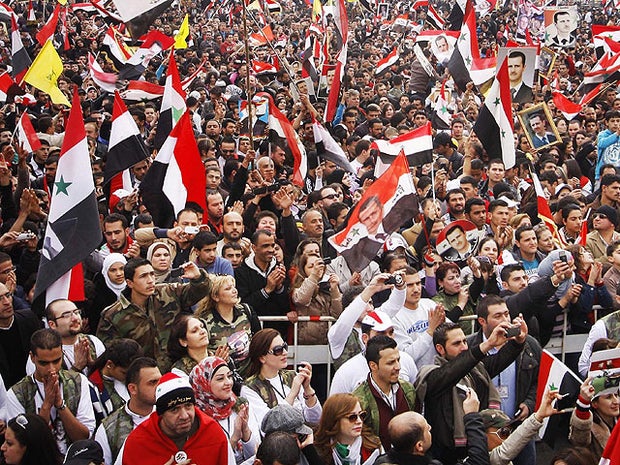
In the meantime, hundred of thousands of Syrian President Bashar Al-Assad's supporters gathered over the past two days in the main squares of Damascus and elsewhere to show their loyalty for the incumbent leader.
Marchers chanted slogans in support of Assad and huge Syrian flags were seen hung from surrounding office blocks, alongside the colors of Damascus' regional allies.
State television gave prominent coverage to the rally, hailing the young demonstrators' desire to "express their support for the reforms being undertaken by Assad and their rejection of foreign interference."