Minnesota fraud case is biggest among many multimillion-dollar pandemic scams. Here are the 10 most costly.

Federal prosecutors have repeatedly called the fraud case that plundered Minnesota's child nutrition program the "largest pandemic fraud in the United States." But it's far from the only multimillion-dollar scheme to cheat the U.S. government out of taxpayers money that Congress intended to help the country through the economic disaster that accompanied the COVID-19 crisis.
A CBS News analysis of government data and records determined the Minnesota fraudsters appear to have made off with more taxpayer money than any other individual scheme. Dozens of people in that state have been charged, and more than 50 have been convicted or pleaded guilty.
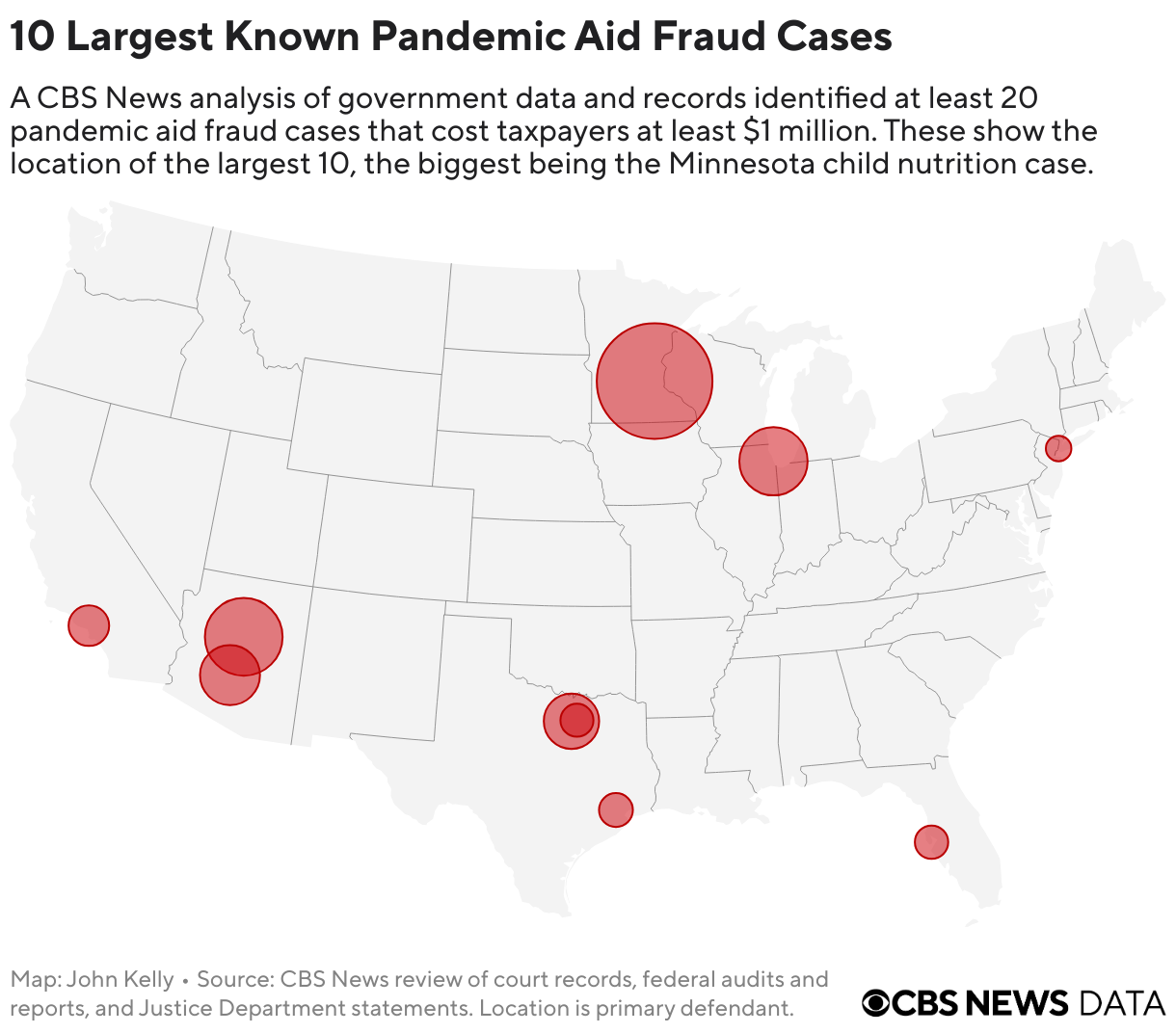
But the review of court files, government audits and investigative documents identified at least 20 other cases that each cost taxpayers at least $1 million. At least nine known cases cost more than $10 million apiece.
Outside the Minnesota case, the next most costly fraud cases were highlighted by a related pair of Paycheck Protection Program loan scams run out of Arizona that defrauded the federal government of $109 million and $63 million. The program, known as PPP, was intended to provide businesses forgivable loans to keep workers on their payrolls while they were shut down or operating at a loss because of public-health restrictions.
A separate fraudulent COVID-test billing scam out of Chicago cost the government some $83 million.
CBS News reviewed court records, Department of Justice announcements, government audits and inspector general reports and the records of the federal government's Pandemic Response Accountability Committee to identify cases with losses of at least $1 million each, then studied each case for details.
The CBS News review focused the financial losses for each case on the money received or obtained from the government, rather than the sometimes much larger amounts that the schemes attempted or sought.
Here is a list of the 10 largest document cases identified in the public record.
1. Feeding Our Future
Estimated fraud value: $250 million
What happened: A Minnesota nonprofit group called Feeding Our Future partnered with the state Department of Education and the U.S. Department of Agriculture to distribute meals to children during the pandemic. But prosecutors say instead the group submitted fake meal count sheets and invoices claiming they helped feed thousands, making millions of dollars in administrative fees and taking kickbacks from meal distribution sites, according to court documents. Feeding Our Future's founder, Aimee Bock, was convicted earlier this year. Numerous other defendants have pleaded guilty or were convicted.
2. Karnezis brothers PPP loan scam
Estimated fraud value: At least $109 million
What happened: Two Arizona brothers pleaded guilty to submitting thousands of fraudulent Paycheck Protection Program loan applications, including some through Blueacorn (a lending service provider which was implicated in a separate PPP loan fraud case). Government forensic auditors found the brothers falsified business records and misrepresented eligibility certifications, often using similar wording in the narratives and supporting documents across multiple faked applicants for the loans.
3. COVID-testing fraud
Estimated fraud value: At least $83 million
What happened: A Chicago-area laboratory owner allegedly billed tens of millions of dollars for COVID-19 tests that federal prosecutors say were never performed, improperly conducted, or already had been reimbursed under a program that supposed to provide tests for people without health insurance. Investigators found the lab issued negative results for unperformed tests, submitted batches of duplicate claims, and manipulated clinical data to try to hide the fraud. The owner/defendant, Zishan Alvi, of Inverness, Illinois, pleaded guilty to wire fraud in 2024 and was sentenced to seven years in prison.
4. Blueacorn
Estimated fraud value: At least $63 million
What happened: Blueacorn, a lender service provider, fraudulently obtained at least $63 million in PPP loans guaranteed by the Small Business Administration. The co-founders pleaded guilty. One co-founder, Stephanie Hockridge of Arizona, was sentenced to 10 years in prison. Government auditors say they found as many as 1,600 applicants with extremely repetitive data and recycled identities. The federal government's Pandemic Response Accountability Committee estimated the losses could have been as much as $111 million, but the court-ordered restitution ordered was $63 million.
5. Recycling companies' fake PPP loan ring
Estimated fraud value: At least $53 million
What happened: Fourteen people were arrested and charged in Texas, California and Oklahoma in 2023 for allegedly engineering a nationwide fraudulent PPP loan ring using fabricated IRS documents, payroll logs and front companies. The individuals used a network of purported recycling companies to make at least 29 fraudulent loan applications, according to Justice Department records.
6. California PPP fraud scheme
Estimated fraud value: At least $27 million
What happened: A federal jury convicted a California man who allegedly created eight companies on paper, each claiming 100 employees and a monthly payroll of $400,000, according to Justice Department records. Between April and August 2020, Robert Benlevi of Encino submitted 27 Paycheck Protection Program applications to four banks using fabricated tax records and boilerplate language about nonexistent operations, according to federal records. Benlevi was convicted of bank fraud, false statements to a financial institution, and money laundering.
7. Nationwide PPP and check-cashing fraud scheme
Estimated fraud value: At least $18 million
What happened: A network of 11 people in Texas and Illinois allegedly filed more than 80 PPP applications across a web of nominally unrelated businesses in 2020 and 2021, including faking and cashing payroll checks that sometimes went to relatives, according to Justice Department records. The conspirators sought $35 million in loan funds, but were paid out $18 million. Some already have pleaded guilty.
8. PPP scheme involving NFL player
Estimated fraud value: At least $17.4 million
What happened: One of the earliest large-scale Paycheck Protection Program fraud rings involved more than 90 fraudulent applications submitted by a coordinated group of people from Ohio and Florida using templated applications, according to Justice Department records. Many of the loan applications were successful, producing over $17 million in payouts. Former NFL player Joshua J. Bellamy of St. Petersburg, Florida, allegedly received more than $1.2 million for his own shell company and prosecutors say he spent funds on jewelry and other luxury goods and casino trips. Investigators identified recurring wording and patterns across loan submissions, including identical employee lists and other payroll details. Bellamy pleaded guilty and was sentenced to 37 months in prison.
9. Texas businessman uses PPP for luxury cars and homes
Estimated fraud value: At least $17 million
What happened: A Coppell, Texas, businessman pleaded guilty to submitting 15 fraudulent Paycheck Protection Program loan applications seeking nearly $25 million for several businesses he controlled. Each application featured inflated employee counts and falsified payroll documentation, according to court records. Federal prosecutors reported the man purchased eight homes and six luxury vehicles, all seized by federal agents along with other significant assets. The businessman, Dinesh Sah, got an 11-year prison sentence and was ordered to pay $9 million in restitution.
10. NYC PPP loan scheme
Estimated fraud value: At least $9.4 million
What happened: A New York City woman recruited multiple people to apply for PPP loans in exchange for kickbacks. Sherry Joseph, of New York, pleaded guilty in federal court in Florida to conspiracy to commit wire fraud in 2022. The loan applications included faked bank statements and payrolls, according to court records. The DOJ's prosecutors said that Joseph engaged in the scheme while on pretrial release for separate federal fraud-related offenses in New Jersey.
There were at least 10 other cases with $1 million or more in losses documented in federal law enforcement, court and audit records, according to the CBS review.