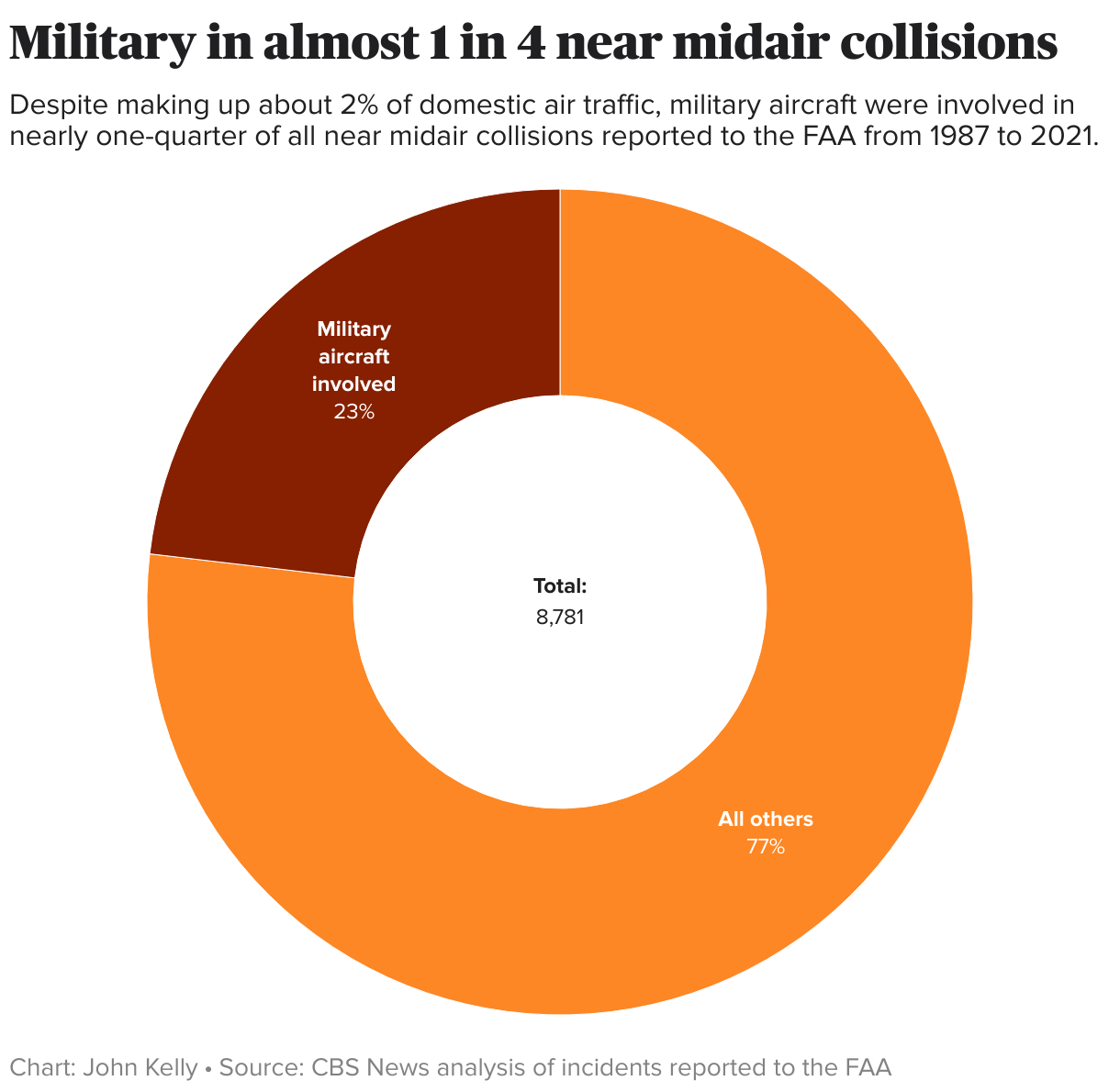
Nearly a quarter of all midair close calls over 34 years involved at least one military aircraft


Nearly one out of every four of the more than 8,000 near midair collisions in U.S. airspace reported from 1987 to 2021 involved at least one military aircraft, a CBS News analysis of Federal Aviation Administration data has revealed.
For near midair collisions involving one commercial aircraft and one military aircraft, those accounted for about one out of every 10 reported incidents.
Overall, there were more than 2,000 near midair collisions involving military aircraft and 258 involving a military aircraft and a commercial aircraft. Of the 258 incidents between military and commercial aircraft, 34 of them, or 13%, were considered critically close.
About one in six of all the near midair collisions involving at least one military aircraft were considered critically close.
The analysis also found that military flights only accounted for about 2% of all flight miles over that time period, giving its aircraft an outsized role in close calls during that time.
The analysis followed two incidents involving commercial planes and military aircraft at Reagan National Airport, just outside of Washington, D.C. The first, a Jan. 29 midair collision between a Black Hawk helicopter and an American Airlines flight that was coming in to land that killed 67 people, making it the deadliest U.S. aviation disaster since 2001. And last Friday, a Delta Air Lines flight departing the airport experienced a close call just after takeoff as four Air Force jets were headed toward a flyover at Arlington National Cemetery.
National Transportation Safety Board investigators are looking into the Army's handling of close calls in the wake of the January collision. NTSB Chair Jennifer Homendy noted in testimony before Congress last week, "We have found, so far, that a lot of the conversation and safety discussion at the battalion level is really focused on OSHA (Occupational Safety and Health Administration) slips, trips and falls. There is a disconnect."
After Friday's incident, former NTSB Chair Robert Sumwalt told CBS News, "Again we have conflict between a military aircraft and a civilian airliner and that's not acceptable."
Following the January crash, military helicopters were banned from flying in the area where the collision occurred, except in the case of law enforcement action or the transportation of important personnel such as the president. As the investigation into the collision goes on, it was not immediately clear if similar action could be taken for military jets as well.
Acting FAA Administrator Chris Rocheleau told Congress last week that warning signs were missed leading up to the January collision and they're working to understand how they were missed and to prevent another collision from happening again.