Memorializing the bedrooms of children killed in school shootings: "She was real. She was here."
This is an updated version of a story first published on Nov. 23, 2025. The original video can be viewed here.
Since the mass shooting at Sandy Hook Elementary School in Newtown, Connecticut, 14 years ago, more than 170 children have been killed in school shootings across the U.S. They've left behind devastated families, and friends, and empty bedrooms they once filled with life. For many parents, these rooms have become sanctuaries: a tangible link to a child they can still feel but no longer hold. As we first told you last year, Steve Hartman, a veteran CBS News correspondent, and Lou Bopp, a photographer, have spent the last eight years asking parents whose children have been killed for permission to take pictures of the empty rooms they've left behind. No easy task; they are, after all, portraits of a child who is no longer there.
Up a flight of stairs in their Nashville home, Chad and Jada Scruggs took us to see their daughter Hallie's room. It remains as she left it one Monday morning three years ago.
Chad Scruggs: I don't think anything's changed.
Hallie Scruggs loved Legos, Tennessee football, and hiding things in a toy safe from her three older brothers. The books she and her mom read together at night are still stacked by her bed. A school project, with important milestones in her life, a reminder Hallie was just 9 years old.
Chad Scruggs: First tooth, first soccer game, first Tennessee game.
Anderson Cooper: That was a-- that was a-- a milestone.
Jada and Chad Scruggs: Yeah.
Chad Scruggs: This is the first time they held her.
Jada Scruggs: I love that picture.
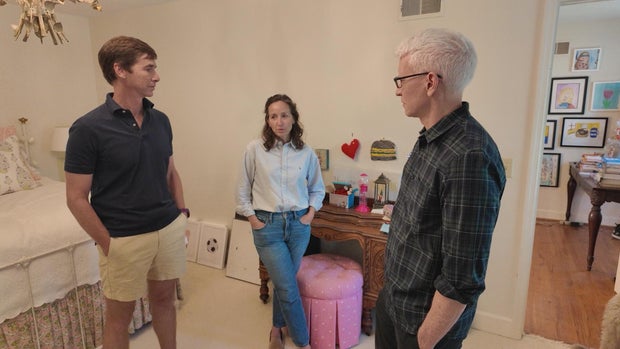
Jada Scruggs: I do wonder, sometimes, like, what will we do with this room, eventually. All these physical things are tangible ways of reminding me, like, she was real. She was here. She lived with us. In some ways, this room kinda holds the space for her.
Chad Scruggs: Yeah.
Jada Scruggs: And so--
Anderson Cooper: And it still does.
Jada and Chad Scruggs: Yeah. Yeah.
Hallie was killed along with two classmates, Evelyn Dieckhaus and William Kinney, in a shooting at The Covenant School in Nashville in 2023.
Anderson Cooper: What has grief been like, for you?
Chad Scruggs: It felt like everything collapsed, everything, internally, pain that-- I mean, gosh. It's just hard to endure. And then, you know, you have to relearn how to do everything, like how to eat, how to sleep. And you just have a-- new relationship with pain, and sadness, and anger. There's been joy, too, but-- the-- the sadness-- was-- has been-- was just, I mean, overwhelming.
Chad is a pastor at the church that's part of The Covenant School. He was drawn to Hallie's room the day she was killed.
Chad Scruggs: I went into her room to lay on her bed to smell. I knew that would go. And I wanted, you know--
Anderson Cooper: You knew that-- you knew the smell would dissipate?
Chad Scruggs: Oh, yeah. Yeah, yeah. And her blankie was there and everything was there.
Anderson Cooper: And you could smell her, that day?
Chad Scruggs: Oh, yeah. Absolutely. Yeah. That was true probably, for a week or two after. So you're trying to get her back. And it's not possible. But you don't believe that. And so anything that-- that draws that possibility closer, I wanted to be there for that, so-- yeah. I went in, just laid on her bed, and cried by myself.
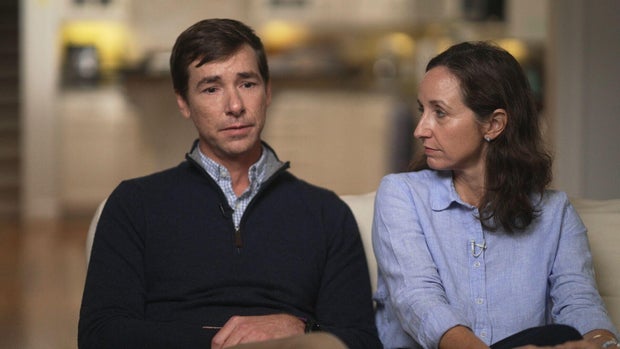
Anderson Cooper: Has your relationship to the room changed over time?
Jada Scruggs: Maybe, it's not as frequent that I go up there, but the feelings haven't changed, when I go in the room. You know, it kind of captures all the feelings of sadness and joy, just because it's-- it's a capsule of time.
Chad Scruggs: I think initially, that room was for me, an indication of, like, presence. And now, it feels more of an indication of absence.
Jada Scruggs: Absence, yeah.
Chad Scruggs: You know. It feels more like a relic now.
Anderson Cooper: Like a relic?
Chad Scruggs: A relic.
Anderson Cooper: Yeah.
Some 2,000 miles away, in Santa Clarita, California, another room, another child killed.
This is Gracie Muehlberger. She was 15. She adored her brothers and her Vans sneakers. She was killed six and a half years ago in the Saugus High School shooting. Cindy and Bryan Muehlberger are her parents.
Anderson Cooper: Do you remember the first time you went into Gracie's room after--
Cindy Muehlberger: Right when we got home from the hospital.
Anderson Cooper: You went right to her room?
Cindy Muehlberger: Right to her room. And that's where I spent, like, the next week or two. I slept in her bed. I just--it's the closest I could feel to her, so.
Anderson Cooper: Did that feeling though of the room providing comfort, did that last for a long time?
Cindy Muehlberger: Yes.
Bryan Muehlberger: Oh yeah--
Cindy Muehlberger: Always. Yeah.
Bryan Muehlberger: Always.
Gracie Muehlberger and Hallie Scruggs' rooms are two of eight that were photographed as part of the project begun by Steve Hartman, who began covering these tragedies for CBS News 29 years ago. This was his first, a shooting at a high school in Pearl, Mississippi, two years before the massacre at Columbine High School in Littleton, Colorado.

Steve Hartman: It was news, at the time. A school shooting was actually big news.
Anderson Cooper: As opposed to now?
Steve Hartman: As opposed to now. It still gets coverage, but it's usually a day or two. And people forget about them, I'd say, by the end of the week, many times.
Anderson Cooper: Initially, in your mind, what was the idea?
Steve Hartman: I wanted to shake people out of this numbness that I've-- that I was feeling whenever there was a school shooting. Now, I was moving on quickly. I was forgetting the names of the children who were lost. And I knew the country was doing the same.
So eight years ago, he began writing letters to parents asking to photograph their murdered children's rooms.
Steve Hartman: Because when you go into a kid's room, you go into my kid's room, you see their whole history. You see every dream, every desire, everything they value. It's all there on the walls and sitting on the shelves.
Anderson Cooper: Or scattered on the floor.
Steve Hartman: Or scattered on the floor, in some cases. It's all there. And I don't think there's really a better way to get to know a kid and to remember a life than to look around that room, to stand in that space.
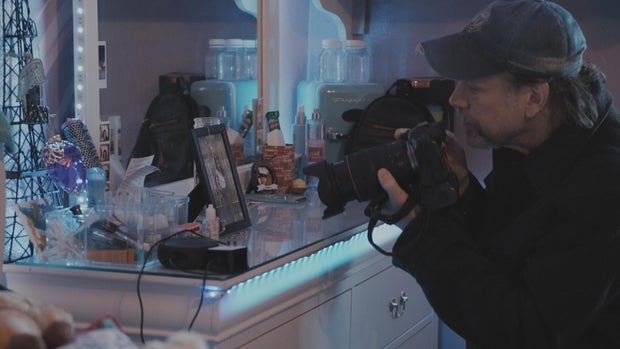
Eight families whose children were killed in five different schools agreed to let photographer Lou Bopp into their kids' rooms. At an exhibit in New York, he showed us some of the 10,000 photos he's taken.
Lou Bopp: You know I'm trying to take a picture of a-- of a-- of a child who's not there.
Dominic Blackwell's room is still filled with Spongebob. He was killed, along with Gracie Muehlberger, at Saugus High School. Dominic was 14. A basket of his laundry still waits to be washed. A toothpaste tube remains uncapped in the bathroom of 14-year-old Alyssa Alhadeff, killed at Marjory Stoneman Douglas High School in Parkland, Florida.
Charlotte Bacon loved pink. She was 6, killed at Sandy Hook. There's a library book in her room that's now 13 years overdue.
Lou Bopp: If that's not a little girl's room, I don't know what is.
Lou Bopp: And even this. This to me, it's so poignant, the way the head is tilted down.
Anderson Cooper: It's such a reminder-- that while everybody else moves on-- from what is a story to them the-- the families never move on.
Steve Hartman: That's part of the reason the families did agree because it's very frustrating for them when the country moves on. And they certainly haven't moved on and will never move on.
Anderson Cooper: I think there's such weight in-- for these parents in being the holders of the memory, that they are the only ones who remember--excuse me--
Steve Hartman: It's okay. What are you thinking about?
Anderson Cooper: Whew. I've been in a lot of these rooms, as well. And there's such sadness in being the last ones left to remember everything about this child.
Steve Hartman: And that's why they can't surrender the rooms, because you surrender the rooms and that's just another piece of their kid that's gone.
Steve Hartman's project is the subject of an Academy Award winning documentary on Netflix. It follows him and Lou Bopp as they travel across the country, visiting rooms, including Dominic Blackwell's and Gracie Muehlberger's.
When Bryan and Cindy Muehlberger received Steve's letter in 2024, they were considering moving — but didn't know how they could leave their daughter's room behind.
Anderson Cooper: How much of the discussion was about, "What do we do with the room?"
Bryan Muehlberger: I would say that was the primary driver of-- of us not moving sooner. I mean, after the-- the shooting we-- we wanted to get outta town.
Anderson Cooper: But you didn't want to leave that room.
Cindy Muehlberger: Right--
Bryan Muehlberger: But we didn't want to leave that room, yeah. You know, it's, like, do you take a lotta pictures of it and then try to recreate it somewhere else? We didn't know what to do with it. And it really wasn't until this opportunity to work with Steve on this film that we started feeling a peace about it.
Last year, the Muehlbergers felt ready. They sold their house and packed up Gracie's room. They found mementos, artwork, and cards she made they hadn't seen in years.
For now, they've placed them in a storage unit, while they build a new home, and a new life in Georgia.
Anderson Cooper: When you found this did you-- did you know how you wanted to kind of incorporate Gracie?
Bryan Muehlberger: Not initially.
This past fall, they showed us the plot of land where they'll live, and an area they are going to create called "Gracie's Point."
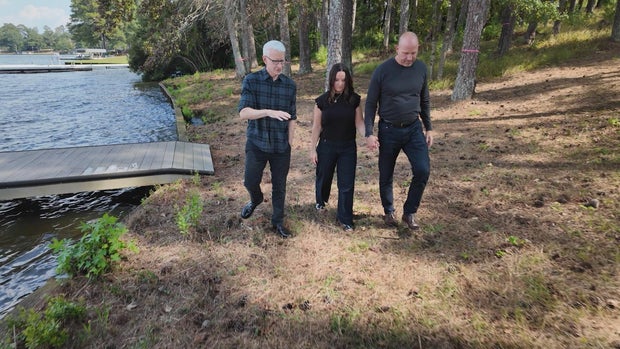
Anderson Cooper: So this is going to be Gracie's Point?
Bryan Muehlberger: Yeah, this kinda area right here. Where when you're out here you know all you've got is nature and the water.
Anderson Cooper: And a place for a fire pit, a place where people can come together?
Bryan Muehlberger: Yeah, come together. She loved doin' s'mores and things like that.
Anderson Cooper: It could not be a more beautiful spot.
Cindy Muehlberger: So peaceful, which is what we were lookin' for.
Anderson Cooper: Is this project over for you?
Steve Hartman: No. If parents want us to, we'll continue to document the rooms, just so they have the pictures. I wish this project would end, but I don't anticipate it will.
Back in Nashville, Chad and Jada Scruggs have no plans to change Hallie's room but they did send some of her drawings and journals to an artist, Brenda Bogart, who created this collage portrait of her.
Jada Scruggs: Everything on this canvas is something that was made by Hallie's hand. Brenda went through and noticed a theme of, "I am happy. I am happy. I am happy."
Anderson Cooper: Wow.
Jada Scruggs: She pretty much ended every journal entry with, "I am happy." She wanted to make sure that that got put on Hallie.
Anderson Cooper: When people see the photos, of Hallie's room, what would you like them to take away?
Chad Scruggs: This is not a generic person, you know? It's someone that uniquely bore God's image in the world and--irreplaceable. And we just want you to know her, you know? She's worth being known. We don't have a lot of aspirations, beyond that. We want you to come step inside of our world for a moment, so.
Anderson Cooper: Step inside the sadness?
Chad Scruggs: Yeah.
Jada Scruggs: And feel it.
Chad Scruggs: People can talk about solutions. But until they feel the weight of the problem, I don't know how to really talk about solutions.
If you or someone you know is struggling with the loss of a child, support networks are available.
Produced by Katie Brennan. Associate producer, Matthew Riley. Broadcast associate, Grace Conley. Edited by Matthew Lev.