Manage Emotions = Big Money.
If you're going to sell at the highest level, you can't afford to let negative emotions reduce your level of motivation or (worse) intrude upon your performance during a key customer meeting. In a previous post, "Don't Believe in Rejection," I explained how Art Mortell, author of the bestseller The Courage to Fail, describes the experience of selling as a five-step cycle, where beliefs create attitudes, which create emotions, which determine sales performance, which determine results, which in turn reinforce the beliefs, thus completing the cycle:
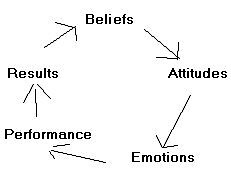
In that post, I focused on the importance of beliefs and spent some time discussing how to change an ineffective belief. However, while beliefs are important (because they create the foundation for your attitudes and emotions), the ability to manage your emotional state is equally, if not more, important.
If you're committed to being really successful at sales, you must be able to put your unproductive emotions (like fear, anger, doubt) aside at will, and change your emotion state into what's appropriate for the individual sales situation (like enthusiasm, curiosity, empathy).
In other words, to sell consistently at the highest level, you need to be able to call upon, and really feel, the right emotions at the right time.
Please note that I'm not talking about being phony. Customers sense phony faster than you can say "well, call me if you change your mind..."
How do you change your emotional state? You master the ability to change two things: your physiology and your focus.
Your physiology (body chemistry, posture, physical condition, etc.) has an enormous impact on your emotional state. If you're in poor physical condition, feeling positive emotions can be a major uphill battle. Similarly, when you work out, your body releases hormones that put you in a better mood. That's why so many of your comments about how to keep motivated mentioned a morning workout.
Your focus is whatever you're deciding to think about. If you focus on things that make you feel lousy, you'll feel lousy. If you focus on things that create positive emotions, you'll feel better.
For example, suppose your biggest account declares bankruptcy in the morning, but you've got an important meeting with another key account on that very afternoon. If you focus on all the hassles that the bankruptcy means to you (e.g. telling your sales manager, missing your quota, no trip to Aruba, etc.), you'll likely flub your afternoon meeting.
By contrast, if you focus on how much you like your job and how much you enjoy helping your customers, you'll not only feel more energized and positive during the afternoon meeting, but after the meeting you'll probably be thinking of ways to help your friends at the big account, who are now going through the pain of bankruptcy.
Your focus is also in a feedback loop with your emotions. If you feel angry, you'll tend to ignore things that could put you in a better mood (like your favorite song playing on your car radio) and instead focus on things that make you more angry (like that jerk who just cut you off at the highway exit.)
To repeat: If you want to generate the emotion states that will make you wildly successful at sales, you must master the ability to change both your physiology and your focus.
I'll explain exactly how to do this in the next two posts.