Lebanese Leader Visits Arab States Before U.S. Visit
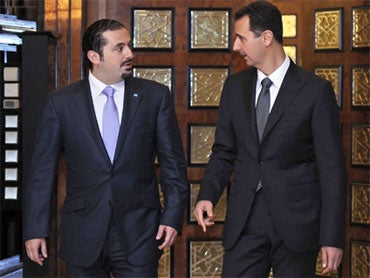
This story was filed by CBS News' George Baghdadi in Damascus.
Lebanon's Prime Minister Saad Hariri arrived Tuesday in Damascus for talks with his counterpart there ahead of a meeting later this month with President Obama.
Hariri, an ally to the U.S., was quickly whisked away for private meetings with Syrian President Bashar Al-Assad, (Hariri on left in photo, Assad on right) who has been at pains lately to deny any chill in the blossoming relations between his country and the Obama administration.
The Syrian capital is Hariri's second stop on a trip that began Monday in Saudi Arabia, where he met King Abdullah Bin Abdel-Aziz. The Lebanese Premier was set visit Cairo on Saturday, and later Amman and Ankara before heading to the United States.
Lebanon currently holds the rotating chairmanship of the United Nations Security Council, where the U.S. has been pressing for tougher sanctions against Iran over its nuclear program.
Hariri's regional tour and his five-day trip to Washington come amid mounting concerns in the region of a renewed conflict between Israel and Lebanon's Hezbollah, which fought a devastating war in 2006.
Syria denied earlier this month Israeli accusations it had furnished Hezbollah with Scud missiles, saying the Jewish state might be using the charges as a pretext for a military strike.
The missiles can carry warheads of up to one ton for hundreds of miles, putting all of Israel within the reach of anyone possessing such an arsenal.
Lebanon's prime minister has also dismissed the accusations, comparing them to claims that Iraq had unconventional weapons before the American-led invasion in 2003.
American officials have said they did not have any confirmation that Scuds were actually delivered to Hezbollah but expressed concern nonetheless.
Hezbollah, which fought a month-long war with Israel in 2006, is considered a terrorist organization by the U.S. government, but is seen across the Arab world as a resistance movement.
The group is a political party which holds two ministerial positions in Lebanon's unity government.
Assad on Monday vowed to help Lebanon on all levels, ridiculing a question on whether Damascus was uncomfortable about Hariri's visit to the U.S.
"Annoyed? Absolutely not," he told a number of intellectuals participating in the Arabism and the Future Conference held in Damascus.
"We will listen to him (Hariri) and to what his government wants and we will help and be positive. We are ready to help Lebanon in all fields, including economic development, that would reflect positively on Lebanon," he pledged.
Lebanese sources said the premier's visit to Syria reflected a common Syrian-Lebanese interest in improving the atmosphere of trust and concurrence between the two states, as well as completing what was achieved in a first visit.
Assad gave a warm welcome to Hariri during his landmark fence-mending visit to Damascus last December. The two young leaders undertook to open new prospects on bilateral relations as the visit ended nearly five years of bitterness between the two countries.
Relations between Hariri and Syria have been edgy since a massive bombing on the Beirut seafront killed his billionaire father and five-time former premier as well as 22 other people nearly five years ago.
Saad Hariri, 39, and his allies have in the past pointed an accusing finger at Syria, without evidence, and also blamed Damascus for a string of political killings in Lebanon.
Damascus has denied any involvement but, faced with mounting pressure, it withdrew its troops from Lebanon in April 2005, two months after the murder, ending 29 years of military and political presence.
Syria opened an embassy in Beirut in 2008, and a Lebanese ambassador arrived in Damascus soon after, in the first diplomatic ties between the two states since independence six decades ago.
Hariri has moved to heal the rift with Damascus at the same time that the Obama administration also has sought greater engagement with the Syrians, announcing last month plans to send its first ambassador to Damascus since 2005.