How consumers can get a refund for Trump tariffs struck down by Supreme Court
Refunds for illegal U.S. tariffs are starting to flow to businesses, and consumers could get a cut from companies that have vowed to share that financial relief with customers.
The U.S. Customs and Border Protection (CBP) agency can only issue tariff refunds to the so-called importer of record — the entity that directly paid one of the emergency tariffs struck down by the Supreme Court earlier this year. But businesses that receive refunds for International Emergency Economic Powers Act, or IEEPA, tariffs can choose to keep them in their entirety or pass along some of the money to consumers.
To date, the U.S. government has refunded more than $100 billion in IEEPA tariffs to businesses, or about 60% of what it owes importers, according to a court filing earlier this month.
"There's no way for consumers to get money from customs," Rathna Sharad, CEO of FlavorCloud, an international logistics company that handles customs paperwork for retailers, told CBS News. "If they get them at all, it's directly from carriers who decide to send them refunds."
Although importers aren't legally obligated to refund customers, some businesses have pledged to do so when the tariff cost can be differentiated from an item's total price. UPS, FedEx and DHL have each committed to send refunds to customers on a rolling basis as the U.S. government repays the delivery companies for IEEPA tariffs and have set up refund portals for customers.
Other corporations have been more opaque about issuing rebates to shoppers. For example, Amazon Chief Financial Officer Brian Olsavsky said on an analyst call that the online retailer has "identified a limited set of circumstances where we can trace that we pass specific import charges on to customers."
In those cases, Amazon "will proactively contact affected customers and automatically issue refunds to them," he added.
How can I get a tariff refund?
If you paid tariffs on an online purchase shipped via UPS, FedEx or DHL, you can visit the shippers' websites for refund information.
On its refund portal, UPS said it is passing the company's refund claims on to consumers as it receives money from the federal government. In April, UPS said it expects to receive $5 billion in tariff refunds. The shipper has not indicated that customers must take any action, such as file a claim, to be eligible for reimbursement.
In the first phase, UPS applied for $500 million in refunds and said customers' refunds should arrive within one to three months after it receives reimbursement from the Treasury.
FedEx has said it is issuing $800 million in refunds to customers billed for the IEEPA duties. "If refunds are issued to FedEx, we will issue refunds to the shippers and consumers who originally bore those charges," FedEx said in a statement earlier this year.
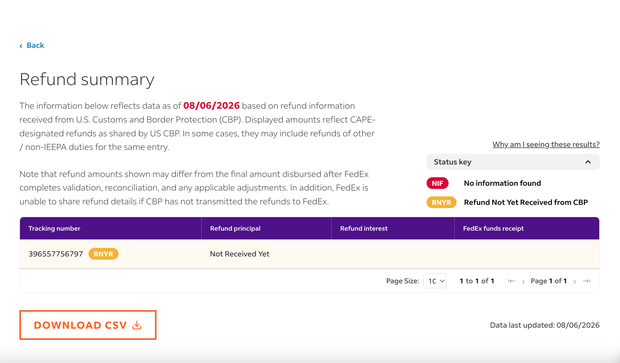
The delivery giant also has a portal where consumers can track the status of refunds. Consumers who placed an online order with a retailer can enter the shipment's tracking info on FedEx's site. FedEx will indicate whether it has received a refund from CBP for the shipment or is still awaiting payment.
FedEx said that if it has received a tariff refund from CBP, its portal will show customers the refund amount (including interest) and when FedEx received the money. Consumers can enter up to 100 shipping tracking or entry numbers at a time.
For example, the image below shows that FedEx has not yet been reimbursed for a tariff on a customer's shipment, as indicated by the "Refund Not Yet Received from CBP" label.
DHL also said it is issuing refunds to consumers as it receives government refunds. The company has not created a dedicated refund portal.
That process is automatic, according to DHL. Once CBP refunds its eligible claims, DHL will return those funds to the party that originally paid the duties, the company said on its website.
When customers don't have a claim
Although some consumers will get back the money they paid due to stepped-up U.S. tariffs, they are likely to recoup only a small share of the roughly $1,000 households paid in additional import duties, according to the Tax Foundation, a nonpartisan group focused on tax issues.
Many retailers that imported goods from overseas paid the tariffs but shifted the burden onto consumers by spreading price hikes across a range of products.
Some businesses have pledged to use their tariff refunds to lower prices, but that may not benefit consumers, especially if they're not repeat customers, experts noted.
"Consumers are very sensitive to the price of the good, and other things that happen years later, they may not see as much," Eric Johnson, a Columbia Business School professor focused on consumer behavior and marketing, told CBS News. "Getting a refund check is very different from other people not paying increased prices because of tariffs."
Shoppers who purchased those higher-priced goods agreed to the price without expecting a rebate later. Shoppers shouldn't expect refunds in such cases, according to Foley & Lardner trade attorney Greg Husisian.
"Because they were told at the time, 'This is how much the good costs, do you want it or not?' they don't have a claim," he told CBS News.
Other shippers, mostly smaller businesses, mailed imported goods to consumers and left shippers like UPS, FedEx, and DHL to pay the tariff, which they passed on to shoppers. In principle, that allows carriers to refund consumers directly.
Can I sue and get money back?
Consumers have filed numerous class-action lawsuits to recover tariff costs from Amazon, Costco, Nike, Walmart and other U.S. retailers, arguing that these businesses are now receiving a windfall from the government after dumping those costs on customers.
Yet those lawsuits are in their early stages, rest on shaky legal ground and may not succeed, according to trade attorneys.
Sen. Elizabeth Warren, a Democrat from Massachusetts, is also investigating seven major U.S. retailers, seeking information about the size of the tariff refunds they're receiving and pressing firms to return the money they recoup directly to consumers.