House Page program ends after nearly 200 years
A nearly two-hundred year old tradition in the House of Representatives ended Monday with the termination of the U.S. House of Representatives Page Program.
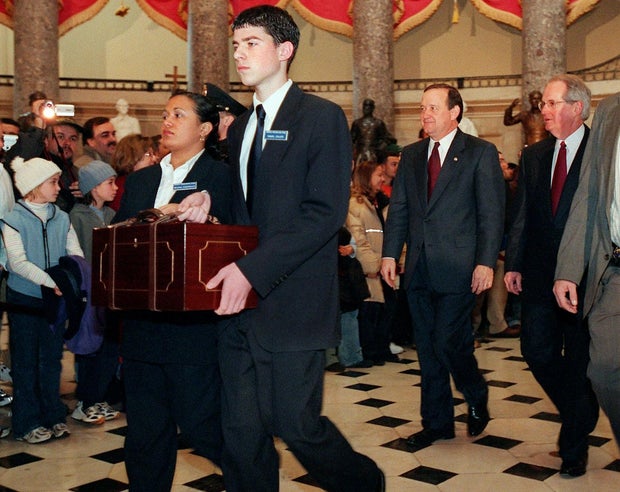
High school juniors running around the Capitol wearing navy blazers and grey slacks and skirts were a regular sighting on Capitol Hill. The pages were there whenever the House was in session. They filled the elevators to maximum capacity, slammed the cafeteria in the basement all at the same time and wandered the marble halls in herds.
The pages also had official duties. During the semester they spent learning the ways of Washington at the U.S. Capitol, the students delivered messages and packages to members on the House Floor, answered phones in the cloak rooms and attended Page School to keep up on their regular high school courses. The pages all lived in the House Page Residence Hall conveniently located just a few blocks from the Capitol.
But House Speaker John Boehner and Democratic Leader Nancy Pelosi announced today that the House Page Program must now come to an end. They cited the program's $5 million annual price tag, which does not include the costs of the residence hall and the school. They also said that the page's services are no longer necessary.
"This decision was not easy, but it is necessary due to the prohibitive cost of the program and advances in technology that have rendered most Page-provided services no longer essential to the smooth functioning of the House," Boehner and Pelosi said in a joint statement.
The statement pointed out that messages that once had to be delivered to lawmakers in person are "no longer required for that purpose as most Members are contacted directly via electronic devices."
The page program has made headlines in the past for being at the heart of notable congressional scandals. Democrat Gerry Studds of Massachusetts and Republican Daniel Crane of Illinois were both punished by the House of Representatives for sexual affairs with pages in the 1970's and 1980's. And more recently, Rep. Mark Foley (R-FL) was forced to resign from Congress in 2006 after exchanging sexually explicit messages over the internet with male pages that went public.
But the page program is meant to groom future leaders of the country. The House Page Program produced notable graduates in the past including former Microsoft CEO Bill Gates and the longest serving member of the House of Representatives John Dingell (D-MI) who is still serving today.
Pelosi and Boehner said in their statement that "although the traditional mission of the Page Program has diminished, we will work with Members of the House to carry on the tradition of engaging young people in the work of the Congress."