Hegseth announces review of U.S. forces in Europe, blasts "shameful" NATO allies
The Pentagon is launching a six-month review of U.S. forces and bases in Europe, Defense Secretary Pete Hegseth said Thursday at a meeting of NATO defense ministers, shortly after he accused allies of "shameful" inaction during the Iran war.
Without naming specific nations, he called out allies for criticizing the U.S. campaign against Iran and denying permission for the U.S. to use some bases in Europe for launching aircraft or ships.
"It's shameful," Hegseth said. "These allies, they put America's sons and daughters, our sons and daughters, at risk by denying them the predictable access facing overflight that never should have been in question at all."
He said that dynamic is part of why the U.S. will launch what he called a "NATO 3.0" review of U.S. troops in Europe that could take six months or less. NATO 3.0 is an initiative introduced in February by Undersecretary of Defense For Policy Elbridge Colby, who said it was time for European countries to take primary responsibility for the continent's conventional defense.
On Thursday, Hegseth said NATO 2.0, which he called "an era of freeriding," is over.
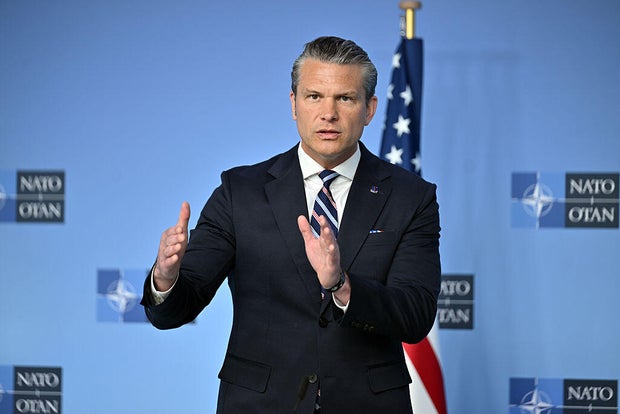
His announcement of the review of U.S. forces in Europe comes ahead of the NATO Summit in Ankara, Turkey, next month, which President Trump is expected to attend. It also comes amid bipartisan concerns on Capitol Hill over recent troop withdrawals from the continent.
In May, the Pentagon announced the withdrawal of 5,000 troops from Germany. Sen. Roger Wicker of Mississippi and Rep. Mike Rogers of Alabama, the GOP chairmen of the Senate and House Armed Services Committees, released a statement saying they were "concerned" by the decision.
"Any significant change to the U.S. force posture in Europe warrants a deliberate review process and close coordination with Congress and our allies," Wicker and Rogers wrote.
The Pentagon also reduced the number of brigade combat teams assigned to Europe, a move that also took some members of Congress by surprise.
During a House Armed Services Committee hearing, GOP Rep. Austin Scott of Georgia told Army leaders that "these are major decisions that appear to many of the members of this committee to be last-minute decisions."
There are currently about 80,000 U.S. troops in Europe. Congress has already required the Pentagon to submit a plan before cutting forces below 76,000. The Senate Armed Service Committee's draft version of this year's defense policy bill, known as the NDAA, would add an additional check.
The current bill, which was voted out of the committee last week, would require the defense secretary to submit an assessment of the impact of any drawdown 120 days before implementing it.
In his announcement of the review, Hegseth said some allies were committed to "freeriding" on America's support because they were not showing tangible progress towards spending 5% of GDP on defense by 2035, a target NATO established during last year's summit in The Hague.
Estimates released by NATO earlier this year showed 31 of the 32 member countries spent 2% of GDP on defense in 2025, an increase from 18 that did so in 2024. President Trump repeatedly pushed NATO allies to meet the 2% target during his first administration.
Republican Sen. Thom Tillis, a co-chair of the Senate NATO Observer Group, noted the "tremendous progress" to ramping up defense spending during an event Wednesday at the Atlantic Council. But he said that allies should use the upcoming summit to discuss shortfalls in the capacity to produce weapons.
"I think as people acknowledge that one of the reasons why the family is having a fight is because some of the brothers and sisters were just not stepping up to the level the family expected, then we can have a good discourse with this president," Tillis said.
"What we don't want to have in Ankara is some discussion of us reducing our commitment to NATO. That's the worst possible thing that can come from that," the senator said before the review was announced.